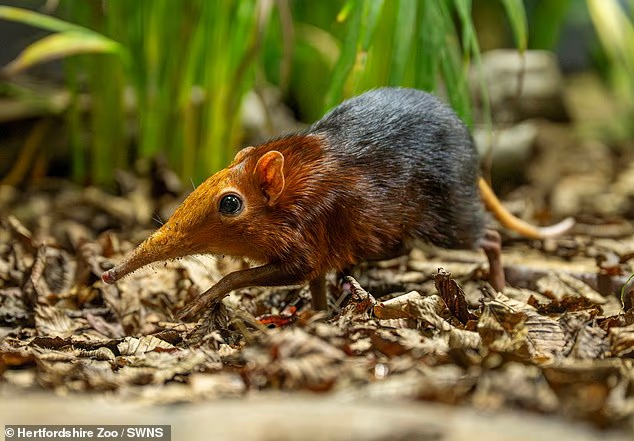
Two rare black and rufous elephant shrew have been born in the UK for the first time, but are so tiny they weren’t initially spotted by zookeepers.
Weighing just 30g at birth, roughly the same as a standard AA battery, they were so minuscule that staff at Hertfordshire Zoo didn’t notice their birth.
Their arrival was only discovered when zoo staff reviewed overnight CCTV footage.
Also known as black and rufous sengi, the babies were born on February 23 to resident breeding pair Nuru and Mala.
The pair emerged from their nest for the first time on Thursday, weeks after their birth.
The species is native to Africa and was officially renamed as sengi in 1998, with the births expected to help with education and ongoing study of the unusual animals.
The insect-eating creature is neither an elephant nor a shrew, although it’s more closely related to the former
They are also distant relation to aardvarks and manatees, as well as elephants, despite being the size of a mouse.
Two rare black and rufous elephant shrew have been born in the UK for the first time

Weighing just 30g at birth, roughly the same as a standard AA battery, they were so minisulce staff at Hertfordshire Zoo didn’t notice their birth

Also known as black and rufous sengi, the babies were born on February 23 to resident breeding pair Nuru and Mala
In recent years, the Hertfordshire Zoo’s black and rufous sengis have attracted millions of views online.
Their twitching noses – sometimes described as a ‘mini trunk’ – and extremely fast movements have helped make them a viral sensation.
Zoo officials say the successful breeding is a significant development, with only a handful of black and rufous sengis currently living in the UK.
Tyler Whitnall, managing director at Hertfordshire Zoo, said: ‘To have the first-ever black and rufous sengi birth in the UK right here at Hertfordshire Zoo is an incredible feeling.
‘We knew when we welcomed the pair last October that we were part of something special, but to see them successfully breed so quickly is a testament to the world-class care provided by our team.
‘These pups are growing incredibly fast and are already showing the same high-energy, inquisitive traits as their parents.’
Hertfordshire Zoo says the new arrivals are expected to draw visitors keen to see the small mammals in person.
The newborns are currently being closely monitored by the zoo’s veterinary team and are said to be thriving under the care of their parents.
While they are still spending much of their time in the nesting area, the zoo expects them to be fully active and visible to visitors in the coming weeks.
The black and rufous elephant shrew is not the only elephant shrew species, and there are approximately 20 in total.
In 2020, having been considered ‘lost to science’ since 1968, the Somali elephant shrew was rediscovered in the rocky landscape of the Horn of Africa.
Following sightings by locals in the African country of Djibouti, scientists set traps for the critters consisting of peanut butter, oatmeal and yeast extract.
After catching several specimens for further study, the team reported that the Somali elephant shrew was still living after fears it had gone extinct.
The Somali elephant shrew is not the only elephant shrew species, and there are approximately 20 in total.
Elephant shrews have been recorded to reach speeds of 17 miles an hour (28.8 km per hour).
They mainly eat insects, spiders, centipedes, millipedes, and earthworms and use their nose to find prey and their tongue to flick small food into its mouth, much like an anteater.
Some elephant shrews also feed on small amounts of plant matter, especially new leaves, seeds, and small fruits.