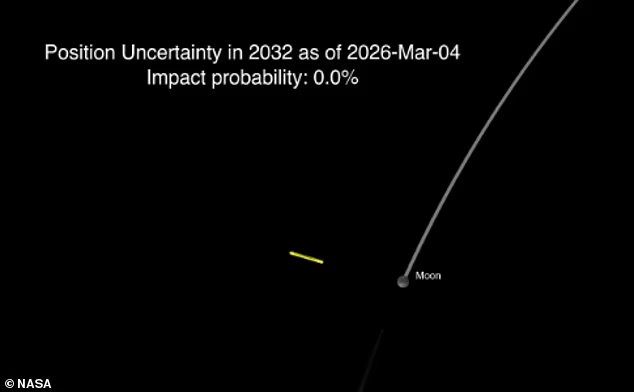
Good news from NASA – an asteroid previously predicted to be on a collision course with the moon will miss it after all.
Since December 2024, the US space agency has been tracking the ‘city–killer’ asteroid, dubbed ‘2024 YR4’, as it whizzes towards us.
The 220ft space rock initially set alarm bells ringing as early measurements suggested it had a one in 32 chance of hitting Earth in 2032.
Further analysis at the end of last year then suggested the moon had a four per cent chance of taking the hit.
However, we can finally breathe a sign of relief.
NASA has confirmed that it has now eliminated the chance of an impact whatsoever.
‘Using data from NASA’s James Webb Space Telescope observations collected on Feb. 18 and 26, experts from NASA’s Center for Near–Earth Object Studies at the agency’s Jet Propulsion Laboratory in Southern California have refined near–Earth asteroid 2024 YR4’s orbit and are ruling out a chance of lunar impact on Dec. 22, 2032,’ NASA explained.
‘With the new data, 2024 YR4 is expected to pass by the lunar surface at a distance of 13,200 miles (21,200 km).’
Good news from NASA – an asteroid previously predicted to be on a collision course with the moon will miss it after all

An analysis at the end of last year suggested the moon had a four per cent chance of taking the hit
Since spring last year, the asteroid has been unobservable from Earth, and it was widely assumed we wouldn’t see it again until 2028.
However, an international team, led by researchers at Johns Hopkins University, identified two narrow opportunities last month when James Webb would be able to see it from its unique position in space.
‘The challenge was significant: to use one of the most complex machines humankind has ever built to track an almost invisible object many millions of kilometres away – and then accurately predict its position almost seven years into the future,’ the European Space Agency explained.
By carefully comparing the asteroid’s position relative to the background stars, the researchers were able to measure its orbit.
This confirmed that the space rock will miss the moon, passing by on December 22 2032 at a safe distance of 13,200 miles.
‘The Moon is safe, 2024 YR4 poses no danger, but the work continues,’ ESA cautioned.
‘The Planetary Defence team in ESA’s Space Safety Programme continues to detect and track near–Earth objects to ensure that if a genuine danger ever emerges, we will not be caught unaware.’
Although it wouldn’t be as destructive as an impact with the Earth, a lunar collision would have been dangerous enough for deflecting 2024 YR4 to be an option worth considering.

With the new data, collected on Feb. 18 and 26 (pictured), 2024 YR4 is expected to pass by the lunar surface at a distance of 13,200 miles (21,200 km
The asteroid was on track to hit the moon at over 29,000mph (46,800 kmph), releasing a blast 500 times larger than the atomic bomb dropped on Hiroshima and ejecting 10,000 tonnes of rock into space.
If the asteroid hit in the right place, Earth’s gravity would have funneled between 10 and 30 per cent of the ejected material directly towards our planet.
This could have had a devastating effect on satellites in low–Earth orbit that are responsible for maintaining communications and navigation services on Earth.
Richard Moissl, head of planetary defence at ESA, previously told Daily Mail that a lunar collision posed no risk for people on Earth.
However, he said it ‘could pose a potential threat for space–based infrastructure’.
While 2024 YR4 is no longer a concern, we can’t relax too much just yet.
Every 2,000 years or so, an asteroid the size of a football field hits Earth, causing significant damage to the area.
And once every few million years, an object large enough to threaten Earth’s civilisation comes along, such as the infamous dinosaur–killing asteroid that struck Earth 66 million years ago.
As it stands, there are no known asteroids this big heading our way, according to NASA.
However, the space agency hasn’t ruled out the chance that there’s one out there that’s yet to be found.
‘While no known asteroid larger than 140 meters in size has a significant chance to hit Earth for the next 100 years, only about 40 percent of those asteroids have been found to date,’ NASA warns.