Humanity has taken a ‘notable step forward’ in its ability to deflect asteroids heading towards Earth, a new study reveals.
Back in 2022, NASA deliberately smashed a spacecraft into a small asteroid ‘moonlet’ that orbited a larger space rock.
The probe, called Dart, successfully changed the path of the moonlet, called Dimorphos, around its parent asteroid, Didymos.
The mission was hailed as the first–ever successful demonstration of planetary defence, proving humanity can alter an asteroid’s trajectory.
But now, scientists have revealed the test also knocked both asteroids off their regular orbit around the Sun.
Researchers have calculated that the speed of Didymos as it orbits the Sun has been reduced by 11.7 micrometres per second as a result of the collision.
This means that future missions could target small moonlets in orbit around large asteroids to change the orbit of the bigger space rock, the team said.
And it ‘marks a notable step forward in our ability to prevent future asteroid impacts on Earth.’
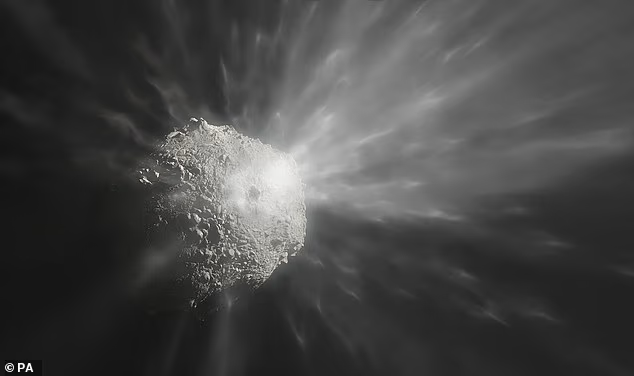
In 2022, NASA deliberately sent a spacecraft called Dart 6.8 million miles into space to crash into a mini moon called Dimorphos (pictured) at 14,000mph in a bid to alter its orbit
Researchers from the University of Illinois Urbana–Champaign made the discovery after examining almost 6,000 instances in which Didymos flew in front of a star, blocking out its light.
The change to its orbit – although small – marks the ‘the first time a human–made object has measurably altered the path of a celestial body around the Sun’.
This shift occurred because, although Didymos was not directly hit during the Dart mission, it is linked by gravity to its smaller moonlet.
As a result, changes to one asteroid affect the other.
‘This is a tiny change to the orbit, but given enough time, even a tiny change can grow to a significant deflection,’ said Thomas Statler, lead scientist for solar system small bodies at NASA Headquarters in Washington.
‘The team’s amazingly precise measurement again validates kinetic impact as a technique for defending Earth against asteroid hazards and shows how a binary asteroid might be deflected by impacting just one member of the pair.’
When Dart struck the smaller space rock, the impact blasted a huge cloud of rocky debris into space, altering the shape of the asteroid, which measures 560 feet (170 metres) wide.
As the debris carried its own momentum away from the asteroid, it gave the moonlet an explosive ‘thrust’ – changing its trajectory and shortening its orbit around Didymos by 33 minutes.

This image of asteroids Didymos (left) and Dimorphos (right) was captured by NASA’s Dart mission a few seconds before the spacecraft smashed into Dimorphos

As part of their new study, scientists explored which direction the material thrown off an asteroid goes, and how that direction affects the push on the asteroid
The impact ejected so much material that it also changed the pairs orbit around the sun by 0.15 seconds.
‘The change in the binary system’s orbital speed was about 11.7 microns per second, or 1.7 inches per hour,’ said Rahil Makadia, the study’s lead author, whose research was published in the journal Science Advances.
‘Over time, such a small change in an asteroid’s motion can make the difference between a hazardous object hitting or missing our planet.’
In a blog post, NASA wrote: ‘Although Didymos was not on an impact trajectory with Earth and it was impossible for the Dart mission to put it on one, that change in orbital speed underscores the role spacecraft — aka kinetic impactors in this context — could play if a potentially hazardous asteroid is found to be on a collision course in the future.
‘The key is detecting near–Earth objects far enough in advance to send a kinetic impactor.’
The space agency is currently building their Near–Earth Object (NEO) Surveyor mission – a telescope designed specifically for planetary defence.
It will seek out some of the hardest–to–find near–Earth objects, such as dark asteroid and comets that don’t reflect much visible light.
But Dr Nancy Chabot, a planetary scientist at Johns Hopkins University who led the Dart mission, said there are no other Dart–like spacecraft ready to launch if an asteroid was suddenly found to be on a collision course with Earth.
‘Dart was a great demonstration,’ she recently said. ‘But we don’t have [another] sitting around ready to go if there was a threat that we needed to use it for.’
She referenced YR4, an asteroid measuring up to 90 metres wide, which last year was deemed to have a 3.2 per cent chance of hitting Earth in 2032.
Eventually this chance was downgraded to zero, meaning no defensive action needed to be taken.
‘If something like YR4 had been headed towards the Earth, we would not have any way to go and deflect it actively right now,’ she added.