Observing, in 1970, what he described as mainstream American media’s disinterest in interrogating the mounting crises of the day, filmmaker William Greaves published a forceful op-ed in the New York Times, calling on media executives to exhibit courage and invest in a media ecosystem that could educate and empower audiences.
“What constructive suggestions can a Black producer offer the irrelevant, frightened media establishment, that has been too frightened to speak the truth,” Greaves ponders in the article.
Almost six decades later, Greaves’s question has greater relevance than perhaps even he could have predicted in 1970 or, two years later, in 1972, when he began production on his feature documentary Once Upon A Time In Harlem, an oral history of the Harlem Renaissance, which finally debuts this month at the Sundance Film Festival.
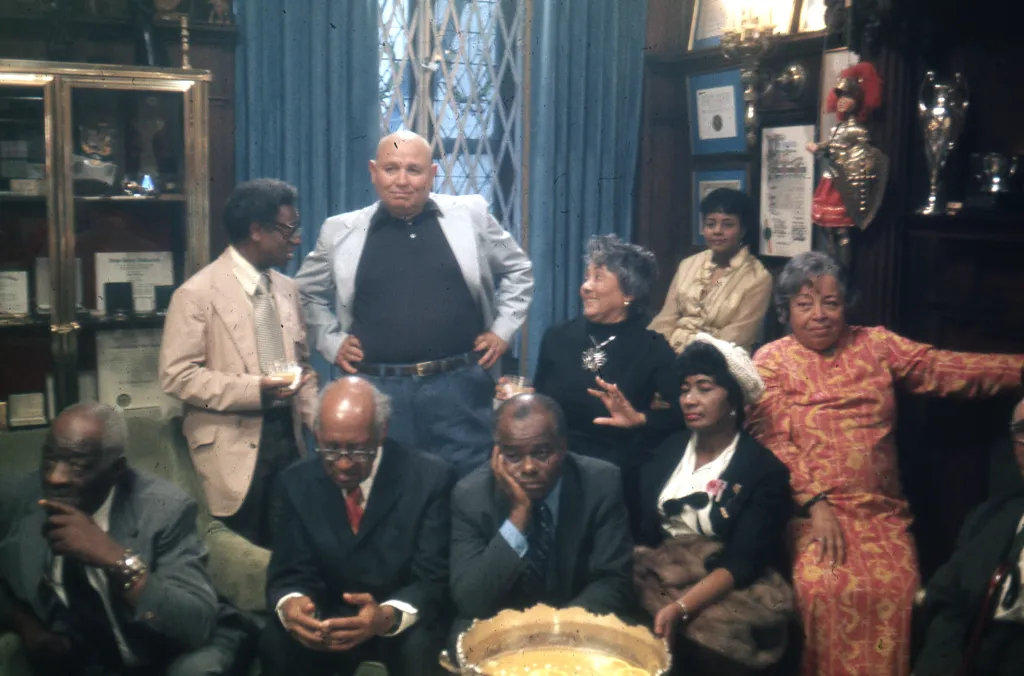
Inventive in form, Once Upon A Time In Harlem is shaped around a cocktail party that Greaves hosted at Duke Ellington’s home in Harlem. Greaves invited every surviving creator of the Harlem Renaissance he could locate – many of whom had not seen one another in over fifty years. For four hours, the group of artists laughed, drank, and debated their position in the rapidly shifting cultural landscape. Greaves filmed it all.
The footage was originally shot for a film about the Harlem Renaissance called From These Roots, which Greaves completed in 1974, using only archival materials. The interviews and discussions from the party were put to the side, and Greaves spent much of the rest of his life wrestling with how to finish the film. He died in 2014, with the film incomplete. His widow, Louise Greaves, continued working on the project until she died in 2023, at which point his son, David Greaves, and David’s daughter, Liani Greaves, picked up the mantle.
Among the more than two dozen Harlemites featured in the film are painter Aaron Douglas, artist and queer cultural pioneer Richard Bruce Nugent, painter and printmaker Ernest Crichlow, composer and pianist Eubie Blake, actor and activist Leigh Whipper, and poet, novelist, and historian Arna Bontemps. Curiously, though, no Duke Ellington.
“He was ill, apparently, and couldn’t attend,” David, who was in the room in 1972 working as a cameraman under his father, told Deadline during an expansive interview alongside Liani ahead of Sundance.
Unfinished portions of the film were screened at works-in-progress sessions in New York, at the Metropolitan Museum of Art and the Museum of Modern Art, in 2024 and 2025. Anticipation that the film may finally be near completion began late last year when New Yorker critic Richard Brody detailed a revelatory screening he attended in the city.
“I’ve just seen one of the greatest talking pictures, one of the greatest cinematic works of creative nonfiction that I’ve ever seen,” Brody wrote.
To complete the project, David and Liani oversaw the restoration and digitization of the footage captured by Greaves, which, in total, amounted to over 60,000 feet of film, “all 16mm,” David explained.
David is credited as the director of this version, and Liani is a producer. Below, the duo speaks with us in depth about the decades-long journey to bring Once Upon A Time In Harlem to the big screen, how Greaves constructed the film in 1972, and their plans to release other projects from Greaves’s large archive.
“There is more, so much more,” Liani teased during the interview.
Sundance begins January 22.
DEADLINE: David, the film was originally conceived and produced in 1972. What was your father struggling with throughout the years? What was stopping him from completing the film?
DAVID GREAVES: The film was originally supposed to be a combination of this party and still photographs. However, when we started piecing it together, they couldn’t get the stills to work with the live action. He decided to go with the stills, which became the project From These Roots (1974). He won over 20 film festival awards with that project. With this film, he couldn’t finish it because he had to be a part of it. As you see, he permeates the film. Also, we were working on other things because the only project that was paid for was From These Roots. This film was not going to be paid for at that time, so he went where the contracts took him. He also started working on some additional contemporary shooting for this project.
LIANI GREAVES: My grandfather and his wife, Louise, had been working on this film, trying to figure out how to make it work. With the additional filming my dad was talking about, the more contemporary stuff, they were just trying to figure out what the story was and how they could incorporate all the things they were seeing in Harlem and in Black culture in the US. They were trying to figure out how to integrate all of that. But they couldn’t quite manage it. It was almost necessary for them to be separated from the material by their passing.
DEADLINE: Where was all of this footage housed over the years?
DAVID: It was housed at the Schomburg. That’s right, Liani?
LIANI: Yep, some of it was there, and other parts were at our storage facility up in Iron Mountain. Altogether, it was about 60,000 feet of film, which had to be scanned and restored. Bill Brand handled that preservation. It was a huge task and took about two and a half years.
Sitting (left to right): Jean Blackwell Hutson, Eubie Blake, Irvin C.Miller. Standing(left to right): Aaron Douglas, Nathan Huggins, Richard Bruce Nugent. Photo taken in 1972. Credit: Bruce Stanford. Courtesy: William Greaves Productions.
DEADLINE: And what’s been the timeline? When did you guys start working on the project?
LIANI: They started the restoration portion around 2021. My grandmother had landed a big grant from the Ford Foundation. We came on in 2023 after she died, at which point the restoration of the film had been completed, and we began the editing process. We’ve been working on it since then.
DEADLINE: Had William left any instructions about how to proceed?
LIANI: Don’t F— it up. That was from Louise.
DAVID: That was the only instruction we had, along with make it happen. There were no granular instructions. We had this incredible footage to work with. It was simply a process of going through and selecting parts, losing others, and making it work. It was the regular cinéma vérité process.
LIANI: Additionally, my grandfather’s writings guided a lot of the film’s structure. My grandfather was a prolific writer of philosophy, creative expression, and film. We’ve incorporated some of that into the film.
DAVID: Yes, I went through a lot of his books. When we say his writings, we mean all the notes in the margins of his books, where he’d be crossing out things and then underlining and highlighting. He read intensely, and I hadn’t really seen any of it until I started this film. That experience, coupled with working on From These Roots, really grounded me in the area.
DEADLINE: The film’s structure is exactly what one would expect from a Greaves film, which is to say completely free of convention. I’m 28, and Greaves’s work has had a real resurgence amongst my generation because it all feels so contemporary.
LIANI: He would love that because my grandfather considered himself a young, struggling filmmaker until his very last breath. That’s who he was as a person. He maintained a curiosity about everything.
DEADLINE: David, can you talk me through the organization of the party in 1972? How did William find the guests and contact them?
DAVID: He was working very closely with the librarians up at the Schomburg, who had maintained contacts with everyone and consulted with him, passing along numbers and contact information.
DEADLINE: And what were his instructions in the room when you were filming?
DAVID: There were four cameramen and two sound people. We split into two groups. It was two cameras and one sound operator, and we just tried to catch the conversations. His basic advice was just shoot everything, and we were able to do that. And as you see in the film, he’s also directing some of the conversation. He’s asking questions and prompting topics.

David Greaves.
DEADLINE: You screened parts of the film around New York. At MoMA and The Met?
LIANI: Yes, we did work in progress screenings. MoMA was part of the Flaherty seminar, so we showed the first 20 minutes. And with The Met, we screened 20 minutes as part of the Harlem exhibit they had installed. That was great fun, and the first time that we got to share it publicly with folks.
DEADLINE: What did people say when they saw it?
DAVID: We had criticism sessions with folks who made wonderful suggestions. One of the suggestions was concerning my opening sequence. I originally had an elaborate beginning with all the history, and people said, Oh my God, will you get to the party? We don’t have to relive everything. That opening was actually based on the Langston Hughes poem The Negro Speaks of Rivers. But folks said no, no, no, you’ve gotta do better than that at the beginning.
DEADLINE: Richard Brody mentioned in his piece that you guys had hoped to release the film in time for William Greave’s centenary. Is that still the case?
LIANI: Absolutely, we are planning a retrospective in New York. That’ll happen this year. His birthday is October 8, so we’re looking forward to that. Ideally, it would be great to be able to premiere in New York. And Matthew Barrington at the Barbican in London will be doing a retrospective around that same time, too.
DEADLINE: This is often how it goes, but your father was a fiercely independent filmmaker. He wasn’t really embraced by Hollywood or other film institutions during his time working, but now, over time, everyone wants a piece of him. How do you navigate that?
LIANI: There wasn’t any Hollywood money. We didn’t have Hollywood names. Some people told us we had to have a Hollywood name doing a narration or a Hollywood name as the executive producers. The fact that the film is being embraced, that Greaves is being embraced, is great because that’s been my personal mission. I want to preserve his legacy and further introduce his writing and philosophy to the world. That is what excites me about the way people are embracing this film. And this opens the door for us to share even more, because there is more, so much more. He was a prolific filmmaker and writer.
DEADLINE: That was going to be my next question. Is there more unreleased work to share?
LIANI: Oh, yes. I want to publish some of his writing. There is a script called The Sweet Fly Paper of Life, which is based on Langston Hughes’s book by the same name. Langston had written to my grandfather asking him to make the film, so there are other stories that our company wants to be thinking about. Right now, the writing and this film will be our primary focus.
DAVID: We’re also creating a public-facing archive as part of this film project, where people will be able to access full interviews and conduct deep dives on all the people involved in the film.
William Greaves.
DEADLINE: How did the finished film end up at Sundance? I know William had a checkered history with the festivals. I always remember hearing that story about the mistake that led to Symbiopsychotaxiplasm being rejected from Cannes.
LIANI: Yeah, with Cannes and Symbio, they mixed up the film cans at the screening for the festival programmers. The projectionist showed the second reel first, and as my grandfather said, the film was already confusing enough. But yeah, that’s what happened with Cannes.
Sundance was a wing and a prayer. We had no money at the time we applied, but I thought we should just go ahead and send it because you never know. My grandfather had a relationship with Sundance, having been there several times. We sent it, we had no money, and we didn’t have a finished film. And then Richard Brody wrote this wonderful article, which caught the attention of one of our funders, the Cromwell Harbor Foundation. The founder of that organization just happened to be reading the magazine and saw this article, called us up, and gave us the money to finish. So the timing of it all worked out perfectly.
DEADLINE: How do you hope this film will be distributed? What is your ideal release?
LIANI: We want it to be as widely distributed and available as possible. Wide in every city. We want people to experience this film in a theater with their friends, family, and community because that’s what this film is about. It’s about community, collaboration, and being together.