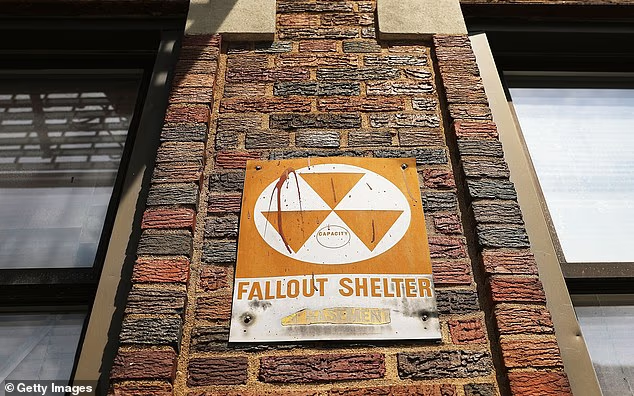
Fears of nuclear war have surged after the US and Israel launched a major military operation against Iran, killing the country’s supreme leader and other senior officials.
As speculation grows about possible retaliation on American soil, new research reveals which parts of the country could be safest if the unthinkable happens.
Scientists at the University of Massachusetts Amherst modeled a worst-case attack on the 450 intercontinental ballistic missile (ICBM) silos clustered across the Midwest, which are considered prime targets because disabling them early would cripple America’s nuclear arsenal.
Using historical wind patterns recorded through 2021, scientists projected how radioactive fallout would spread if each silo were struck with a warhead roughly 50 times more powerful than the bomb dropped on Hiroshima.
According to their research, scientists determined that parts of the western US, stretching from Washington down to Texas, could be among the least affected regions in the immediate aftermath of a nuclear strike targeting US missile silos.
Coastal regions of North Carolina, South Carolina, Georgia, Alabama, Louisiana and much of Florida would also see lighter fallout exposure – which occurs when radioactive particles descend through the atmosphere after a nuclear explosion – giving residents a better chance of surviving the initial devastation.
These areas could see doses as low as 0.001 grays (Gy) – a unit used to measure how much radiation energy the human body absorbs – in the days following an attack, which is relatively close to the annual public radiation limit.
States in New England, the Northeast and the more eastern parts of the Midwest would also face lower levels of initial fallout exposure compared to the areas most likely to be targeted.
In the modeling study, which used advanced weather data and modern computing power, scientists simulated what would happen if all 450 US missile silos were struck simultaneously.
The results suggested the explosions would devastate large portions of the Midwest, contaminate farmland for years and send dangerous levels of radioactive fallout across much of North America.
Depending on wind conditions, researchers estimated that several million people could die from acute radiation exposure alone, even if residents had time to shelter indoors.
Acute radiation sickness can begin with nausea, fatigue, vomiting and diarrhea, and at higher doses may lead to organ failure, seizures or coma.
Landlocked states closest to the missile fields, including Montana, North and South Dakota, Nebraska, Wyoming and parts of Colorado and Kansas, would likely be devastated in the immediate aftermath.
The areas facing the greatest danger could experience radiation doses ranging from 1Gy to as high as 84Gy, levels far above what the human body can tolerate. Scientists generally consider exposure above 8Gy to be lethal.
By comparison, exposure levels in states considered relatively ‘safer’ are estimated to range from 0.001Gy to 0.5Gy, though even these levels could still pose health risks depending on the duration of exposure.
The analysis comes as tensions between the US and Iran continue to escalate.
To model the worst-case scenario, researchers simulated an attack on the 450 ICBM silos clustered across the Midwest, a region considered a prime target because disabling those facilities early would cripple America’s nuclear arsenal
President Donald Trump has said repeatedly that Iran can never have a nuclear weapon.
He claimed to have ‘obliterated’ Tehran’s nuclear program in strikes last June, but said this week that it had attempted to rebuild.
‘Just imagine how emboldened this regime would be if they ever had and actually were armed with nuclear weapons as a means to deliver their message,’ Trump said on Saturday.
Western powers say there is no credible civilian justification for Iran’s enrichment of uranium to the levels it has allegedly produced, and the International Atomic Energy Agency has said the activity is of serious concern.
No other country has reached those levels without eventually producing nuclear weapons.
While Iran does not currently have a nuclear arsenal, analysts warn that any escalation involving nuclear-capable states could have catastrophic consequences far beyond the Middle East.
A massive US Air Force report released last year detailed the potential environmental effects of deploying the Sentinel missile system, which will replace all 400 Minuteman intercontinental ballistic missiles by the mid-2030s as part of a sweeping $1.5trillion overhaul of America’s nuclear arsenal and command systems.
But critics say the thousands-page assessment does not fully address one of the most dangerous scenarios: what could happen to surrounding communities if the missile silos themselves became targets during a nuclear war.
Land-based missiles have long been considered a key part of the US nuclear deterrent, originally designed to ensure a devastating retaliatory strike if America were attacked.
Over time, however, military planners also argued that the fixed silos served another purpose – acting as a vast network of targets that could absorb an enemy’s nuclear weapons.
During the Cold War, Air Force leaders even described the missile fields as a nuclear ‘sponge,’ forcing adversaries to expend huge numbers of warheads attempting to destroy them.
However, modern analysts warn that the strategy carries enormous risks because the missiles are stored in known locations, making them prime targets in any nuclear conflict.
Studies of previous nuclear-war scenarios have shown that detonating warheads near these underground silos would blast radioactive debris high into the atmosphere, where winds could carry contaminated particles hundreds or even thousands of miles.