Dictionary entries for the word ‘wool’ must be urgently updated to include plant–based alternatives, woke scientists say.
For centuries, the term has been used to describe the soft, curly hair forming the fleecy coat of sheep and other animals.
It even features prominently in nursery rhymes such as ‘Baa Baa Black Sheep’, sung by children across the UK.
But the Oxford English Dictionary’s definition must be modernised to include plant–powered varieties that ‘leave sheep in peace’, campaigners say.
People for the Ethical Treatment of Animals (PETA) argues that wool derived from linen, hemp and bamboo has existed for centuries.
There are also newer, cutting-edge fibres made from food waste, flowers and fruit that should be added to the entry, it said.
‘Adding plant wool to the Oxford Dictionary would recognise a simple truth: wool doesn’t need to be taken from suffering animals. It can be warm, stylish, durable, and entirely made from plants,’ said Yvonne Taylor, PETA’s vice president of corporate projects.
‘PETA urges the Oxford English Dictionary to update its definition to reflect today’s innovative, planet-friendly, plastic-free, animal-free yarns that are reshaping fashion.’
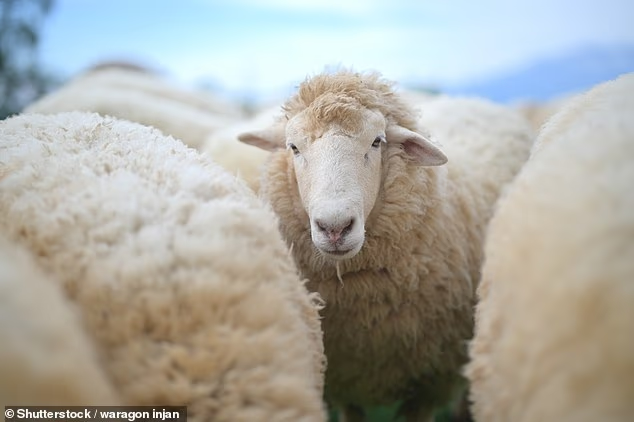
For centuries the word has been used to describe the soft, curly hair forming the fleecy coat of sheep and other animals (file image)

The letter in full, addressed to the dictionary editors and signed by PETA’s vice president of corporate projects Yvonne Taylor
The organisation argues that sheep produce large amounts of methane which can contribute to global warming.
This, along with other factors, has led sheep’s wool to be ranked as a ‘Class E’ material by the Made-By Environmental Benchmark for Fibres, which analyses the environmental impact of different materials.
In contrast, hemp – a plant wool used for thousands of years to make clothing – is ranked as a ‘Class A’ material, PETA said.
In the letter to dictionary editors, which was sent today, Ms Taylor said: ‘As part of your regular updates to ensure the dictionary accurately reflects our ever-evolving language, we’re requesting that you please include “Plant Wool” under the entry for “Wool” to encompass the many innovative, eco-friendly, animal-free yarns available.
‘Plant wools like hemp, bamboo and linen have existed for centuries, and the OED notes that “pine wool” has been used since the 1850s.
‘Now, cutting-edge fibres made from food waste, flowers, fruit and more are being used by designers in everything from sportswear to knits.
‘Plastic-free plant wools match (and often outperform) animal wool for warmth and comfort while being less environmentally impactful and kinder to animals.
‘We’re in the throes of a fashion revolution borne of people’s desire to subvert concern for animals and the planet, with plant wool at the forefront. Please add “plant wool” to the Oxford English Dictionary to reflect that we need not steal from animals; we can instead work with nature to grow wool.’

In 2022, PETA supporters took to the streets of Melbourne to demonstrate against the use of wool
Currently, the main online dictionary entry refers to the fleece or ‘woolly covering’ of sheep and similar animals.
The second entry also says the word can be applied to ‘any fine fibrous substance naturally or artificially produced’.
This isn’t the first time PETA has called for changes to wording commonly used in the UK.
In April last year, PETA pleaded with editors at the Cambridge Dictionary to update its definition of the word ‘rat’.
When used in reference to a human, the informal definition is ‘an unpleasant person who deceives others or is not loyal’.
The letter, signed by Elisa Allen – PETA’s Vice President of Programmes – read: ‘We’re writing on behalf of rats and those who care about them – as well as anyone who appreciates accuracy in language – to ask that you please update your entry for the informal noun “rat”, currently defined as “an unpleasant person who deceives others or is not loyal”.
‘This is not only inaccurate but unfair to rats, who are pleasant, loyal individuals who form strong attachments and loving family bonds.
‘As altruistic as they are clever, rats also show empathy and a willingness to help other rats – even when they don’t know the individual in peril and dream of a better future.’

In 2019, an advert by PETA claiming ‘wool is as cruel as fur’ was banned by advertising chiefs for being ‘false and misleading’
Meanwhile, in May last year, PETA called for World Milk Day to be renamed ‘World Bovine Mammary Secretion Day’.
In a letter written to the Food and Agriculture Organization, the group pointed out that cows secrete milk to feed their offspring in the same way as humans.
However, calves in the dairy industry are removed from their mothers, often very shortly after birth, so that ‘the milk meant to nourish them can be stolen and sold to humans’.
‘This rebrand reflects the fact that cows don’t make milk because they’re cows, but because they are mothers,’ said Ms Allen.
‘What you call a “global food” is really a food intended for baby cows and bulls only.’
The Oxford English Dictionary has been contacted for comment.