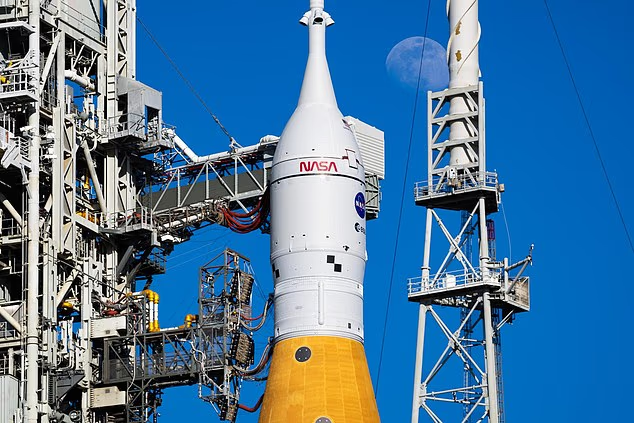
NASA‘s Artemis II moon mission has been delayed for a second time after several last–minute issues were spotted on the Space Launch System (SLS) rocket.
After successfully completing the second wet dress rehearsal last Thursday, hopes had been high that the historic moon mission would launch in March.
However, NASA administrator Jared Isaacman now says the March launch window is ‘out of consideration’.
That means Artemis II will not take its crew – Reid Wiseman, Victor Glover, Christina Koch, and Jeremy Hansen – around the moon until April 1 at the very earliest.
Mr Isaacman says that the reason for the delay is an ‘interruption in helium flow in the SLS interim cryogenic propulsion stage’.
The system worked during both wet dress rehearsals, but engineers were unable to get helium flow through the vehicle during routine maintenance on Saturday night.
Now, as the long–awaited moon mission is pushed back once again, some frustrated fans have called for Elon Musk’s SpaceX to step in with assistance.
Taking to X, one fan vented: ‘Time to scrap the 1960s tech and innovate to build next gen space launch vehicles and to stay on par with SpaceX.’
NASA’s Artemis II moon mission has been delayed for the second time, as last–minute technical issues are found in the Space Launch System (SLS) rocket

NASA administrator Jared Isaacman said that the issue had been caused by an ‘interruption in helium flow in the SLS interim cryogenic propulsion stage’
Fed–up space enthusiasts have taken to social media to vent their irritation over the persistent delays.
One commenter wrote: ‘At this rate, the Chinese will soundly beat us to the Moon.’
Others explicitly suggested that SpaceX should be called on to lend assistance or even replace the SLS rocket altogether.
On X, which is owned by SpaceX CEO Elon Musk, one commenter wrote: ‘@SpaceX Those guys need a ride to the moon, please help them.’
Another asked: ‘When will NASA stop the financial haemorrhaging and turn this program over to SpaceX?’
‘Can we get out of this contract and save money with SpaceX,’ suggested another.
In particular, a number of space fans suggested that the experimental Starship rocket could make a viable replacement.

Mr Isaacman (left) says that the setback will ‘almost assuredly’ affect the intended March launch date, ruling out the Artemis II launch until April

Mr Isaacman says the systems performed well during both wet dress rehearsals, but unexpectedly failed during a ‘routine operation’

On X, frustrated space fans have called for Elon Musk’s SpaceX to provide assistance to the Artemis II programme
‘I beginning to think that the SpaceX Starship will be launching astronauts to space before the Artemis program,’ one commenter suggested.
While one added: ‘Time to replace SLS with Falcon Heavy. Might even actually do it faster with Starship.’
For context, SpaceX has been contracted by NASA to provide a modified version of Starship for the lunar landing during the Artemis III mission.
In April 2021, NASA awarded Elon Musk’s company a $2.9 billion contract to provide the first crewed lunar lander, but SpaceX is widely expected to miss the 2027 target date.
Last year, acting NASA administrator Sean Duffy threatened to open up the contract to other countries due to persistent delays, saying at the time: ‘The problem is, they’re behind.’
However, NASA’s immediate problems are the ongoing delays afflicting the problem–plagued SLS rocket.
Mr Isaacman says that the source of the problem could be located in one of the filers or quick–disconnect ‘umbilicals’ that pass gases between the ground and the rocket.
Alternatively, he says that the issue could have been caused by a ‘failed check valve onboard the vehicle, which would be consistent with Artemis I’

Angry commenters lamented the costs of the SLS rocket and its persistent delays, arguing that the mission should be turned over to SpaceX

One commenter asked why America could ‘get out of this contract’ in order to save money with SpaceX

The SLS rocket will now need to roll back to the Vehicle Assembly Building at the Kennedy Launch Centre for repairs, meaning that another wet dress rehearsal is almost certain
After problems with the helium system were discovered overnight, NASA has now made the disappointing decision to roll SLS back to the Vehicle Assembly Building (VAB) at Kennedy Space Centre.
While the agency has a limited capacity to fix issues at the launch tower, more serious problems need to be addressed in the VAB, which gives engineers better access to the vehicle.
The vibrations caused by rolling the rocket in or out of the VAB risk loosening or disturbing seals and valves, meaning that one or two more wet dress rehearsals are almost certain.
After the success of the second wet dress rehearsal, the Artemis II crew entered quarantine in Houston, Texas, on Friday night.
During quarantine, the crew limit their exposure to other people so that they can stay in good health for the flight.
This procedure usually starts 14 days out from the launch date, but NASA has not said whether the crew will be able to leave quarantine before the April launch date.
Writing on X, Mr Isaacman added: ‘I understand people are disappointed by this development. That disappointment is felt most by the team at NASA, who have been working tirelessly to prepare for this great endeavor.’