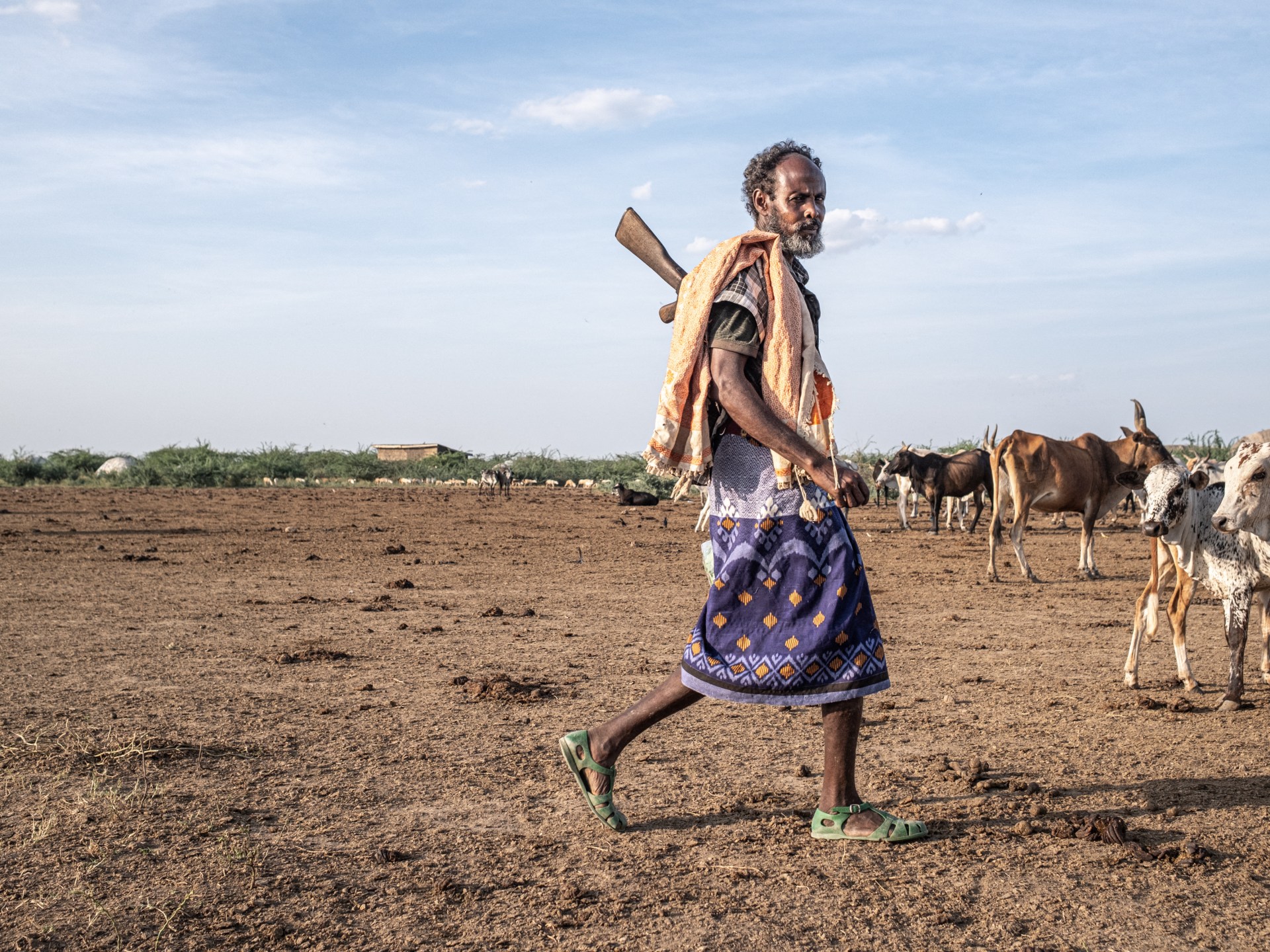
Once lauded as a remedy for Ethiopia’s advancing desertification, a non-native tree has transformed into an uncontrolled menace across the East African country, endangering delicate ecosystems and threatening the existence of local communities.
The prosopis, a shrubby tree indigenous to Latin America, was initially introduced to Ethiopia’s northeastern Afar region during the 1970s.
For livestock farmer Khadija Humed, it has become a source of misery.
“Because of this plant, we have become poor,” she told the AFP news agency.
Initially, prosopis seemed promising. Resistant to heat and quick-growing, it was intended to prevent soil erosion and provide cooling shade in Afar’s dry lowlands.
Today, however, it dominates the region’s expansive plains with thorny branches that reach heights of up to 10 metres (33ft).
Each tree extracts up to 7 litres (nearly 2 gallons) of water daily through its extensive root system, depleting soil moisture and devastating agriculture.
Local pastoralists also reported that prosopis harms their livestock.
“The plant has turned against us,” Hailu Shiferaw, a researcher at the Ethiopian Water and Land Resources Centre, told AFP.
“No one could have foreseen its harmful effects.”
In Humed’s village, about 200km (124 miles) northeast of Addis Ababa, she explained that the tree’s pods sicken their cattle and obstruct their mouths and stomachs, sometimes fatally. These losses have plunged the community into severe poverty, she said.
“I personally have 10 cows and more than 20 goats and sheep. But before prosopis, people here used to have 50 to 100 cattle,” she said.
“Everything has changed,” 76-year-old Yusuf Mohammed remarked, noting that the tree’s thick foliage attracts predators that prey on their livestock.
“We never had wild animal attacks before. … After prosopis spread, lions, hyenas, wild cats and foxes invaded our villages,” Mohammed said.
He added that its toxic thorns injure livestock, leaving them weakened and unable to forage effectively.
Globally, humans have introduced about 3,500 invasive species, many causing ecological damage.
These species cost economies around the world at least $423bn each year, according to a 2023 report by the Intergovernmental Science-Policy Platform on Biodiversity and Ecosystem Services. That amount is equivalent to Denmark’s gross domestic product.
Ketema Bekele, associate professor of environmental economics at Ethiopia’s Haramaya University, calculated that prosopis has cost Afar $602m over three decades – nearly quadruple its annual budget.
The plant now infests about 20,000sq km (7,720sq miles) of Afar and is “out of control”, spreading into the Amhara and Oromia regions, he noted.
By 2023, it covered 8.61 percent of Ethiopia, according to the Journal of Environmental Management, up from 2.16 percent in 2003, while pastureland diminished by more than a quarter during the same period.
The journal projected that prosopis could occupy 22 percent of Ethiopia’s 1.1 million square kilometres (425,000sq miles) by 2060.
Camels contribute to its spread by consuming the pods and dispersing the seeds through excretion.
Since 2022, CARE International has tried to halt the spread by encouraging locals to harvest the plant.
With support from the Danish fund Danida, the nongovernmental organisation also removes trees to establish fruit orchards.
Mohammed believes the invasion can be controlled but emphasises the need for additional assistance.
“We can’t tackle it alone,” he said.