Solar activity can be dangerous to astronauts in space. As Artemis II prepares to launch on April 1, NASA will be monitoring the Sun’s eruptions to help keep the Artemis crew safe from excess radiation.
With the launch of Artemis II planned in a few weeks, NASA is ready to monitor the sun during the mission in order to protect the astronauts while in space.
Artemis II, the NASA lunar test flight that will carry four astronauts around the moon on a 10-day mission, has a target launch date of April 1.
NASA STILL ON TRACK TO LAUNCH ARTEMIS II TEST FLIGHT AFTER ROLLBACK DUE TO REPAIRS
While in space, the astronauts will be at an increased risk of radiation exposure from the sun’s solar activity because they will not be protected by Earth’s magnetic field, NASA said.
Orion will serve as the main protection for NASA astronauts Reid Wiseman, Victor Glover, Christina Koch and Canadian Space Agency astronaut Jeremy Hansen while they’re in space.
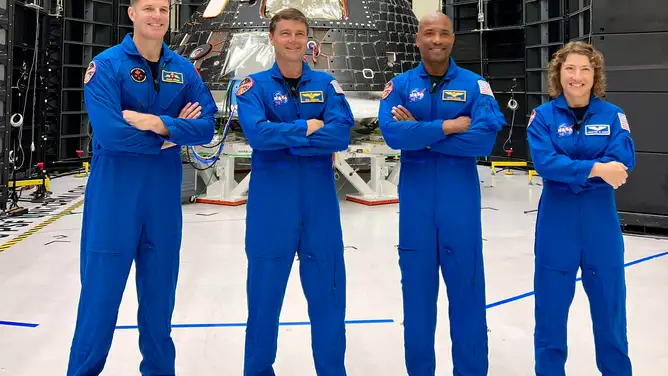
The Artemis II astronaut crew in front of the Orion spacecraft at Kennedy Space Center in Florida on Aug. 8, 2023. From left to right: CSA astronaut Jeremy Hansen and NASA astronauts Reid Wiseman, Victor Glover and Christina Hammock Koch. (Image: NASA)
(NASA)
But NASA and NOAA will do their part during the mission by watching the sun, helping to make real-time decisions based on space weather conditions to help keep the astronauts safe.
Experts will watch for solar flares and coronal mass ejections.
A coronal mass ejection (CME) is an enormous cloud of electrically charged gas, called plasma, that erupts from the sun, according to NASA.
DANGEROUS ASTEROID NO LONGER EXPECTED TO HIT THE MOON IN 2032
One single CME can blast billions of tons of material into the solar system all at once and occur in the sun’s outer atmosphere.
Solar flares are the most powerful eruptions in the solar system. The strongest solar flares can unleash more energy than a billion hydrogen bombs, NASA said.
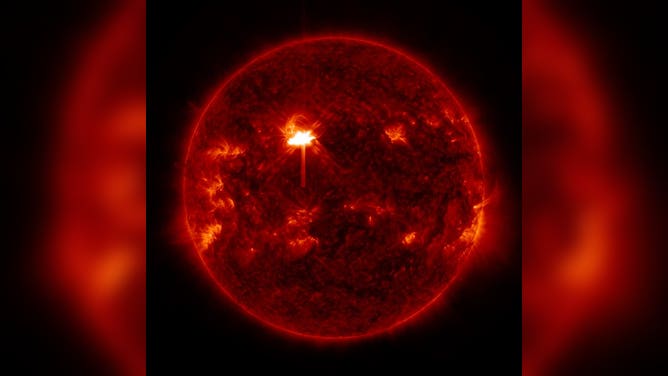
The Sun as seen in ultraviolet light from space by NASA’s Solar Dynamics Observatory. The Sun’s surface is mottled, with several brighter spots and one very bright spot glowing near the center-left of the disc.
(NASA)
The primary concern for the astronauts during these events are the solar particle events they can trigger.
If a solar particle event happens near the Artemis II crew, it can raise radiation levels inside the spacecraft.
NASA’s Goddard Space Flight Center team will track any solar eruptions, measuring how large they are, how fast they’re moving and how likely they are to generate energetic particles that will cross Orion’s path, NASA said.
NEW DEVELOPMENTS IN NASA ELECTRONICS WILL LEAD TO FURTHER INTERPLANETARY EXPLORATION
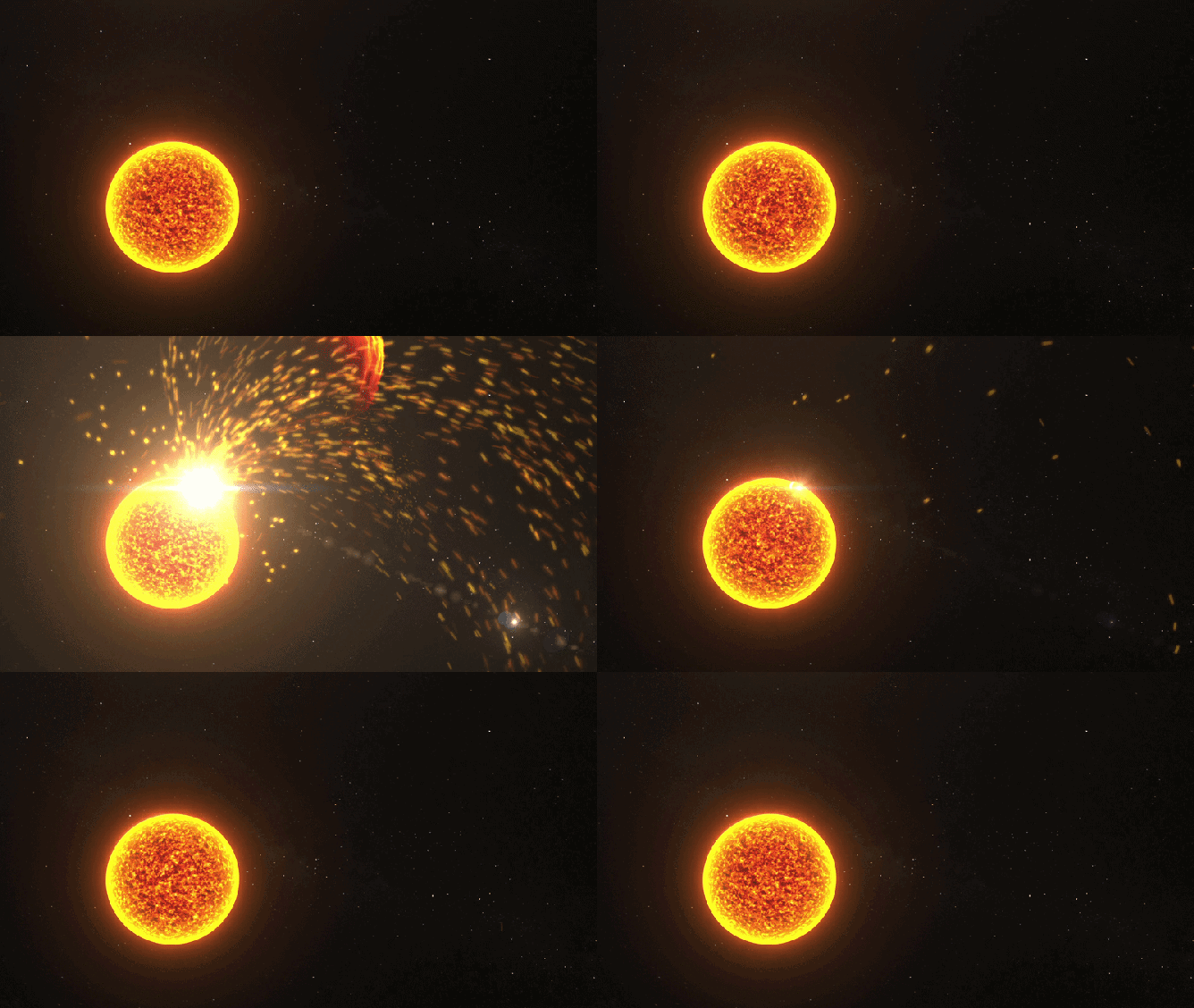
This animation shows a solar eruption that produces a solar flare, a coronal mass ejection, and a flurry of energetic particles. The particles follow the spiral shape of the solar wind’s magnetic fields into interplanetary space.
(NASA’s Goddard Space Flight Center Conceptual Image Lab / NASA)
The teams will use real-time data from sun-watching spacecraft across the solar system to monitor the sun.
One such spacecraft is the Mars Perseverance Rover, which can look at the far side of the sun, where Earth has no view, NASA said.
The rover’s Mastcam-Z cameras can give NASA’s space weather teams a view of the largest sunspots up to two weeks in advance, so the team can monitor and prepare for possible solar flares.
NASA said the gradual rise in radiation caused by a solar particle event gives analysts time to evaluate the situation.
HOW TO SPOT THE INTERNATIONAL SPACE STATION IN THE NIGHT SKY
Inside Orion, six radiation sensors measure dose rates in different parts of the cabin. If radiation levels increase, Orion’s onboard systems display warnings accompanied by an audible alarm.
Too high lifetime radiation exposure can increase risks for certain cancers or health disorders that could impair cognition and performance.
NASA will monitor dosage levels inside Orion, and alert for low threshold markers, signaling caution and prompting close monitoring, as well as high threshold markers, which will require the crew to take shelter.
SCAN REVEALS NEW CLUES INTO ASTEROID BENNU’S SURFACE, FINDING ‘MISSING PIECE’ FOR SCIENTISTS
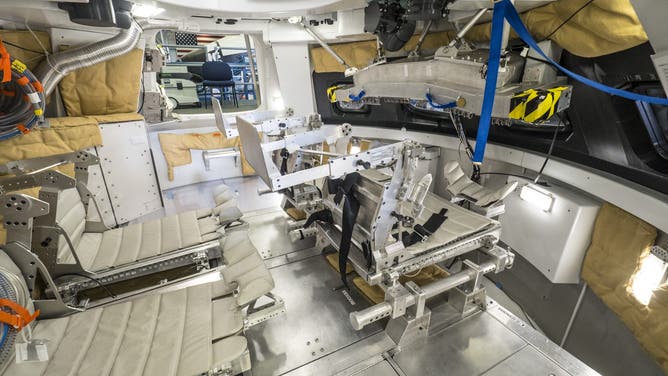
Interior of the Orion Medium Fidelity Mockup at the Johnson Space Center in Houston.
(NASA)
NASA said one such way the Artemis II crew will be able to help shield themselves during a particle event will be by taking equipment from storage bays around the cabin and securing them to the walls to add mass between the event and the astronauts.
“Once crews add mass to the places that tend to be hotter in terms of radiation exposure, they can then continue to go about their duties,” Stuart George, a space radiation analyst at NASA Johnson, said.
The International Space Station (ISS) has hosted astronauts living and working in space for more than two decades, making groundbreaking contributions to technology and medicine along the way.
Artemis II astronauts also wear personal radiation trackers called crew active dosimeters.
Radiation exposure occurs naturally when in space, as astronauts must go through Earth’s radiation belts and galactic cosmic rays.
It’s #SunDay! Here’s your space weather report for the week of March 6 – March 12:
•0 M-class flares
•2 C-class flares
•27 coronal mass ejections
•0 geomagnetic stormsThis video from NASA’s Solar Dynamics Observatory (SDO) shows the week’s activity. Another pretty quiet… pic.twitter.com/GH3bV1mCR5
— NASA Space Alerts (@NASASpaceAlerts) March 15, 2026
Together, the radiation exposure from these sources is expected to be comparable to a one-month stay on the International Space Station, or about 5% of an astronaut’s career limit, NASA said.
NASA said any additional radiation exposure from solar events would add to the baseline radiation exposure from the belts and the galactic cosmic rays.