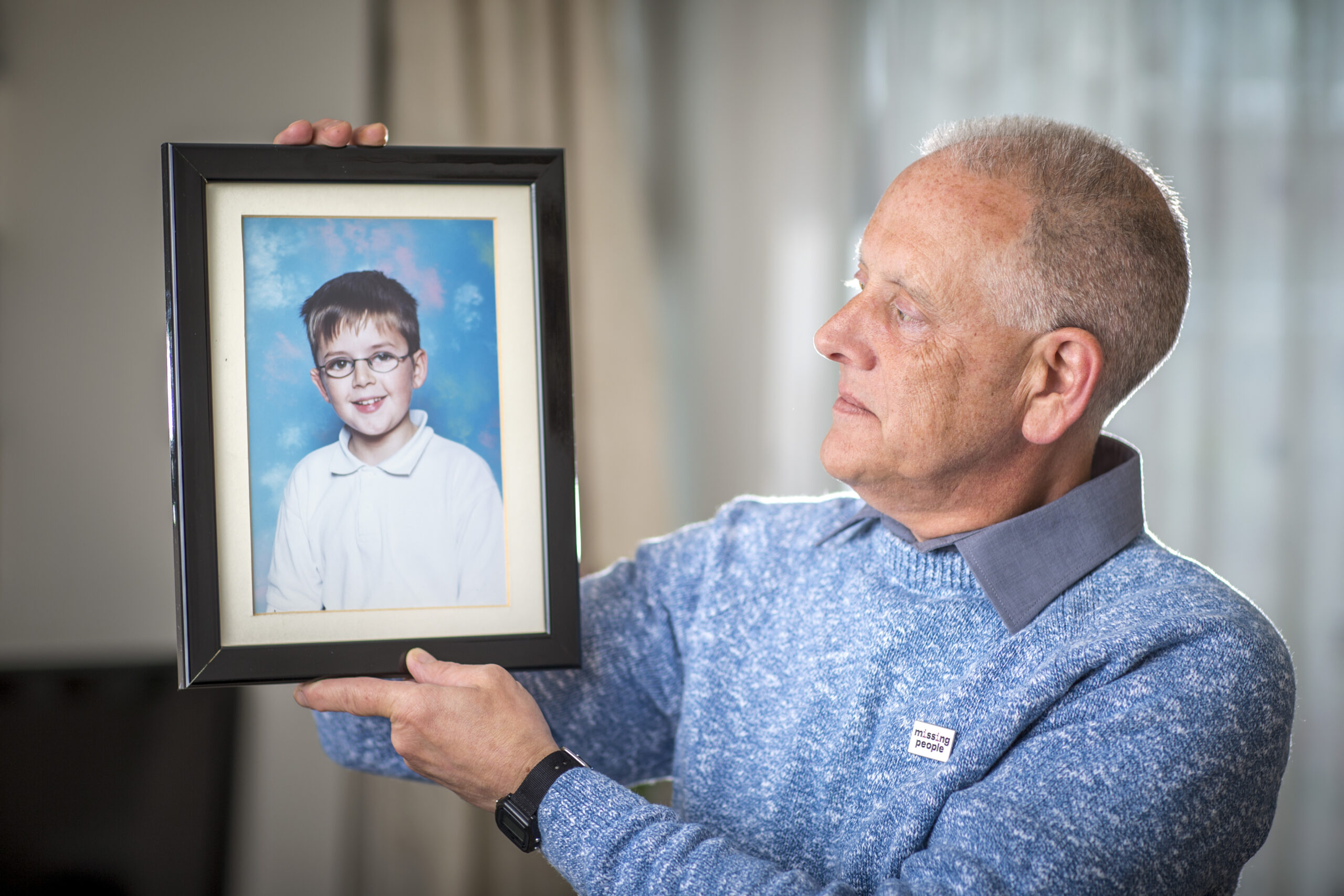
HEARTBROKEN dad Kevin Gosden can’t have a smartphone anymore as he lives in fear of seeing his missing son’s face plastered across social media.
Kevin‘s boy Andrew has not been seen for nearly 20 years in one of the UK’s most baffling missing persons cases. But now he faces a new torment – with his son becoming a lightning rod for an endless parade of online true crime creeps and obsessives who send his family false leads, making their lives a living nightmare.
Exasperated and drained, Kevin, from Doncaster, continues to hope for his son’s return – but is often haunted by armchair detectives and their chilling theories on what could have befallen Andrew.
He’s sent AI videos of his son, fake articles claiming his body has been found. He’s also been contacted by psychics with “messages”, and is bombarded by true crime addicts trying to do what the police so far haven’t done – find Andrew.
Without a care, Andrew’s case has become fodder for online ghouls, with one quick search of TikTok revealing hundreds of videos of wannabe sleuths sharing their theories.
Many of them have vile teases such as “mystery solved, and it’s way worse than we think” – or prompt you to search for “sightings” and “spotted”.
Other videos can be described as AI slop and brain rot – with “analysis” of Andrew’s case reimagined by video generation tools, or twinned up with footage from video games and make-up tutorials.
Facebook and Reddit are also havens for theories, with groups of thousands, or sprawling threads of users, speculating on cases like Andrew’s.
Andrew, who was 14 when he vanished, has been missing for 19 years after skipping school and boarding a train from Doncaster to London, only to vanish without a trace.
He would now be in his early thirties now.
Kevin, 60, is scared that websleuths are “ruining” the chances of finding his boy – and other missing people like him by turning their tragedies into clicks.
And campaigners told us more action needs to be taken to protect families of missing people, with Kevin not being alone in his torment.
To avoid the barrage of videos, the frustrated dad doesn’t use a smartphone, adding he “walks around looking like a drug dealer” with a Nokia ‘burner’ phone.
As he described his ordeal to The Sun, he was gardening near his cabin and connecting with nature.
This is one of many coping mechanisms he’s come up with to try to help his mental health, including only keeping emails on his laptop.
He says: “I just can’t cope with the quantity. It’s bad for my mental health and anxiety. It’s not good to be exposed to that.
I have caught myself before, to my shame, feeling envious of parents whose child has been murdered
Kevin Gosden
“I struggle with it — Reddit threads, especially with the theories. I don’t look at it.
“It’s daily torture. I read it and wonder if that did happen, what it could have been like.”
In the years since Andrew vanished, Kevin has had a breakdown, attempted suicide and had to resign from his job.
“I always thought the worst feeling ever would be to have a child die, but this to me is worse,” he has said in the past.
“I have caught myself before, to my shame, feeling envious of parents whose child has been murdered, but then you stop and want to hug them.
“We just want to know what happened to our son before we die.”
Andrew was incredibly intelligent, having taken part in the government’s Young, Gifted & Talented Programme for high-achieving students and was on track to attend Cambridge.
He had a 100 per cent attendance record at school, was never bullied and loved metal music – counting Funeral for a Friend and Slipknot among his favourite bands.
The teen took a train from his hometown of Doncaster to London on September 14, 2007.
Weeks later, detectives were able to track down CCTV showing the teenager in King’s Cross station – but from there the trail ran cold.
‘Strangers tell me they know he was murdered’
In December 2021, two men were arrested on suspicion of kidnap and human trafficking, but police confirmed no further action was being taken in September 2023.
But for Kevin, the nightmare has never ended – with the mystery never being solved, and only being made worse by the bombardment of terminally online weirdos.
Speaking about AI-written articles shared online last year, Kevin says: “They said Andrew’s body had been found, that there was CCTV, the police weren’t investigating. None of it was true.
“My reaction was, ‘Oh come on. I spend all this time trying to keep hope alive, to keep the search going, and you come along and ruin it for a few clicks.’
“The creepy aspect that really haunts me is that they made it seem like I had been quoted.
“It said things in the way I would have said them. It’s really disturbing.
“But I know Andrew’s body hasn’t been found, I know I never said these things. It was extremely disturbing, psychologically.
“If stuff like this goes viral, it wrecks any possibility of finding him.”
Kevin said he has learned to “brush off” the worst of it and tries not to look online too much.
On Facebook, there is a missing persons page for Andrew – but a friend manages it for Kevin.
The dad says they have to be “ruthless” with monitoring what is posted in this space.
He adds: “It’s instant block and delete. You learn how to do that pretty quickly.”
Kevin tells The Sun: “These people are just getting underfoot when the police are trying to get on with their investigation.
“It’s easy to type stuff online, but it can have a really tough impact on the families.”
It’s especially damaging when people claim to be witnesses or seem to have credible information – and parents will leap at the slightest ray of hope.
Kevin says: “Very occasionally, I have someone comment and say they knew Andrew at the time, they know what happened to him, and he was murdered and so on.
“You can’t imagine the shock at reading that. I manage to not panic too much and sleep on it.”
Kevin restricts his exposure to social media as much as possible.
He says: “I’m glad I don’t have TikTok. None of it helps. Even if it was plausible.
“With the nasty comments, I ignore them, and I don’t want to get involved. I don’t want to get in an argument with anyone.”
Kevin isn’t alone in this living nightmare – it’s disturbingly common for families of all missing people who have captured the public’s interest.
Matthew Searle, from missing persons charity Safe Harbour, supported the family of Jay Slater when the teen vanished in Tenerife.
But searches for the 19-year-old were disrupted by thousands of armchair detectives with “evidence”, and some even turned up in person.
Jay’s mum, Debbie, was harassed with messages and fake videos suggesting her son was being beaten up by a gang.
The search for Jay was an extremely high-profile case that gripped the nation – but Matt told The Sun it is far from unique.
The rise of AI and social media has forced Safe Harbour – previously called LBT Global – to change the way they work, making sure they “fly under the radar”.
Matt told The Sun: “We just get thousands of calls with untrue information.
It’s not an episode of The Bill for people to write fanfiction about. It’s in the name – it’s true crime. This happened
Matthew Searle,
“We get AI images sent in saying they died in a car crash. Here’s a picture of it. It’s sickening.”
He adds: “It’s not an episode of The Bill for people to write fanfiction about. It’s in the name – it’s true crime. This happened.”
It would be easy to just blame unregulated online spaces for this, but it’s not just the rise of social media and technology.
Millennials and Gen Z are watching, reading and listening to true crime stories in record numbers. In 2022, 18-29 year-olds devoured more hours of true crime content a week than any other age.
Matt said Facebook remains the worst platform for sleuths as they can create groups of unlimited numbers, but there are also countless Reddit threads and TikTok videos full of theories.
Matt says: “The rise of AI and bots and social media has had a really detrimental effect on my work.”
He wants a crackdown on armchair detectives posting disturbing theories and hampering ongoing investigations.
“How can you rein stuff like this in, though? The thing is, it’s not a crime unless it’s harassment.
“There aren’t any safeguards for this. It’s an unregulated world.”
Matt also explained how sick people have found videos of missing people online, and used their voices to create deepfake calls.
“I had one, and I thought, ‘Oh my god it sounds just like one of the people we were looking for’, but it wasn’t.
“We’ve had messages from people pretending to be missing people too.
“You don’t know what’s true anymore. And for the families getting these, if you get even the slightest hint of hope, you pay for it and think about it later.”
Matt – who founded his missing persons charity in 2004 – slammed these armchair detectives as “sickening”.
“Mediums and psychics are less of a problem now than armchair detectives.
“They’re horrific, they’re the worst. Even on a regular case, not a high-profile one, there will be hundreds or even thousands of comments.
“The hardest thing is that the families of these people Google their name every day and are reading all of this.
“I’ve received death threats when I’ve asked people to stop because of the effect on the families.
“TikTokers get funding to travel to these places to look for missing people.
“They come up to me wanting to work in partnership. But the funny thing is, they only go to the nice sunny countries, not the cold ones with bad weather.
“People ask why we have stopped looking for missing people, but we haven’t.
“We just work in a different way now, in this digital world. And it’s only going to get stranger.”