Nevada has been hit by multiple earthquakes in a region where the Earth’s crust is slowly pulling apart.
The US Geological Survey detected two tremors on Monday, measuring 3.5 and 3.8 magnitudes, with the latest striking at 11:08am PT (2:08pm ET).
The epicenter, near Empire, sits in the Basin and Range Province, a vast region stretching across much of the western US.
In this area, the Earth’s crust is gradually being stretched and thinned, creating frequent faulting and seismic activity.
As the crust pulls apart, fractures known as faults form, and movement along these faults produces earthquakes.
Empire lies within a seismically active region influenced by major fault systems, including the Walker Lane zone, a large strike-slip fault system that helps accommodate motion between the Pacific and North American tectonic plates.
An assessment from Michigan Tech University showed that people typically do not feel quakes with a magnitude of 2.5 or less. Those from 2.5 to 5.4 are often felt but only cause minor damage.
While Monday’s earthquake was strong enough to shake buildings, Empire is sparsely populated, and the USGS received only two reports of shaking for both tremors combined.
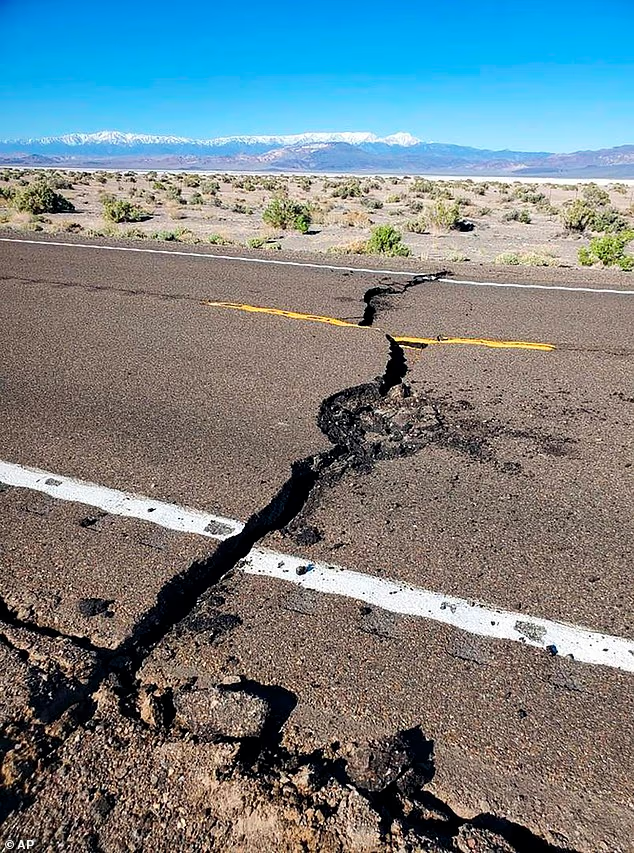
A 6.5-magnitude earthquake struck Nevada in 2020 (pictured), which was likely caused by the Basin and Ridge Province cracking and stretching

The earthquakes, measuring 3.5 and 3.8 magnitudes, hit outside of Empire on Monday
Nevada is the nation’s third-most seismically active state, ranking after California and Alaska.
The 3.8 magnitude quake hit first, striking at 7:35am PT.
Multiple earthquakes in Empire can be caused by several factors, but the most common reason is movement along faults, which are fractures in the Earth’s crust where blocks of rock slip past each other.
When stress builds up in the crust and is suddenly released, it creates earthquakes. Another cause can be regional tectonic activity.
Because Nevada sits in an area where the Earth’s crust is stretching and pulling apart, this stretching creates frequent faulting and seismic activity.
In some cases, aftershocks can occur after a larger earthquake, producing a series of smaller quakes over days or weeks.
Occasionally, human activity can trigger earthquakes, such as geothermal energy operations, mining or underground fluid injection.
However, most earthquakes in Nevada are naturally occurring.
Volcanic or geothermal processes can also cause tremors, especially if underground heat and fluids are moving, though this is less common than tectonic causes.