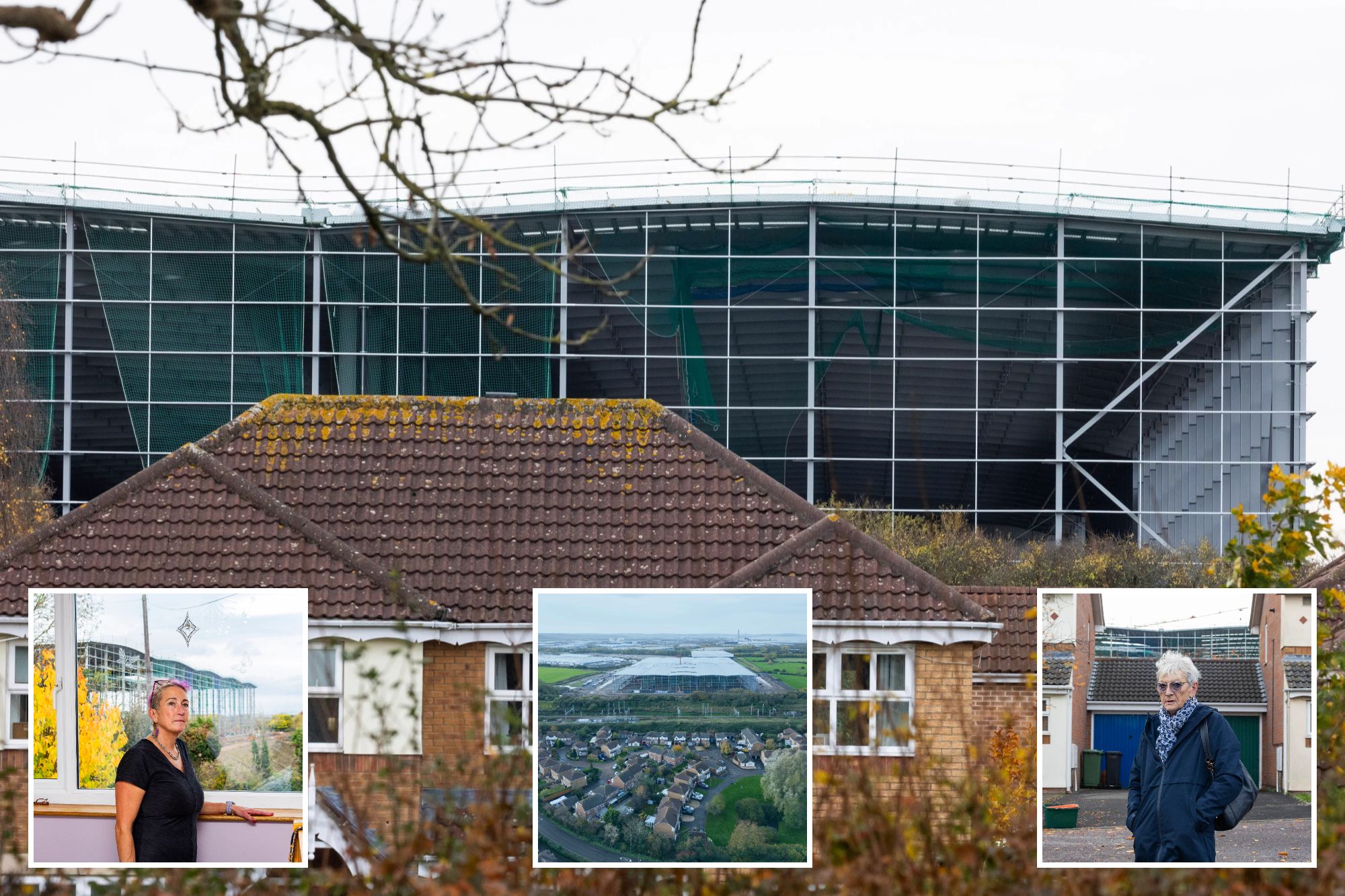
RESIDENTS say a monstrous “mega shed” has turned their town into the War of the Worlds, with them living in the dark and losing all privacy.
The controversial massive warehouse was built in a village without the locals being consulted – using a rule from 1957.
Locals in Pilning in Gloucestershire say the 500,000 sq ft building is a “monstrosity” which blights the area, has robbed them of views and even blocks the sun.
They say the ”stadium-size” 20m (65ft) high facility looks like a “large prison” or “War of the Worlds” and is also floodlit all night.
People say they weren’t consulted over the building of the ”industrial distribution hub” because of an historic planning consent dating back to 1957.
The 1957 scheme was part of a post war building initiative and allows developers to go ahead with an application in the area without fully consulting residents.


It was originally designed 70 years ago to boost future expansion of chemical, storage, and distribution industries.
The ”consent” also means councillors are prohibited from taking into account many issues raised by residents.
Speaking today locals say estate agents have told them their homes have been significantly devalued by up to ten per cent by the building.
They have dubbed it the ”giant green house” or the ”mega shed”.
Simone Harrison, 55, and husband Ricky Harrison, 51, say for 13 years all they could see there was wildlife and animals like deer and rabbits.
But now when they open their windows all they can see is a massive warehouse.
Simone said: “I feel so upset. We have never drawn our curtains. Now you feel like you have no privacy.
“It is an effing monstrosity. It has certainly changed the way I feel about the area.
“If it is going to be a distribution hub there are going to be lorries every night.
“I might as well move out and live in the city again if this is going to be fully operational.
“When they started the piling work the whole house was shaking and a lot of dust. They told they were going to clean our house and cars and they didn’t.”
Ricky said: “I understand we need progression but there has been little thought about the houses and who lives here.
“It is not planned by someone who lives here. They just plonked it here.
“What is it going to look like? Is it going to look like a stadium?
“When it was being built it was like War of the Worlds – it just kept getting bigger and bigger.”
Sue Jones, 67, a retired army veteran went on holiday and when came back after two weeks the “monster-shed” had appeared.
“I was disgusted when I saw it,” she said. “They managed to get it so close to the houses.
“And what about the flood plan? Where is all the water going to go?
“When it is completed it is going to be like living next to a large prison.
“We didn’t get any correspondence from the developers until last week we got a newsletter number six out of six. Where did the other correspondence go?”
Sue said she doesn’t know what the industrial unit is meant to be but is afraid there are going to be lorries in and out the village day and night.
She added: “They go on about this creating jobs.
”But this will create a few minimum wage jobs and the rest is automated. There are thousands of warehouse jobs around here.
“It is a monster. It looks like a giant green house.”
Collin, 75 and his wife Marilyn Cheetham, 73 can see the warehouse from a room upstairs.
Collin said: “I see it when we are upstairs and it is right in our faces.
“If they had stuck to their first plans that would have been fine.
“We have got to accept progress. What we are opposed to is the size of it. It all happened in 10 weeks.
“We’re going to have to put up with it for the rest of our lives.
“You can see it from miles around.”
Couple Christine, 68, and Paul Selby, 71 believe it will be a 24/7 operation.
Christine said: “I feel annoyed and powerless to say the least. It has destroyed the area.
“They are doing this relying on the old planning permission. They have not envisioned flooding and the consequences.
Paul added: “It is going to alter the area completely. There has been no consideration given and no questions asked to residents.”
South Gloucestershire Council said it had “limited” control over the plans because of planning permission for the Severnside area granted in 1957.
Cllr Simon Johnson told ITV Westcountry: “It goes back to a historic planning consent in the 1950s.
”Probably for the best will in the world after the Second World War a rebuilding mission was on track there.
“But what we’re now seeing here in 2025 and what’s being built on these blanket planning consents no longer fit for purpose.
“This should not have been built at this height and not with this much impact for local residents.”
Claire Young MP, Liberal Democrat for Pilning and Yate, has raised the issue in the Commons.
She said: “Historic consents need to be looked at and we need legislation to introduce modern conditions on them, so we don’t have this situation where people’s very reasonable concerns can’t be taken into consideration.
“In the early 90s the government regularised this for quarries but they didn’t fix ones like this (Severnside) consent.
”Now I’m asking them to finish the job and that’s why I’m calling for a debate to directly ask ministers.”
A Government spokesperson said: “We’re taking decisive action to update the planning system and get Britain building, while ensuring communities are engaged with developers’ plans.
“Councils are ultimately responsible for reviewing old permissions if the development is no longer suitable and deciding whether action is necessary.”
In a statement, South Gloucestershire Council explained they had limited powers to halt the project.
A spokesperson for South Gloucestershire Council, said: “Much of the new development at Severnside is governed by a planning permission granted in 1957, pre-dating both South Gloucestershire Council and probably the arrival of many local residents in Easter Compton.
”This permission gives wide ranging powers for development with limited remaining control for the council to exercise.”
The “1957/58 Severnside Consent” refers to significant, large-area planning permissions granted to chemical industries for industrial development in the Severnside area of South Gloucestershire, UK.
The permissions were granted to facilitate future industrial expansion over a large area of land – approximately 650 to over 1000 hectares.
They are “extant” or still valid today, meaning that much of the land benefits from this existing planning permission for uses such as industrial, storage, and distribution.


It allows development to proceed without necessarily requiring the same level of investment in strategic flood or ecological mitigation that new permissions would need.
The rule has created some planning and environmental challenges for local authorities.The building is expected to be finished in April.