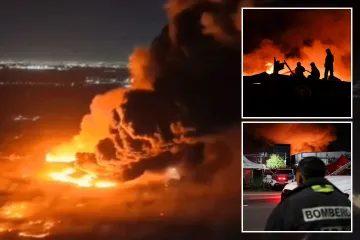
THIS is the horrifying moment a towering 30ft wave swallowed a crowded beach in Argentina, killing one and injuring dozens more.
Terrifying footage from the coastal town of Santa Clara del Mar shows the sea surging suddenly inland, racing across the sand and catching sunbathers completely off guard.
What had been a calm summer day erupted into chaos in seconds.
Beachgoers can be seen sprinting for their lives as panic reverberates through the crowd.
Umbrellas topple and bags are swept away as the shoreline vanishes beneath a mound of water.
While the main wave itself isn’t visible in the footage, eyewitnesses told local media it rose to an astonishing 30ft before slamming into beachgoers.
Read more about Argentina
A 29-year-old man, reportedly visiting Argentina to see family, was tragically killed after being dragged out to sea and smashed head-first into rocks.
When the waves finally subsided, lifeguards rushed into the surf in a desperate attempt to save him.
They performed CPR at the water’s edge, but the victim could not be saved.
The devastation did not end there.
Another man suffered a heart attack after being pulled into the water, and at least 35 others were injured.
Experts believe the deadly surge was caused by a rare phenomenon known as a meteo tsunami – a freak event that behaves much like a traditional tsunami, but without an earthquake.
Witnesses reported seeing the sea eerily retreat moments beforehand, before waves rushed ashore, driven by sudden drops in atmospheric pressure and volatile weather systems.
“It’s an unpredictable event; we don’t know if it could happen again,” said Fabián García, head of Civil Defense for the province of Buenos Aires.
Lifeguard union head Nahuel Nardone said the waves reached “unimaginable heights”.
Nardone said the phenomenon is extremely rare for the region, describing it as a kind of “mini tsunami” driven not by seismic activity, but by violent shifts in air pressure and powerful winds.
What is a meteo tsunami?
METEO-TSUNAMIS are a freak weather phenomenon that causes large, tsunami-like waves.
They are triggered by disturbances in air pressure caused by fast-moving weather events, like thunderstorms, and are generated when rapid changes in barometric pressure cause the displacement of a body of water.
Most tsunamis are geological, meaning they are triggered by vertical movement on the seabed, which can be caused by an earthquake or landslide.
The difference with a meteo-tsunami is that they are created by the weather.
A small, rapid change in atmospheric pressure – even by a few millibars – can change the sea surface elevation by a few centimetres.
This elevation can go unnoticed in deep water, but in shallower water near shorelines, it can cause the sea level to rise significantly, often by several feet.
They can reach heights of six feet and more, and have been observed in many places around the world, including Gulf of Mexico, Atlantic Coast and the Mediterranean
Those on the beach spoke of terror and desperation as the surge tore through the sand, sweeping away chairs, towels, and personal belongings.
Strangers clung to one another to avoid being dragged out to sea.
One witness recalled how the sea suddenly drained away, moments before a massive wave “like a wall” came crashing ashore.
García confirmed the unusual water behaviour affected several coastal towns, including Mar Chiquita, Santa Clara del Mar, and Mar del Plata.
Authorities ordered the evacuation of all nearby beaches, while emergency crews fanned out to hospitals and health centres to check on the injured.
Experts later agreed the lethal wave was a random, isolated episode, with the most severe impact concentrated in Mar Chiquita.
The danger then spread further south.
Flash flooding was reported in Mar del Plata, where lifeguards carried out emergency rescues after water levels surged from waist-high to neck-high in mere seconds.
This is not the first time a meteo tsunami has disrupted a tourist hotspot.
In 2024, panicked visitors scrambled as a similar wave struck Menorca, submerging tens of sun loungers under water – though fortunately, nobody was injured.
Just 24 hours earlier, another meteo tsunami hit the shores of Majorca, where the sea level rose sharply, flooding parts of Puerto Alcudia on the island’s northeast coast.