The Milky may not have a supermassive black hole at its centre, scientists claim.
Until now, it has been widely believed that our galaxy contains both a supermassive black hole at its core and a diffuse ‘halo’ of dark matter.
The enormous gravity of a black hole would explain the orbits of so–called S–stars, which spin around the core at speeds of a few thousand kilometres per second.
Meanwhile, the gentle tug from the cloud of dark matter is said to explain why our galaxy’s rotation doesn’t slow down dramatically towards the outer rim.
Now, scientists from the Institute of Astrophysics La Plata have put forward an alternative theory.
They suggest our galaxy might actually rotate around an enormous clump of mysterious dark matter.
Dark matter is the invisible substance that can’t be seen by our telescopes but is estimated to make up over a quarter of the universe.
According to the experts, a super–dense clump of dark matter would explain both the violent dance of stars near the galactic core and our galaxy’s gentle rotation.
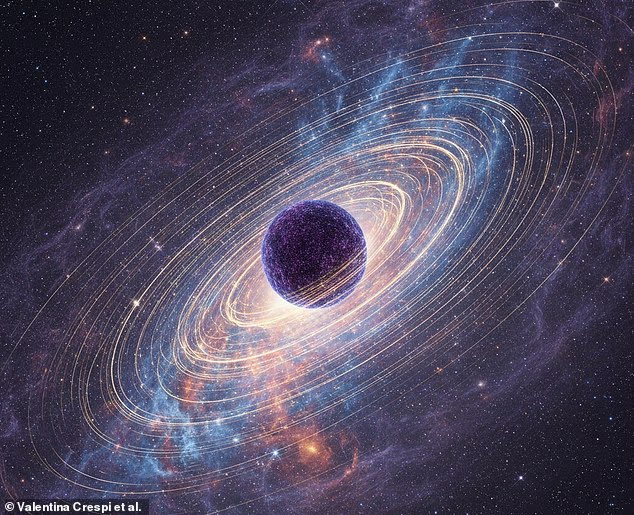
There might be black hole at the centre of our galaxy, but rather an enormous clump of mysterious dark matter (artistic impression), according to scientists

The conventional theory is a supermassive black hole named Sagittarius A* (artist’s impression) at the centre of the Milky Way is responsible for the galaxies rotation, but scientists now say dark matter could produce the same effects
Study co–author Dr Carlos Argüelles, of the Institute of Astrophysics La Plata, says: ‘We are not just replacing the black hole with a dark object; we are proposing that the supermassive central object and the galaxy’s dark matter halo are two manifestations of the same, continuous substance.’
The key to this surprising suggestion lies in a very specific form of dark matter composed of particles called fermions, which are extremely light subatomic particles.
In theory, these particles could form a super–dense, compact core, surrounded by a diffuse halo that would act as a single, unified entity.
The dense core would explain the fast movement of the S–stars, while the outer halo could explain the broader movements of the galaxy on the grandest scale.
‘This is the first time a dark matter model has successfully bridged these vastly different scales and various object orbits,’ says Dr Argüelles.
Crucially, this theory can also explain one of the most important observations we have of the Milky Way’s inner core.
In 2022, scientists from the Event Horizon Telescope Collaboration used an Earth–spanning network of telescopes to take the first image of the galactic core.
What they observed was a bright halo of light surrounding something dark, which was believed to be the black hole Sagittarius A*.

The researchers say that their theory is compatible with the image of the galactic centre which is believed to show the supermassive black hole Sagittarius A*
Any theory that suggests there is something other than a black hole at the centre of the galaxy needs to explain how this picture might have come about.
Luckily, a recent study conducted by Dr Argüelles and another group of collaborators found that the light generated by matter swirling around a dense clump of dark matter produces an image strikingly like the Event Horizon Telescope image.
Lead author Valentina Crespi, a PhD student at the Institute of Astrophysics La Plata, says: ‘Our model not only explains the orbits of stars and the galaxy’s rotation but is also consistent with the famous ‘black hole shadow’ image.
‘The dense dark matter core can mimic the shadow because it bends light so strongly, creating a central darkness surrounded by a bright ring.’
According to the researchers, our current observations of stars surrounding the galactic core are equally compatible with the black hole and fermion dark matter models.
However, they argue that the dark matter theory is preferable because it explains the structure and behaviour of the Milky Way with a single unified object.
In the future, more precise observations will be necessary to determine with certainty what lies at the heart of the galaxy.
For example, extremely sensitive instruments might be able to detect the signature of ‘photon rings’ – a tell–tale sign of black holes that would be absent in the dark matter scenario.