Ocearch Senior Veterinary Scientist Dr. Harley Newton joins FOX Weather to talk about the recent shark encounters her team has had tagging sharks off the coast of Florida.
JACKSONVILLE, Fla. – New research from scientists reveals that the Gulf of America serves as an ideal destination for great white sharks during the winter.
OCEARCH experts tracked the movements of 92 great white sharks who were tagged while traveling between Nova Scotia, Canada and Jacksonville, Florida.
FOUR WHITE SHARKS PING IN THE GULF JUST IN TIME FOR SPRING BREAK
A recent study revealed that the Gulf of America serves as a regular winter habitat for white sharks migrating thousands of miles from Atlantic Canada and Northeastern U.S.
OCEARCH is a global nonprofit organization dedicated to researching and protecting sharks, whales, sea turtles and other ocean life, tagging these animals to track and study their migration habits and behaviors from afar.
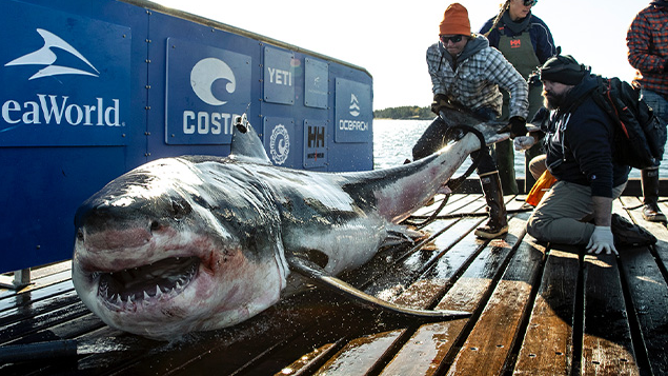
OCEARCH scientists handle a massive great white shark on a dock while conducting research.
(OCEARCH)
Through various methods such as satellite-linked smart positioning and acoustic tags, researchers discovered that 57 of the 92 sharks, across all life stages, spent significant time in the Gulf of America.
“Each year, white sharks migrate from summer/fall feeding grounds in Atlantic Canada and the northeastern United States to warmer winter habitats farther south,” OCEARCH said in a press release.
This time frame for winter residency of the white shark is primarily from December to May.
10-FOOT WHITE SHARK PINGS ‘TIGHT TO THE BEACH’ OFF NORTH CAROLINA COAST JUST AHEAD OF SPRING BREAK
According to experts, tracking data shows most of the 57 sharks frequently moving along the edge of the West Florida Shelf, with notable activity near Pulley Ridge, which is a reproductive reef system off the coast of Southwest Florida.
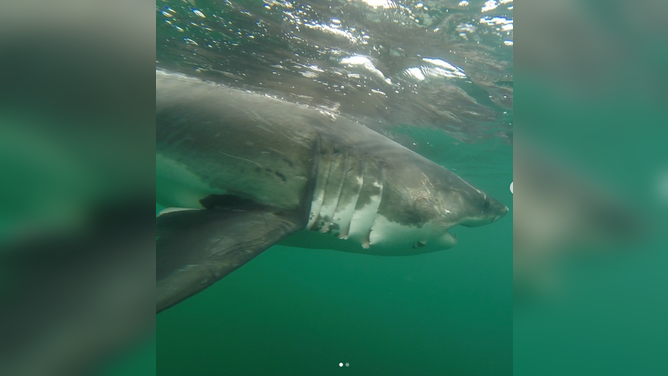
Ernst, the great white shark, has gotten the attention of scientists amid increased activity.
(OCEARCH / Instagram)
Researchers observed that the sharks spent most of the time in the upper layers of the ocean, sometimes diving vertically into larger depths. Experts say that this sort of behavior is commonly associated with hunting certain prey.
HERE’S WHAT YOU NEED TO KNOW TO STAY SAFE AT THE BEACH DURING SPRING BREAK
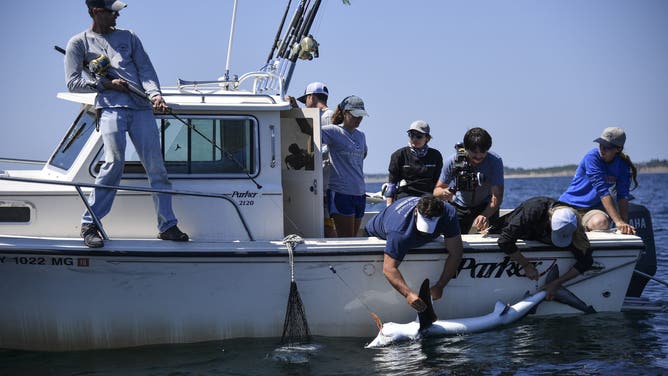
MONTAUK, NY – AUGUST 9: Captain Greg Metzger, left, holds on to a fishing pole with a six and a half foot blue shark as Dr. Matt Ajemian, research professor Florida Atlantic University Harbor Branch Oceanographic Institute, center front, and Lisa Hoopes, nutritionist Georgia Aquarium , front right, draw blood, measure and try to get a tissue sample from the shark just offshore in the Atlantic Ocean on August 9, 2017 in Montauk, N.Y. Captain Greg Metzler is a high school marine science teacher and assists the crew of the OCEARCH in catching shark from his own boat.
(Ricky Carioti/The Washington Post / Getty Images)
Water temperatures also play a role, ranging from 70 to 75 degrees in the Gulf waters during the winter months.
In the past, great white sharks were considered to be occasional visitors of the Gulf of America, but this new research demonstrates that the region has a reliable habitat for the apex predators to thrive and rebuild their numbers after decades of overfishing.
Studies from these tags allow scientists to map shark movements across thousands of miles and discover more information on the breeding habits of the large species.