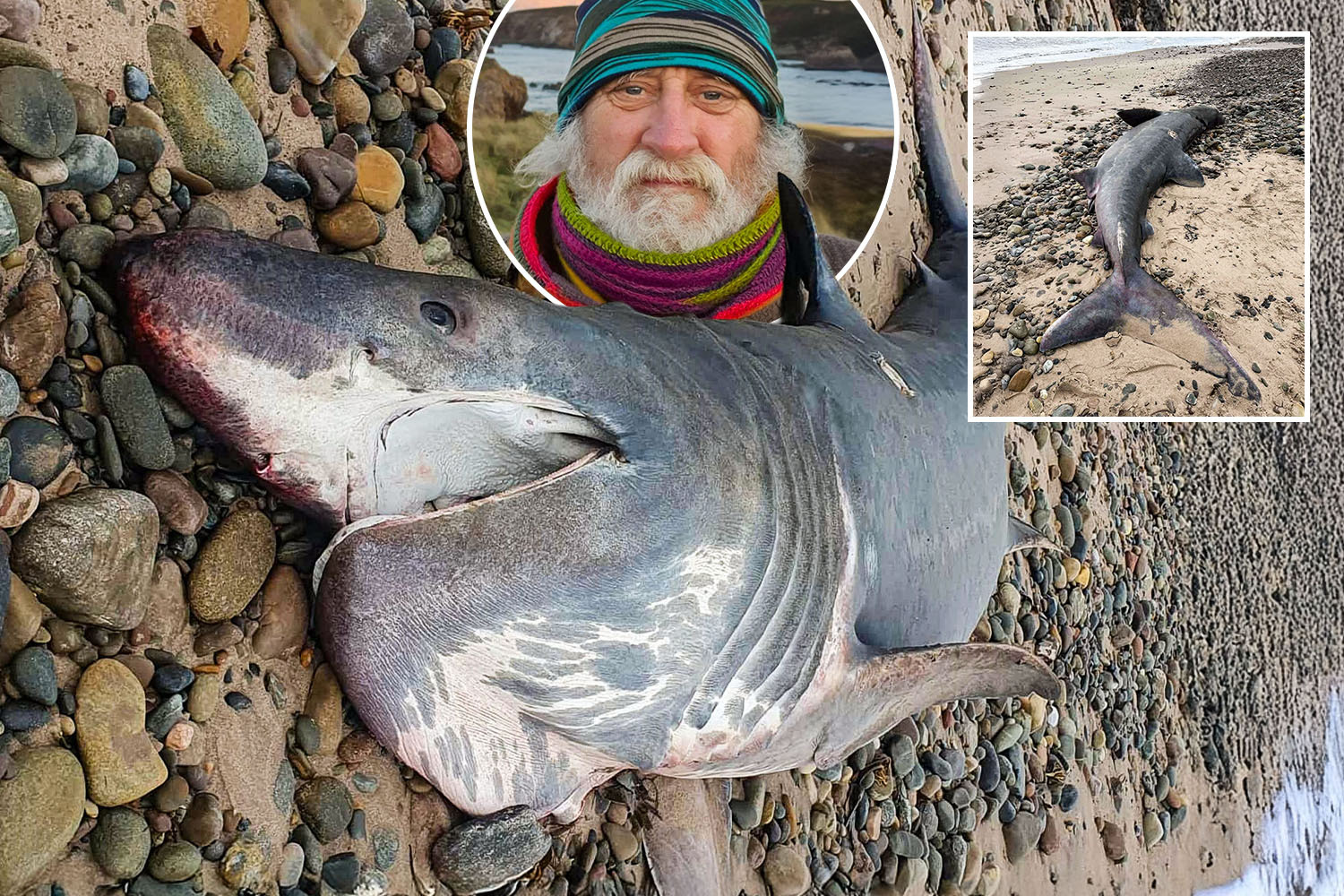
A HUGE shark has washed up on a Scottish beach for the third time in weeks.
The 12-ft-long animal was discovered at a beauty spot in Portgordon, Moray, by local man Peter MacDonald.
Experts said it was a juvenile basking shark and were working to establish the cause of death.
It comes after a blue shark and a porbeagle shark also washed up on beaches in the same general area of north-eastern Scotland.
Peter said he was saddened after finding the shark and told What’s The Jam is it “the yin and yang of wildlife at Portgordon”.
He added: “The sad sight of a young basking shark about 12ft long. I’ve never seen one beached before.
“Though last year we had over 35 swimming in Moray Firth. Some were very close in.
“This year we had the same number but in different areas.”
Experts from Shark and Skate Scotland examined the shark, but they said they were baffled by how it came to be on the Scots beach.
A spokesperson said: “We carried out a necropsy on the deceased male basking shark that had been reported to have washed in at Portgordon.
Most read in The Scottish Sun
“This shark was still immature.
“When fully grown, this species can reach more than double this individual’s length.
“They are the second largest fish in the world, the largest being the whale shark.
“There was no obvious cause of death.
“However, we have taken several samples which will be analysed to hopefully give more insight.
“Due to the shark’s size and location, it has been left in situ on the beach to decompose.
The sad sight of a young basking shark about 12ft long. I’ve never seen one beached before
Peter MacDonald
“Although it may also be carried out or moved along the coast with the upcoming spring tide.”
In October, Joy Peacock discovered a nine-foot-long blue shark at St Ninian’s in Shetland.
At the time, Joy, from East Yorkshire, said: “I was very sad to find it like that. It wasn’t really what I expected to see.”
And a few days later, walker Annemarie Simpson was shocked after finding a fearsome-looking cousin of the great white shark washed up on shore.
Scotland’s Shark Species

There’s a number of sharks that are found in Scottish waters. Here’s some of the most interesting.
Basking shark
Basking sharks are the second-largest fish in the world but usually only eat plankton by swimming through the water with their mouths wide open.
You’re most likely to see this species just off the Scottish shoreline in summer since the temperatures are warmer.
Their hotspots are in the Isle of Skye and the Isle of Mull in the Scottish Hebrides.
Porbeagle shark
A bit chunkier than your average shark, this species can be found several miles offshore because they prefer the deeper water there.
They like to eat mackerel and herring and will also feed on bottom-dwelling fish too.
The porbeagle shark is closely related to the great white shark as both are from the Lamnidae family
Shortfin mako shark
Mako’s are also unlikely to attack humans and typically make seasonal appearances in Scottish waters.
They are one of the fastest shark species in the world and can survive in much colder waters – raising their body temperature higher than that of the depths.
They’re found in many different parts of the world – including off the coast of Aberdeen more recently after an oil rig worker filmed one.
Dogfish shark
While most sharks have blue or grey colouring, dogfish sharks have tan bodies with dark brown spots.
They usually only grow up to 3ft in length and fishermen often see them as nuisances, because they can get caught in fishing nets or take bait meant for much larger fish.
It’s not easy to spot them because they prefer sandy ground and tend to live and feed close to the seabed.
The six-foot-long porbeagle was already dead when spotted on rocks at Wick, near John o’ Groats in the Scottish Highlands.
NHS worker Annemarie said: “I much prefer seeing them in the sea where they belong.
“In Caithness, we love our nature. We see a lot of orca here, so watching the coast is common.
“A porpoise or a risso dolphin is sometimes found on the shore.
“But a porbeagle shark, although known in our waters, is definitely a much rarer find onshore.


“I reported it, and scientists are coming out later to take a sample to get more information on cause of death, condition and age.”