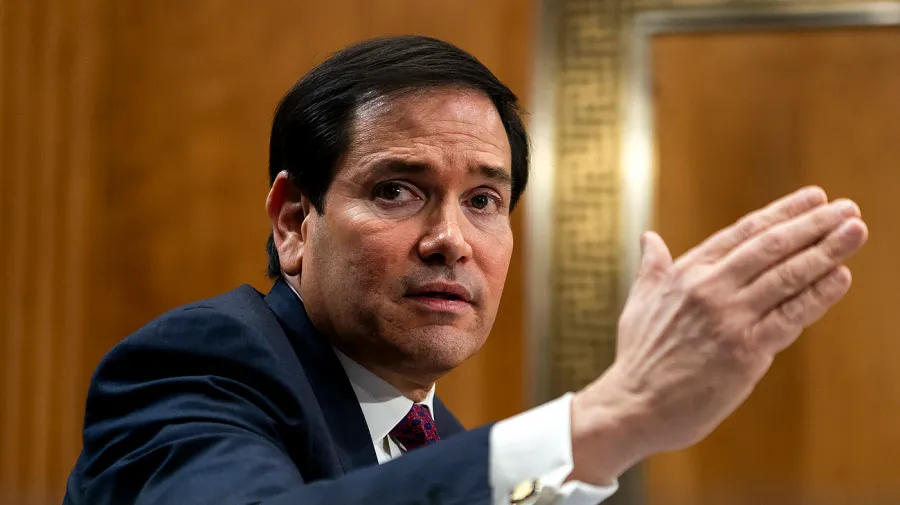
Secretary of State Marco Rubio on Wednesday urged patience on U.S. efforts to rehabilitate Venezuela’s oil industry and eventually return the country to democratic governance.
The secretary’s remarks came during a hearing of the Senate Foreign Relations Committee, Rubio’s first appearance before lawmakers since the Trump administration’s audacious operation that resulted in the capture of Venezuela’s president Nicolás Maduro earlier this month.
Rubio, who also serves as national security adviser, did not rule out the potential for President Trump to order another military attack against Venezuela, but he cautioned that the U.S. is not positioned to take immediate action.
The former senator from Florida fielded nearly three hours of questioning, with Democrats grilling him on Trump’s disregard for legal guardrails. Frustration emerged on both sides of the aisle over the administration icing out the legislative branch.
“I was a big fan of consultation when I was sitting over there,” Rubio remarked.
“Now it’s a different job, different time,” he joked.
Here are five takeaways from Rubio’s hearing:
Rubio doesn’t take military force off the table
Rubio said Trump reserves the right to use military force if Delcy Rodríguez, Venezuela’s interim president and a former Maduro deputy, fails to cooperate fully with U.S. demands.
“The president never rules out his options as commander in chief to protect the national interest of the United States,” Rubio said.
“I can tell you right now with full certainty, we are not postured to, nor do we intend or expect to have to take any military action in Venezuela at any time. The only military presence you will see in Venezuela is our Marine guard.”
Rubio previously assured senators that U.S. military operations in Venezuela were limited to the few hours it took to capture Maduro, as part of the administration’s push to kill a war powers vote in the Senate earlier this month.
Rubio raised a hypothetical situation in which the U.S. would take military action abroad, such as if Iran were to establish a military drone production facility. But in prepared remarks delivered to the committee for the record, Rubio said the U.S. is prepared to use force to “ensure maximum cooperation.”
Rubio sets low expectations for pace of change
The secretary laid out the administration’s three-phase plan for the U.S. to oversee a transition in Venezuela from a corrupt, authoritarian, drug-smuggling regime to democratic governance, but he did not offer a timeline or end date for lawmakers.
“I can’t give you a timeline of how long it takes, it can’t take forever, it’s not even been four weeks,” Rubio said, but he added there needs to be more progress in three months’ time and six months’ time.
During another exchange, Rubio said he could not guarantee that change would happen at all.
“Other than more sanctions and more speeches and more threats and whatever, it was a frozen situation,” Rubio said of past efforts toward Venezuela. “Now, for the first time in literally a decade, there is the opportunity that something could change. There’s not the guarantee that something will change, but there is the opportunity that something will change.”
Rubio was scheduled to meet with Venezuelan opposition leader and Nobel Peace Prize winner María Corina Machado at the State Department on Wednesday. Trump has said Machado — whose surrogate Edmundo González won the 2024 presidential election, according to international observers — does not have the “respect” to run the country.
“I talked to her last week and she was very disappointed in those comments, and so were Venezuelans in my state,” Sen. Tim Kaine (D-Va.) told Rubio.
The secretary replied “sure” when asked by Kaine if he respects Machado.
“The president is acknowledging, today as it stands, whether we like it or not, the elements of control in that country, the people with the guns, and the institutions of government there are in the hands of this regime,” Rubio said.
Rubio says current oil scheme is short-term fix
Lawmakers questioned Rubio on the administration’s moves to take over Venezuela’s oil exports, which appeared to confuse senators on both sides of the aisle.
Rubio corrected Sen. John Barrasso (R-Wyo.) that the U.S. was not imposing a “blockade” on Venezuela, saying that would be an act of war, but that the U.S. had a quarantine in place to control the oil exports.
Rubio said the U.S.’s engagement with two trading companies, Trafigura and Vitol, to quickly sell off Venezuelan oil was “a short-term fix” to a “short-term” problem, as it seeks to stabilize the country after Maduro’s capture. Rubio argued if the oil wasn’t sold quickly, Venezuela would have run out of storage space and been forced to halt production.
“We had to move that oil very quickly. The long-term plan is not those two trading companies. The long-term plan is for them [Venezuela] to have a normal energy program that sells directly into the market, to refineries and to companies that are exploiting and exploring it,” he said.
Rubio also defended the administration’s takeover of Venezuela’s oil revenues to fund basic operations and government salaries. Rubio said the Venezuelan government will submit a budget request to the U.S. and that oil proceeds will also fund a U.S. audit.
“We haven’t finalized what that audit process would be. We’ve only made one payment and that payment we did, and retrospectively will be audited,” Rubio said.
Rubio said about $200 million from an initial $500 million was still being held in a bank account in Qatar, but it would eventually be transferred to a U.S. Treasury account. Asked what U.S. statute allowed such an arrangement, he said Venezuela had agreed to it.
Both sides frustrated with lack of transparency
A few Republicans on the committee mirrored Democrats’ frustration with the administration’s lack of communication of plans, consultation with Congress and transparency on its actions overseas.
Sen. John Curtis (R-Utah), chair of the Senate Foreign Relations subcommittee on the Western Hemisphere, which is also Rubio’s old seat, said the State Department had rebuffed his requests to participate in hearings on Venezuela and the Western Hemisphere and initially refused to brief him on the administration’s strikes on alleged drug boats in the Caribbean.
“I do think the administration could get Congress to be a better partner by informing us better,” Curtis said.
Sen. Rand Paul (R-Ky.), an outlier among Republicans in opposing the administration’s justification for the military strikes in the Caribbean and the operation to capture Maduro, doubled down in questioning Rubio.
Paul, who co-sponsored with Sen. Tim Kaine (D-Virg.) a war powers resolution on Venezuela, dismissed the administration’s argument that it’s not in a state of war with Venezuela.
“Our arguments are empty, the drug busts isn’t really an argument, it’s a ruse, the war argument — not a war, is a war — is a ruse, it’s not a real argument. We do what we do because we have the force, we have the might, because it’s in our interest,” he said.
“I think the arguments are invalid,” he added.
Democrats defend Greenland, NATO against Trump
Democrats also confronted Rubio on Trump’s threats against Greenland, arguing the president’s inciting rhetoric against NATO allies — even as he has ruled out taking the island over by military force — is weakening transatlantic relations and driving democratic partners into the arms of adversaries such as China.
“President Trump’s threats to take Greenland have shaken public confidence in the United States to the core,” Sen. Jeanne Shaheen (D-N.H.), ranking member of the committee, told Rubio after she returned last week from a bipartisan delegation to Denmark.
“I heard from one Danish American woman whose son holds both citizenships and is approaching conscription age. She is worried that her son might one day be forced to choose between the two countries he loves.”
Sen. Chris Coons (D-Del.) led the bipartisan delegation. He called Trump’s denigration of NATO troops who fought alongside the U.S. in Iraq and Afghanistan “appalling.”
Coons said the president’s words “profoundly harm our security” and called for Rubio “to do everything you can to reinforce our commitment to NATO.”
Trump caused a firestorm in Europe and Canada last week when he said NATO troops “stayed a little back” from the front lines of the U.S.-led wars.