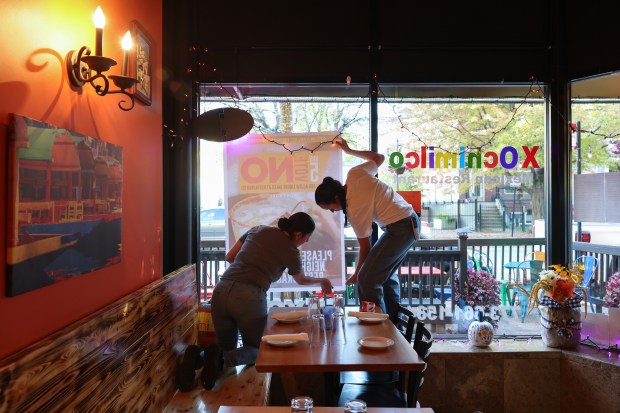
For lack of a margarita, customers have walked out of XOchimilco Mexican restaurant in Lincoln Square.
When the owners applied for a liquor license and passed inspection last year, they thought it would be a simple matter. Then they found out about the liquor ban.
They learned their business was located in a small, three-block long dry district. Restaurants across the street could sell liquor, but they could not.
So owners Lucia Herrejon and Epifanio Benitez started a petition drive to ask voters to allow liquor in the precinct. Herrejon went door to door collecting 150 signatures, enough to put the question on the Nov. 5 ballot. A loyal patron even set up a website in support of the ballot initiative.
“A lot of people were surprised,” Herrejon said. “They did not know this was a dry area.”
Small Cheval plans to open a location on the strip, and supports the proposal. A nearby Giordano’s could also take advantage of it.
The area in question lies between Lincoln, Montrose, Damen Avenue, and Sunnyside Avenues.
The ban on booze dates back to 1907. As part of a backlash against public drunkenness, domestic violence and increased immigration, Chicago voters that year shut down drinking in 160 precincts, leaving half the city without saloons.
At the time, the Ravenswood Women’s Club campaigned against a proposed beer garden and amusement park called the Tyrolean Alps, according to a librarian at Northeastern Illinois University, Christina Cogswell, who wrote a history of the issue as her thesis.
Ravenswood had been an “aristocratic” suburb, largely of native-born white Protestants, before it became part of the city. Progressives of the time saw alcohol no longer as a medicine, but as a corrupter of character, particularly among German, Irish and other immigrants, Cogswell wrote. The temperance movement eventually led to the nationwide Prohibition of alcohol in 1920.
Adolphus Busch, co-founder of what became brewing giant Anheuser-Busch, and a group of brewers had great success running a Tyrolean Alps beer garden and amusement park at the 1904 World’ Fair in St. Louis. An influx of German immigrants had opened many such beer gardens and parks in the 19th century in Chicago and elsewhere, featuring food halls, shooting galleries, poetry readings, theater, and folk dancing.
But one such park — the nearby Riverview Park — bothered neighbors with late night music and carousing. Following the model of Chicago’s Hyde Park, which had banned drinking, the Ravenswood ladies wanted none of it.
One opponent of such parks called them “the resorts of thieves and rowdies.”

After the City Council tried to dodge the issue, under pressure from residents, they eventually voted the area dry.
Dry precincts are hardly a thing of the past, however. Chicago has scores of zones where drinking is prohibited around the city. Aldermen regularly approve new zones in response to residents’ complaints.
Present day 47th Ward Ald. Matt Martin said he supports revoking the prohibition in Lincoln Square.
Martin said he talked to chambers of commerce in the area that support the proposal.
“I feel this would be a very good idea to strengthen business in the neighborhood,” he said.
The only trick is, in an effort to comply with the law, the referendum was written in a backwards style: “Shall the prohibition of the sale at retail of alcoholic liquor be continued…?”
That means those who want to allow drinking would have to vote “no.”
“It’s kind of like a trick question,” Herrejon said. “No means yes.”
The added income would help restaurants struggling to make a profit since the COVID-19 pandemic.
“It would guarantee the doors stay open,” Herrejon said.