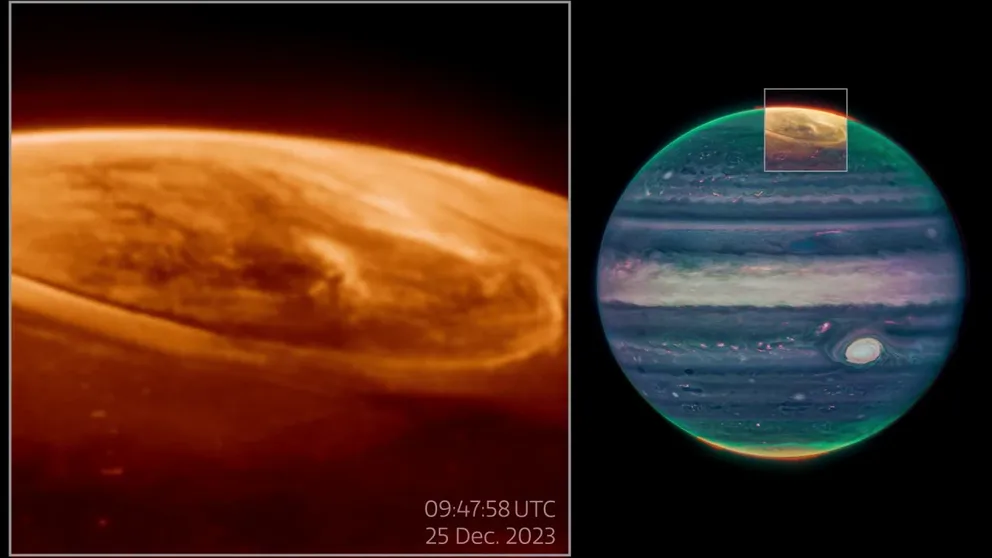
Many of us know Jupiter as the solar system’s largest planet, and while it still is, recent findings from NASA’s Juno mission reveal data that the planet is a little smaller and more “squashed” than initially estimated.
STORMS ON JUPITER GO DEEP BELOW ITS TURBULENT CLOUD TOPS, NEW STUDIES SHOWS
According to NASA, based on analysis of radio occultation data from 13 Juno flybys, scientists found that the planet’s equator is roughly 5 miles narrower, while its poles are about 15 miles flatter than previously thought.
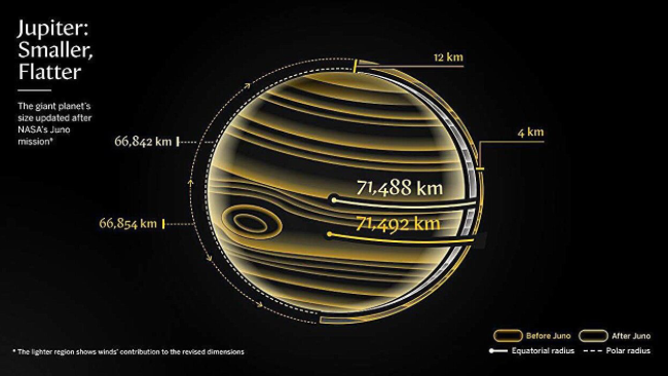
Image depicting Jupiter’s size update
(Weizmann Institute of Science / NASA)
Jupiter is a scientific powerhouse, providing immense knowledge as the largest and oldest planet with significant influence.
“Jupiter’s exact radius serves as a critical calibration standard for modeling giant exoplanets in other star systems,” NASA said.
5 NASA IMAGES THAT COMMEMORATE JUNO’S 50TH ORBIT AROUND JUPITER
The Juno mission is investigating Jupiter to understand its formation and evolution by examining the planet’s gravity and magnetic fields, enormous magnetosphere, and powerful auroras, while also exploring the swirling clouds that create its distinctive, colorful atmosphere.
The mission will also uncover Jupiter’s composition, including the amount of water it contains.
Radio occultation is used to “see” through Jupiter’s cloudy atmosphere and gain knowledge about its internal structure.
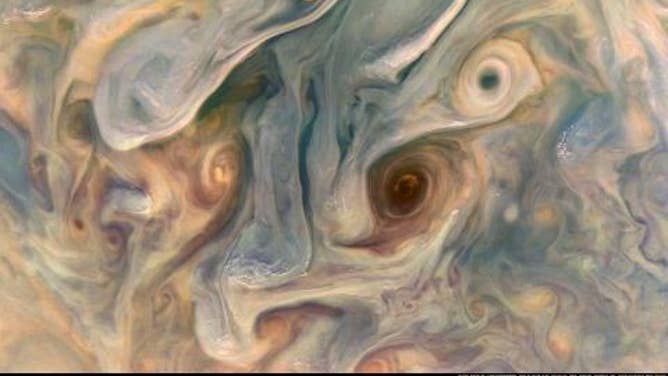
An enhanced Juno spacecraft image taken in July 2022 showing vortices and cloud “pop ups” in the Jovian atmosphere. (Image: NASA / JPL-Caltech / SwRI / MSSS / Björn Jónsson © CC NC S)
(NASA)
When conducting an occultation experiment, Juno sends radio signals to NASA’s Deep Space Network on Earth. As the signals travel through Jupiter’s charged upper atmosphere, they are bent and delayed by the gases.
By analyzing the resulting changes in frequency caused by the bends, scientists can determine the temperature, pressure, and electron density of Jupiter’s atmosphere at various depths.
SWIRLING CLOUDS OF JUPITER STAR IN NEW IMAGES CAPTURED BY NASA SPACECRAFT
According to NASA, “Previously, Jupiter’s physical dimensions were based on data from six radio occultation experiments performed by the agency’s Pioneer and Voyager missions in the 1970s.”
Research from Nature Astronomy explains that the new findings indicate winds high above the visible cloud tops show little vertical variation, highlighting a mostly barotropic environment.
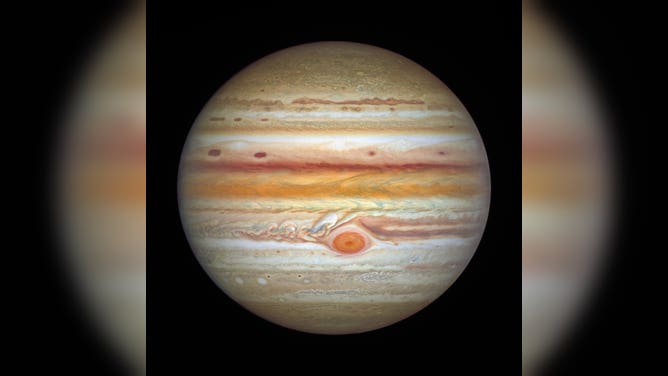
Hubble’s 2021 image of Jupiter tracks the ever-changing landscape of its turbulent atmosphere, where several new storms are making their mark and the planet’s equator has changed color yet again. Hubble’s 4 September photo puts the giant planet’s tumultuous atmosphere on full display. Image Credit: NASA, ESA, A. Simon (Goddard Space Flight Center), and M.H. Wong (University of California, Berkeley) and the OPAL team
(NASA, ESA, OPAL team)
“The updated shape has important implications for interior structure models, supporting a metal-enriched and cooler atmosphere, thereby helping reconcile discrepancies between models, Galileo probe measurements and Voyager-derived temperatures,” as reported in Nature Astronomy.
NASA shared that with a more precise shape, it will help astronomers understand data from planets seen passing in front of their host star well beyond our solar system.