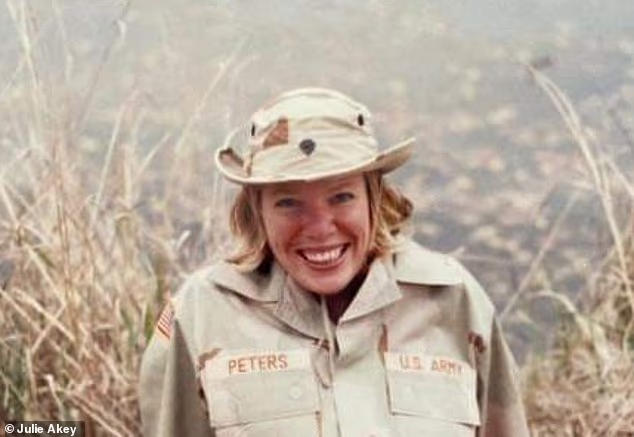
A woman in the prime of her military career was blindsided by a rare blood cancer, a diagnosis that sent her on a search that would unravel one of the Army’s buried toxic secrets.
Julie Akey, a former Army linguist stationed at California‘s Fort Ord in the 1990s, began suffering from searing bone pain and relentless fatigue in 2016. Just three weeks later, doctors told her she had multiple myeloma.
‘My world came crashing down,’ Akey told the Daily Mail.
‘The doctors said I didn’t fit the stereotype. Multiple myeloma is an old man’s cancer. More common in people of color. I was 46, healthy, and none of it made sense.’
It was not until she began digging through Fort Ord’s history, base logs, veteran forums and long-forgotten reports that she uncovered what she calls the true shock: the base had used Agent Orange to kill poison oak for decades.
Agent Orange, the infamous defoliant deployed in Vietnam, contained dioxin, among the most carcinogenic chemicals known to science. It has been tied to cancers, neurological disorders, diabetes, severe birth defects and structural heart disease. Worse, it lingers in soil and groundwater for decades.
Akey, now 55, believes Fort Ord’s toxic past caused her cancer, and she’s not alone. She maintains a growing database of former service members and families, including children, who lived on the base and later fell ill, which she said is a pattern that is hard to ignore. However, her doctors won’t ever say that definitively, she said.
Julie Akey, a former Army linguist stationed at Fort Ord in the 1990s, began suffering from searing bone pain and relentless fatigue in 2016. Just three weeks later, doctors told her she had multiple myeloma
Agent Orange itself was a mixture of two herbicides, but the ingredient linked to cancer is dioxin, specifically TCDD (2,3,7,8-tetrachlorodibenzo-p-dioxin).
TCDD is an extremely toxic byproduct that formed during the manufacturing of the herbicides.
It is the chemical associated with cancers, immune system damage, reproductive problems and long-term environmental contamination.
‘Myeloma makes up about two percent of [all new] cancer [diagenesis],’ she said. ‘But in my Fort Ord database, it’s closer to 15 to 20 percent. I don’t think it’s a coincidence.’
Fort Ord is one of at least 17 US military installations where Agent Orange was stored, tested or used.
Another issue with the chemicals was that the full dangers of dioxin were not disclosed and oversight was limited.
The controversy stems from the gap between what was known at the time, what was reported and what was later proven.
Poor documentation, leaking barrels and inconsistent safety practices added to the public’s distrust.
When the long-term health effects became clear, the lack of transparency and incomplete records made people question whether agencies were downplaying or hiding risks.

Akey’s world was shatter when she received the diagnosis. She was working at teh embassy in Brazil when she had to be medevacked to Ohio for treatment
Historical records show the Army sprayed more than 9,000 acres during Vietnam and Korea training cycles, a fact the Department of Defense still denies.
Fort Ord, which operated from 1917 to 1994, served as a crucial infantry training ground for both World Wars, the Korean War and the Vietnam War.
Akey’s symptoms began while she was working her dream job at the embassy in Bogota, Colombia.
‘I was so tired, sleeping at least 12 hours a day. I just worked and then took the armored shuttle home and went to sleep,’ she said.
‘I had a lot of bone pain too, but I just thought it was normal for approaching 50. A couple of times, I woke up in the middle of the night with a racing heart, got up, then passed out.’
She was transported by medevac to the Cleveland Clinic in Ohio, where doctors needed three weeks to reach a cancer diagnosis.
‘Agent Orange is known to cause multiple myeloma,’ Akey said. ‘So if it wasn’t Agent Orange, was it one of the other 60 contaminants found in the water?’
Akey has since been on a mission to prove Agent Orange was used at Fort Ord, keeping a rolling list of others who fell ill after being stationed on the base.
That includes veterans with lung cancer, lymphoma, ovarian cancer, neck and throat cancers.
While some of the cases go back to the 1990s, there are just as many diagnoses in the past few years.

Pictured are the remaining barracks on the base
The US Department of Veterans Affairs has recognized certain cancers and other health problems as presumptive diseases associated with exposure to Agent Orange or other herbicides during military service.
However, the VA does not include Fort Ord on its list of sites that stored or used the chemical.
The VA may exclude Fort Ord because its official records do not show verified evidence that the chemical was stored or used there.
Federal agencies only list sites when documentation is strong, consistent and confirmed by archived reports, environmental surveys, or military logs.
That does not automatically mean anything illegal happened. In many cases, records from older military bases were lost, incomplete, misfiled or kept by different branches that did not share information.
Some activities were also poorly documented by today’s standards. The Daily Mail has contacted the US military and the VA for comment.

Fort Ord, which operated from 1917 to 1994, served as a crucial infantry training ground for both World Wars, the Korean War and the Vietnam War
New evidence compiled by Denise Trabbic-Pointer, a retired chemical engineer, has claimed the Army extensively used herbicides containing the exact active ingredients of Agent Orange, 2,4-D and 2,4,5-T, at Fort Ord, California, for vegetation control as early as the 1950s.
Trabbic-Pointer retired in January 2019 after 42 years with DuPont and a spin-off company, Axalta Coating Systems, as their Global Environmental Competency Leader.
A 1980 Army letter shows that Fort Ord kept records starting in 1973, showing these chemicals were used regularly to kill weeds and clear vegetation.
Older reports also stated they sprayed large areas, sometimes hundreds of acres, with these herbicides at high levels, similar to how vegetation was cleared during the Vietnam War.
Hazardous waste records detailed how the base stored and threw away Agent-Orange–related chemical waste, sometimes up to 1,000 pounds a year.
In 1989 alone, Fort Ord recorded hundreds of pounds of weed-killing chemicals being used, according to the report.
Despite all this, the VA and the Department of Defense still say there is no proof that ‘tactical’ Agent Orange was used or stored at Fort Ord. Because of this, many veterans are denied benefits for cancers and illnesses linked to dioxin exposure.
And Fort Ord would not be the first American base facing such a threat.
In Gulfport, Mississippi, the Naval Construction Battalion Center stored approximately 840,000 gallons of Agent Orange between 1968 and 1977.
A federal health review later warned that activities such as transferring herbicides between drums may have caused spills, leaks and airborne contamination, affecting densely populated urban areas nearby, including Gulfport and Biloxi, which together were home to nearly 50,000 residents at the time.
Eglin Air Force Base in Florida conducted extensive herbicide testing from 1952 to 1969, including aerial spraying of Agent Orange and other chemicals.

Akey said the myeloma levels in my blood are low, compared to when I was diagnosed. Despite doing monthly chemo, they are increasing, and last month increased by almost 20 percent. Soon she will undergo her fifth treatment
Soil samples from the testing area decades later still showed the presence of TCDD, raising concerns about long-term health impacts for neighboring communities such as Valparaiso, Niceville and Fort Walton Beach.
Hilo, Hawaii, presents yet another case. In December 1966, drums of Agent Orange were briefly stored in the city, raising fears that leaks or mishandling could have tainted soil and groundwater.
A later state health department study confirmed significant dioxin contamination in local soil tied to pesticide operations that ran during the same era.
These sites, with their prolonged storage, intensive testing, or urban proximity, highlight the risk of civilian exposure to dioxin, which may help explain elevated cancer rates reported in surrounding counties.
Harrison County, Mississippi, for example, recorded cancer incidence rates of 470 per 100,000 residents, Okaloosa County, Florida, reported 450 per 100,000, and Hawaii County reported 410 per 100,000.
While no studies have definitively tied these numbers to Agent Orange, researchers have stressed that the gaps in data underscore the urgent need for further investigation.
Nearly three million Americans served in Vietnam, many describing the toxins that fell ‘like heavy rain.’
But far less attention has been paid to the stateside soldiers who trained on US soil already contaminated by Agent Orange, or to the civilians who lived next to their bases.
For families like New Jersey resident Julie DiMaria, the consequences are devastatingly personal.
Her husband, Ronnie, came home from Vietnam healthy in 1969. By 40, he’d had a massive heart attack. Soon after, strokes left him paralyzed. He died at just 43.
‘They still claimed it had nothing to do with Agent Orange,’ DiMaria said. ‘They gave you $1,000 a year, for four years — that was their payoff.’
The VA now recognizes more than a dozen medical conditions linked to Agent Orange. But advocates argue that stateside exposures remain largely ignored, including at Fort Ord.
The Department of Defense continues to insist the base is safe. Yet the new testing suggests a different reality: one where chemicals may still be moving through groundwater and air, decades after the last soldier left.
‘Almost 60 years later, this is still happening,’ DiMaria said. ‘And people don’t even know they might be living next to one of the most toxic legacies in the country.’