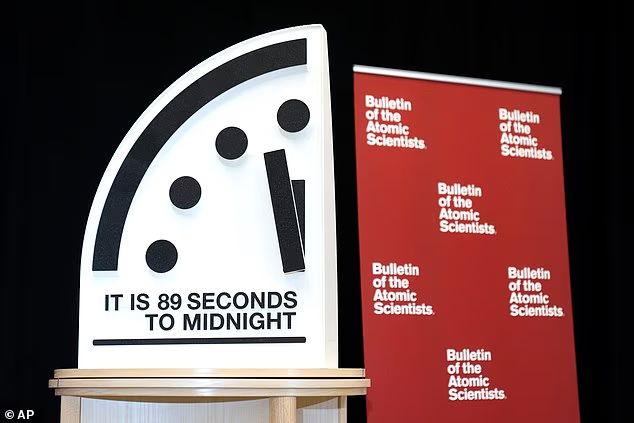
Is humanity doomed? We’re about to find out – as scientists prepare to update the Doomsday Clock tomorrow.
The new time for the symbolic timepiece, which ticks closer to midnight as we approach annihilation, will be revealed at 15:00 GMT on 27 January.
Since last year, the clock has sat at 89 seconds to midnight – the latest time in its 78–year history.
However, ahead of tomorrow’s grand reveal, experts have predicted the Doomsday Clock will move even closer to midnight.
While the clock was initially created to track the risk of nuclear war between Russia and America, the world now faces a far more diverse array of threats.
From rapid advances in AI to the looming threat of climate change, scientists ominously say it’s ‘inevitable’ the clock will move forward.
So, what is the Doomsday Clock, and what time will be it be updated tomorrow?
Here’s everything you need to know.
Is humanity doomed? We’re about to find out – as scientists prepare to update the Doomsday Clock tomorrow
What is the Doomsday Clock?
The Doomsday Clock is a symbolic timepiece showing how close the world is to a human–made global catastrophe, as deemed by experts.
It dates back to June 1947, when US artist Martyl Langsdorf was hired to design a new cover for the Bulletin of the Atomic Scientists journal.
With a striking image on the cover, the organisation hoped to ‘frighten men into rationality’, according to Eugene Rabinowitch, the first editor of the journal.
It came amid a backdrop of public fear surrounding atomic warfare and weaponry, just two years after the Second World War ended.
Every year, the clock is updated based on how close we are to the total annihilation of humanity (‘midnight’).
The clock is set by the Bulletin of the Atomic Scientists (BAS), a nonprofit organisation based in Chicago.
If the clock goes forward and gets closer to midnight (compared with where it was set the previous year), it suggests humanity is closer to self–destruction.

Experts say that increasing conflict between the leaders of global superpowers, such as Russian President Vladimir Putin (pictured), has increased the risk of nuclear war
But if it moves back, further away from midnight, it suggests humanity has reduced the risks of global catastrophe in the past 12 months.
In some years, such as 2024, the hands of the clock don’t move at all – which suggests the global situation has not changed.
When will it be updated?
BAS will reveal this year’s time in a livestream starting tomorrow at 15:00 GMT (10:00 ET).
The Daily Mail will be covering the announcement as it happens, so make sure you check back in tomorrow.
How do experts think the Doomsday Clock will change?
The Daily Mail reached out to some of the leading experts on existential risk and nuclear war – and the outlook for humanity does not look good.
Alicia Sanders–Zakre, head of policy at the International Campaign to Abolish Nuclear Weapons, told the Daily Mail: ‘In my opinion, the Clock could be moved forward by at least one second.

In 2025, Donald Trump ordered the Pentagon to start nuclear weapons testing on a level with China. Experts say that a nuclear war between superpowers is now increasingly likely. Pictured: An unarmed Minuteman III missile launched during testing in 2020
‘Our biggest concern is the existential threat posed by the more than 12,000 nuclear weapons in the world today.’
During 2025, Ms Sanders–Zakre says that nuclear weapons posed an ‘existential risk’ to the world’s survival.
Spending on nuclear weapons topped at $100 billion, and conflict between nuclear–armed neighbours India and Pakistan served as a chilling reminder of the risk.
While nuclear risk was a key factor for the BAS moving the clock forward last year, the expert says that the situation is now even more critical.
She adds: ‘While the risk of nuclear use has been an existential threat for 80 years, it has increased in the last year, due to skyrocketing investments in nuclear arms, increasingly threatening nuclear rhetoric and actions and the increasing application of artificial intelligence in militaries.’
While Ms Sanders–Zakre suggests the clock will only change by one second, others predict a more dramatic jump.
Dr SJ Beard, researcher at the Centre for the Study of Existential Risk at the University of Cambridge and author of ‘Existential Hope’, told the Daily Mail they think the clock should be moved nine seconds forward.
‘Personally, I am no longer so worried about nuclear weapons being used in a proxy war like Ukraine, but I am more worried than I have ever been about direct nuclear conflict between the world’s superpowers,’ says Dr Beard.
‘The multilateral world order is now totally collapsed, and we are already in a multi–polar reality, where all countries are having to pick a side between authoritarian strong men.’
As the US under Donald Trump’s administration asserts an increasingly dominating presence on the world stage, the rules of economic and foreign policy that previously governed the world are eroding.
If this leads to open confrontation between China, Russia, the US, and even European or NATO nations, the risk of nuclear war is significantly increased.
Dr Beard says that the risk of nuclear war might be slightly lower in the immediate short term due to the friendly relationship between Donald Trump and Vladimir Putin.
However, this is likely to become an issue in the long term since the two leaders are ‘unlikely to remain friends forever’.
Additionally, experts point out that imminent changes to the rules governing nuclear weapons will increase the risk significantly.
In three weeks, the New START Treaty, which limits nations’ strategic nuclear arsenals, is set to expire with no real framework in place to renew it.
Hamza Chaudhry, AI and national security lead at the Future of Life Institute, told the Daily Mail that this warrants moving the Doomsday Clock five to 10 seconds forward.

Risk experts point to Russia’s deployment of the nuclear–capable Oreshnik missile (pictured) as a sign of growing risk that could spiral into nuclear war
‘For the first time since the early Cold War, there will be no bilateral arms control treaty limiting US–Russian strategic arsenals,’ says Mr Chaudhry.
‘While President Trump has expressed interest in talks, as of today, there’s been no concrete progress. This represents a fundamental breakdown in the nuclear arms control architecture.’
At the same time, other factors include China’s rapidly growing nuclear arsenal and ‘fractured’ cooperation around Ukraine.
Mr Chaudhry says: ‘China is on a trajectory to match US and Russian ICBM numbers by the end of the decade.
‘China’s arsenal growth creates pressure on US planning, which creates pressure on Russian planning, in cascading spirals, and there’s no trilateral arms control framework.’
Mr Chaudhry also points specifically to Russia’s use of the Oreshnik missile, which had previously been exclusively used for nuclear warheads, and Ukraine’s targeting of Russian strategic bombers at Olenya airbase.
These factors represent a growing escalation risk which ‘could spiral into nuclear conflict.’
Beyond nuclear war, experts also warn that the growing danger of AI and climate change could push the Doomsday Clock closer to midnight.

The rapid development of artificial intelligence by companies like OpenAI, led by CEO Sam Altman (pictured), could exacerbate existing risks or turn AI into an existential threat in its own right

The clock dates back to June 1947 and was created by the Bulletin of the Atomic Scientists. Pictured: Dr Leonard Rieser, Chairman of the Board of the Bulletin of the Atomic Scientists, moves the hand of the Doomsday Clock in 1991
Dr Beard suggests that this will be the first year that AI ‘is given equal billing to nuclear weapons’.
Recent announcements that major military powers will integrate AI into decision–making systems create a risk that conflict might escalate faster than humans can control it.
There is also mounting evidence that AI increases the risk of annihilation through bioweapons by putting the tools to engineer viruses and proteins in non–state hands.
Likewise, as companies like OpenAI and Anthropic pursue super–advanced ‘artificial general intelligence’, Dr Beard says AI is now an ‘existential risk driver in its own right’.
Professor Andrew Shepherd, a climate scientist from Northumbria University, told the Daily Mail: ‘I would not be surprised to see the clock change once again.’
He adds: ‘Sadly, the past year has been another one of climate extremes for our climate.
‘In the cold parts of our planet, the most notable changes are a return to rapid ice loss in Greenland and a continuation of the rapid decline in sea ice in the Southern Ocean.
‘These changes have consequences felt by us all as they drive sea level rise and global warming through reductions in the planetary albedo.’