A US military drone expert has warned that Iranian attack drones could potentially slip through America’s defenses and strike targets on US soil.
Brett Velicovich, a former US Army intelligence and special operations soldier who spent years using drones to hunt ISIS leaders before founding drone company PowerUs, said the threat comes from a new type of warfare that the US is still struggling to defend against.
‘These new asymmetric threats, where you’ve got low-cost, cheap, small drones, in some cases, that are able to be sent in massive waves, don’t have the same signature of an intercontinental ballistic missile,’ Velicovich explained.
Because they fly slower and at lower altitudes, such drones can appear unusual or ‘funny’ to radar systems built to detect high-speed weapons.
Iran has spent years building a massive arsenal of so-called ‘kamikaze drones,’ which are designed to crash into targets with explosive payloads.
Iran’s drones, particularly the Shahed-136, are inexpensive, long-range weapons designed to crash directly into targets and explode, often launched in large waves to overwhelm air defenses.
The delta-wing drones are over 11 feet long, fly roughly 115 mph, and can travel more than 1,500 miles while carrying an explosive warhead weighing 44 to 88 pounds.
Built largely from cheap, commercially available parts, each drone costs roughly $20,000 to $50,000, making them far cheaper than the missiles often used to shoot them down.
‘They got a head start on us in terms of producing and manufacturing low-cost long-range attack drones,’ Velicovich said. ‘They’ve been preparing for this for a while.’
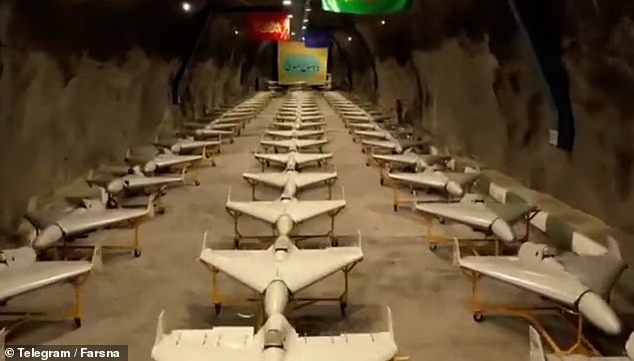
Iran has showed off a sprawling underground network of tunnels filled with row after row of drones and rockets
The warning comes as concerns grow over whether the US is prepared for the rapid rise of drone warfare.
A leaked federal alert warning that Iran could attempt a drone strike on California has sparked fresh questions about America’s defenses against the evolving threat.
The alert, issued by the FBI to law enforcement agencies across the state, suggested Tehran had previously considered launching unmanned aerial vehicles from a vessel offshore if the US conducted military strikes against Iran.
‘I think we should be taking it seriously,’ Velicovich said. ‘The FBI doesn’t put stuff out like that unless somebody had real credible reporting.’
He described the memo as a signal that US agencies are increasingly concerned about the vulnerability.
‘This FBI announcement is a wake-up call to shake the tree a bit and help people understand that we do have some gaps in our defenses, and we need to fix those gaps before an American gets killed,’ he said.
However, White House Press Secretary Karoline Leavitt has since dismissed the alert.
‘No such threat from Iran to our homeland exists, and it never did,’ Leavitt said Thursday.

While White House Press Secretary Karoline Leavitt has dismissed the alert about California, saying there is no threat, experts have noted the alert exposes serious gaps in America’s defenses against cheap, long-range drones capable of striking civilian targets

A leaked federal alert warning that Iran could attempt a drone strike on California has sparked fresh concerns about whether the US is prepared for a new era of warfare (STOCK)
Velicovich noted that Leavitt likely has access to the most reliable intelligence after she dismissed the alert and said there was no threat.
‘It’s possible that the memo got out of hand, and officials went back and asked, ‘Where did this come from?’ and tried to calm things down,’ he continued.
‘At the end of the day, the people who can actually see the intelligence are the ones who know what’s going on. But I will say this: the FBI shouldn’t be pushing out memos like that unless there’s something credible behind it.’
Chris Swecker, an assistant FBI director in the mid-2000s, told the Daily Mail that the alert was never intended for public consumption.
‘Many of these memos go out every day,’ said Swecker, adding that the next step is to ‘corroborate the threat and prepare for the worst.’
Velicovich said that while an immediate threat may be unlikely, particularly as Iran’s drone capabilities are degraded by ongoing military operations, the warning highlights a vulnerability that experts have been raising for years.

Footage released by the Fars News Agency, which is closely linked to the Islamic Revolutionary Guard Corps, shows long lines of missiles and Shahed drones
If Iran wanted to strike inside the United States, he said California could be an attractive target because of its massive population centers, tourism industry and economic importance.
‘I think California’s sort of this beacon of America and a beacon of freedom for the rest of the world,’ he said. ‘And so they want to strike that down.’
The state is home to some of the world’s busiest ports, major tourist destinations and large international events that draw millions of visitors each year.
Civilian infrastructure, such as hotels, ports or oil refineries, could be targeted to disrupt the economy and sow panic, he warned.
‘If you’re going to strike something using sort of the evil that is the Iranian regime’s thought process in terms of where to hurt civilians, California seems like an easy target to do that,’ Velicovich said.
The FBI alert reportedly suggested drones could be launched from a vessel positioned offshore.
But such an attack might not involve a suspicious military ship sitting off the coast.
Velicovich said adversaries could potentially hide drones aboard ordinary vessels that would not attract attention.
‘What if they were able, hypothetically, to take a yacht, or a fishing boat, or any type of boat that already exists that you wouldn’t even think twice about looking at off of Venice Beach?’ he said.
‘Underneath it are a bunch of drones that have been put on them to eventually strike.’
Such tactics fall into a category known as asymmetric warfare, where attackers exploit unexpected methods rather than traditional military deployments.
Velicovich pointed to 2024 drone operations in Ukraine, where hidden launch platforms disguised as normal vehicles were used to strike deep inside enemy territory.
In Ukraine, he noted, hundreds of drones are sometimes launched in a single night to overwhelm air defenses in what was called Operation Spiderweb.
Those drones often fly slowly and can remain in the air for hours, creating uncertainty about when or where they will strike.
The growing threat is particularly concerning as the United States prepares to host major global events such as the 2026 FIFA World Cup and the 2028 Summer Olympics in Los Angeles.
Velicovich warned that government agencies must move faster to strengthen defenses against drone attacks.
‘We need to move at the speed of war, not at the speed of bureaucracy,’ he said. ‘For a long time it’s been the opposite.’