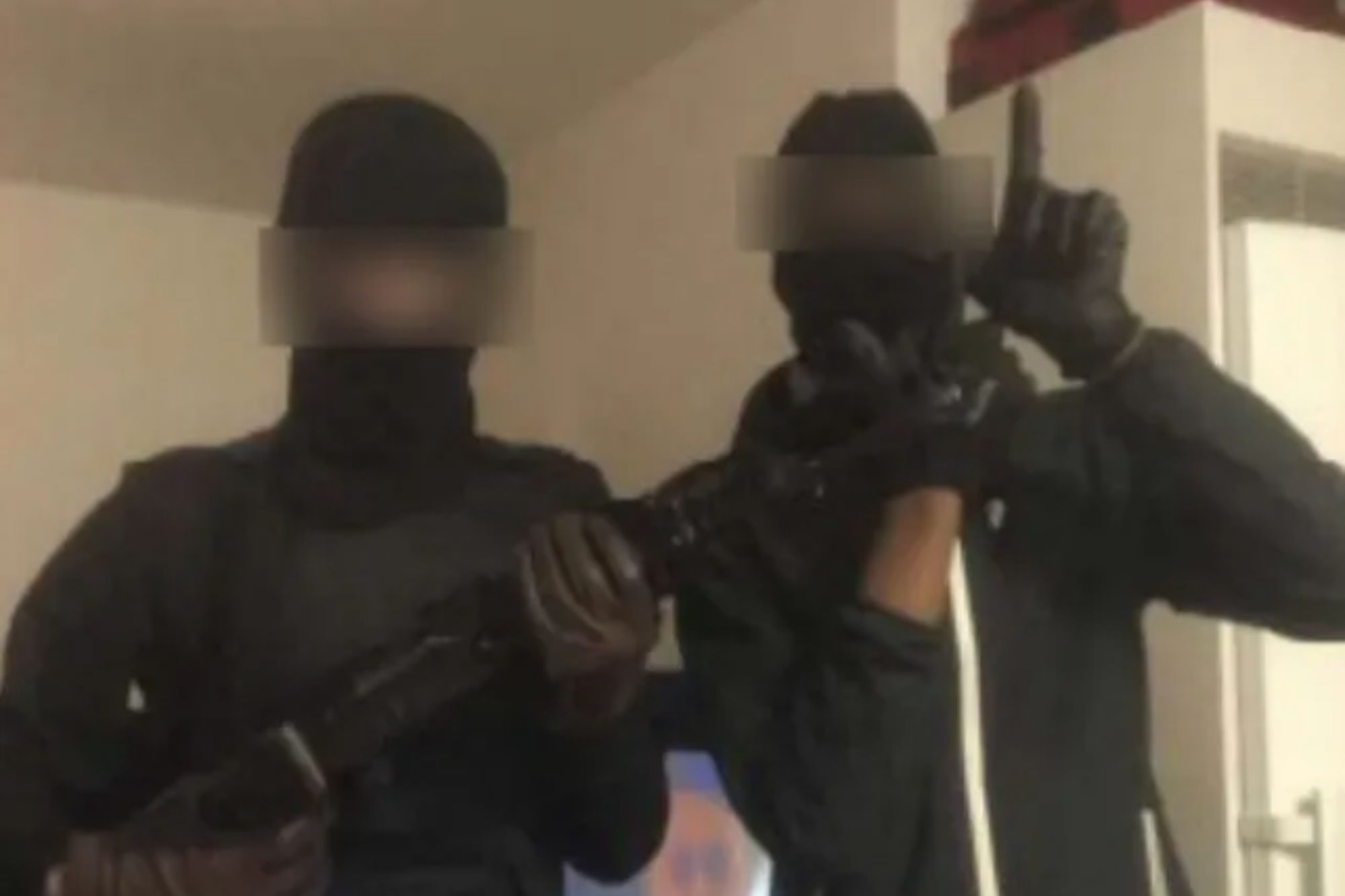
A MESSAGE pops up on a teenager’s phone: “Are you ready to murder someone?” – the child is told the target, handed a weapon, and sent onto the streets to wage war.
Across one European city, violent gangs are doing exactly that, sending child soldiers on the front line, recruiting them through TikTok and encrypted apps so they can carry out shootings, stabbings and bombings.
In Sweden, children as young as 12 are being used as “disposable” weapons by gangsters who know the law can’t touch them.
That’s because they have discovered a brutal “child soldier” loophole, which means youngsters can carry out horrific crimes on their behalf, because under-15s can’t be criminally punished.
The country of just 10.6 million people now records one of the highest rates of deadly gun violence in Europe, with gang feuds driving near-daily attacks.
Sweden’s gang violence has evolved from biker gangs in the 1990s, to localised street gangs in the 2010s, to today’s violent crime networks focusing on pushing high-value drugs such as cocaine.
Hand grenade attacks have become a grim hallmark of gang intimidation, thanks to a surplus smuggled from the Balkans after the 1990s Yugoslav wars, with bombs tossed at a doorway serving as a signature “warning” shot.
Police say criminal networks now operate a “business model” – using minors to carry weapons, carry out shootings and shield the adults giving the orders.
That model has surged in the past five years, as children have become younger and more central to the violence.
In 2024, in Gothenburg, a 14-year-old shot and killed a member of the outlawed biker gang Hells Angels, but despite being convicted, they were never sentenced – the hit was described as a “gangland contract killing”.
While an 11-year-old boy in the city of Örebro was offered $13,680 (150,000 kronor), clothes and transport by a 19-year-old handler to carry out a murder.
The child wrote on Instagram, “Bro, I can’t wait for my first dead body,” while the teen replied, “Stay motivated, it’ll come”.
In the shocking case, four men aged 18 to 20 were accused of recruiting four minors aged 11 to 17 to work for a criminal gang.
But these disturbing tactics don’t always work in the gang’s favour.
In one recent case near Malmö, a 12-year-old boy was detained after allegedly shooting dead the wrong man during a £20,000 contract hit.
Police believe the child had been recruited to assassinate someone else in the car and hit the wrong target.
Child soldiers recruited on TikTok
Sweden’s gang war has turned kids into cannon fodder – with criminal networks trawling TikTok, Snapchat and encrypted apps to find children to carry out stabbings, shootings and grenade attacks.
The recruitment is fast, direct and brutal.
In 2024, a 13-year-old boy was pulled into a private Signal group by a gang recruiter, Al Jazeera reported.
A message landed in the chat: “Are you ready to murder someone?”
The teen was fed “mentorship”, cash talk and reassurance – and then hard instructions.
He was told: “Go behind him one or two metres and shoot him three or four times in the back.”
He was warned: “If you take the weapon and disappear, we will come and find you, brother.”
Just before the planned attack, he was told: “It’s hard now, but later you’ll be a king, brother.”
The boy replied: “I will finish him.”
But moments later the teen began sending frantic messages, saying police or security were on their way and pleading for a taxi.
He had opened fire on his first victim – but the man survived.
Just 48 hours had passed from the moment the boy was added to the Signal chat to the shooting itself.
He was arrested soon afterwards, but because of his age he was neither convicted or sentenced.
Instead, the boy was placed in state care, under the supervision of social services.
Gangs use these kids because they won’t face heavy sentences, but also because they are seen as disposable.
Camila Salazar Atías,
Ardavan Khoshnood, associate professor at Lund University, has tracked the shift as it escalated from errands to executions.
It started with small jobs, such as moving weapons and drugs.
But children are now being pushed into the most savage work – shootings, stabbings and even bombings.
He told The Sun: “Initially, when the recruitment of children began in Sweden, it was largely for small assignments like moving weapons or drugs from point A to B. But today, it is much more. Now, they are directly involved in planning and committing homicides.
“Back in the day, criminals and gangsters would visit schools or specific areas to find these children, trying to manipulate them into joining.
“But they then began using social media – mostly Snapchat and TikTok, and a little bit of Instagram – to reach out to them.”
The Sun has approached TikTok for comment.
Snapchat did not wish to directly comment on the allegations but noted that the app employs “Family Center” tools that allow parents to monitor who their children are talking to.
And while the app is known for disappearing content, Snapchat confirmed they preserve reported or illegal material to assist law enforcement in criminal investigations.
‘Disposable weapons’
Camila Salazar Atías, a senior expert on Swedish gang crime at youth organisation Fryshuset, said gangs are using children because they’re useful – and expendable.
These kids aren’t trusted members as they’re not part of the inner circle.
They’re kept at arm’s length so the bosses stay protected, and nobody cares if the child gets caught, hurt, or dumped.
Atías told The Sun: “We are now seeing children committing crimes that were previously reserved for more ‘professional’ gang members.
“Gangs use these kids because they won’t face heavy sentences, but also because they are seen as disposable.
“They aren’t part of the gang or the inner clique; there are so many layers of separation between the leadership and the child that there is no relationship there. That sense of ‘I don’t want this to happen to you’ is gone – the child is completely disconnected from the gang.”
She continued: “They are treated as an instrument – like a bullet that can just be used.
“This is deeply problematic because they are exploiting the nature of being a child: the inability to understand consequences, the curiosity, and the ease with which they can be fooled, lured, or manipulated.
“Children also don’t have the capacity for revenge that an older member might have if betrayed. They are just disposable.”
Atías said most of the children pulled into gang violence are already known to social services or the police.
“These aren’t random kids appearing out of nowhere; we already knew they were at risk,” she explained, adding that many of the children who end up in juvenile hall or other institutions return to crime.
The legal loophole
Experts warn that children joining organised crime is becoming more common as gangs exploit a loophole in Sweden’s justice system.
Khoshnood explained: “An individual 14 or under cannot be held accountable for the crimes they commit.
“That means they cannot be put into prison, or nothing at all.
“So under the age of 15, you basically go free.”
That means a child 14 or younger cannot be prosecuted, convicted or jailed – even for the most serious violence.
Police can investigate, but the response becomes care under social services, not punishment.
The state can remove a child from the home under the local law of LVU (Care of Young Persons Act) and place them in a secure youth unit run by Sweden’s National Board of Institutional Care (SiS).
When the law was created, the belief was that children who commit crimes need help – that they were individuals who could be guided back on track. No one imagined Sweden would face this situation.
Ardavan Khoshnood,
But these aren’t prisons – and gangs know it, so they’re comfortable using these children for crimes as they won’t be locked up.
Knoshnood confirmed: “We know from various reports – especially from the police and the Swedish National Council for Crime Prevention – that these criminals are very aware that at just 13 years old, nothing will happen to these children.
“They believe the police will never catch them, and even if they are taken to court, nothing will happen.
“The absolute worst thing that can happen is that social services get involved in their case. We know this is exactly why criminal gangs and networks recruit these young people as they won’t suffer the consequences.”
“There is a special court proceeding to establish evidence of a crime committed by a person under the age of 15,” Khoshnood explained.
“You go to court to show that a 12 or 13-year-old boy has actually killed an individual, but there are no penalties for that.
“It is only for the court records; nothing will happen to them, and they won’t be tried once they get older. They can never be penalised for that crime.”
Even their record doesn’t stick, and the impact is obvious.
The expert continued: “The crime will stay on their record until they reach a certain age, at which point the record will be completely deleted.
“And these numbers and figures for individuals under the age of 15, they are sky high in Sweden today in comparison to earlier years.”
Tightening the law
Khoshnood said lawmakers never imagined organised crime would exploit Sweden’s welfare model in this way.
He says: “When the law was created, the belief was that children who commit crimes need help – that they were individuals who could be guided back on track. No one imagined Sweden would face this situation.”
That assumption is now under pressure. Parliament has passed a temporary law lowering the age of criminal responsibility to 13 for an initial two- to three-year period, after which it will be reviewed.
The political debate, he said, has shifted quickly toward tougher measures.
Atias argued early intervention must remain central.
She warned that focusing only on punishment risks gangs recruiting even younger children.
“We need to work early – not just with the child, but with the whole family and surrounding environment.”
She added schools and youth services need stronger support, particularly at a time of high youth unemployment.
Khoshnood said Sweden has made measurable progress against organised crime.
Shootings have declined, and police are solving a far higher share of gang-related homicides – rising from roughly 15–25% in the past to as high as 70–80% today.
More arrests and prison sentences have disrupted criminal networks.
“There is some light at the end of the tunnel,” he said.
Children, however, remain vulnerable. He supported lowering the age not as a deterrent, but as a way to separate young recruits from gangs.
“I don’t think children avoid crime because they fear prison. But if you remove a 12- or 13-year-old from a gang and place them in a structured juvenile facility with schooling and support, you can break that connection and potentially save that child.”
He cautioned that results will take time, saying: “It’s a step forward, but this will not be solved overnight.”
Inside Sweden’s descent into ultra-violence
SWEDEN has become a gangland bloodbath plagued by executions, bomb attacks, and child soldiers rampaging the streets.
More than 30 bombings rocked the country in January alone, mostly around capital Stockholm as ruthless drug gangs vied for supremacy.
Many of those involved are baby-faced hoodlums killing for cash and misplaced street credibility.
Innocent bystanders – including a 12-year-old girl – are being gunned down as a country that was once deemed peaceful and safe becomes a terrifying gangster paradise.
Prime Minister Ulf Kristersson admitted: “We don’t have control over the wave of violence.”
Sweden has grappled with gang violence for decades but the latest surge has been exceptional – fuelled by notorious druglords dubbed Kurdish Fox and The Greek.
As the conflict between gangs bleeds out of the inner circles and onto the streets, blameless teens are found dead near their family homes after being in the wrong place at the wrong time.
Human lives and family homes are being ripped to shreds amid the ongoing gang warfare, as the country chillingly reaches the highest level of children prosecuted for murder since 2019.
Read more here.