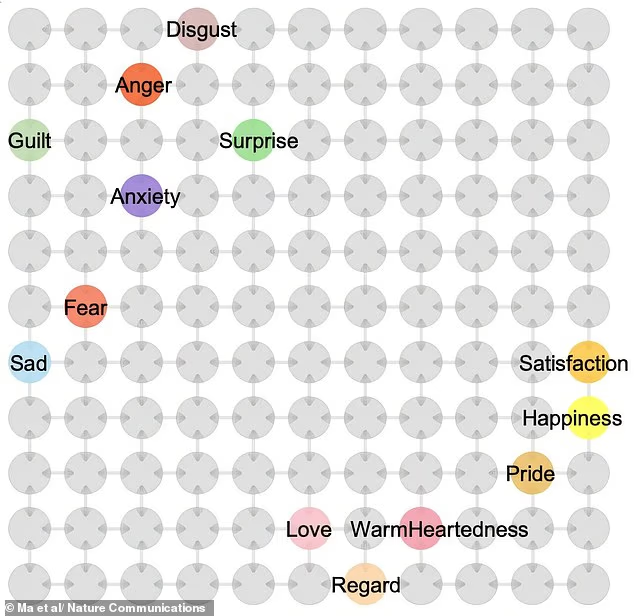
An incredible new map could help explain why anger feels similar to fear, and why being in love makes you feel warmhearted.
Researchers have used AI to analyse brain imaging data, revealing how we process different emotions.
They created an artificial ‘mental map’, with pleasantness along one axis and bodily reactions along the other, and charted how the brain responded while watching clips from films.
The results revealed clear groupings in the way that our brains represent emotion – with guilt, anger and disgust in one corner and happiness, satisfaction and pride in the other.
The findings could help explain why fear, anxiety and anger all elicit the same bodily response – rapid breathing and a beating heart – and all carry a similar level of unpleasantness.
Meanwhile love, pride and warmheartedness are all mapped closely together, showing how these emotions are also comparable.
‘People’s emotional experiences are subjective,’ first author Yumeng Ma, from Emory University in the US, said.
‘We’re using technology to understand the mechanisms underlying emotions in an objective, scientific way.’
The results revealed clear groupings in the way that our brains represent emotion – with guilt, anger and disgust in one corner and happiness, satisfaction and pride in the other
For their study, the team asked 30 participants to watch short, emotionally evocative film clips while rating their emotions.
These ratings were compared to brain MRI scans taken while they were viewing the movies.
The team discovered links between self-reported emotional experiences and MRI patterns in the brain.
Analysis revealed brains ’embed’ emotions in a map-like way.
‘For example, occurrences of anger and fear are often closer together compared to those of happiness and excitement,’ Ms Ma said.
The researchers hope to build on their findings by studying how this mental map may differ among those with mental health issues.
‘Research has shown that individuals with depression and anxiety represent emotions in a more compressed, less differentiated way,’ Philip Kragel, senior author, said.
‘And that people who represent emotion with more granularity and differentiation tend to have better health outcomes.’

The ‘mental map’ involved charting how pleasant or unpleasant an emotion was, along with how it prompted bodily reactions

The researchers used their ‘brain map’ to analyse how participants felt while watching film clips
They also want to explore how this mental map for emotions develops over time.
‘Emotions are central to human experience, they are not simply reactions to things,’ Dr Kragel said.
‘They are important to our success and to our well-being. They help us to communicate better, learn from our experiences, and empathize with others.’
He asked: ‘Are you born with the ability to form broad categories of emotion, such as good or bad, and then you gradually learn where to add more nuanced nodes on the graph?
‘Or maybe you’re born with the ability to learn general relational structures. Do the emotions come first? Or is it the other way around?’
The paper, published in the journal Nature Communications, says the findings ‘shed light on the long-standing observation that people report their feelings using a mental map’.
It adds that this map-like structure could be the product of computations performed in parts of the brain, rather than an actual representation of structure.
Last year, a different map revealed how the human body responds to 14 different common emotions.

Different parts of the brain that were studies as part of the research. The team said their findings could help study how people with mental health issues process emotion
They found fear hits you right in the chest, while depression causes numbness or a lack of feeling in the limbs and head.
Happiness is depicted as a wash of sensation that affects the entire body, while anger was found to trickle mostly up and down the arms and into the hands.
These maps were created by a group of researchers who asked study participants to think of a certain emotion and then paint where they felt stimulated by it onto a blank silhouette.
On a second silhouette, they were also asked to paint parts of the body that felt de-stimulated by the emotion.
While everyone’s paintings looked slightly different, averaging the maps together revealed signature patterns for each of the 14 emotions.
EXPLAINED: MAGNETIC RESONANCE IMAGING USED MAGNETIC FIELDS TO SEE INSIDE THE BODY
Magnetic resonance imaging (MRI) is a type of scan that uses strong magnetic fields and radio waves to produce detailed images of the inside of the body.
An MRI scanner is a large tube that contains powerful magnets. You lie inside the tube during the scan.
An MRI scan can be used to examine almost any part of the body, including the brain and spinal cord, bones and joints, breasts, heart and blood vessels and internal organs – such as the liver, womb or prostate gland.

Magnetic resonance imaging (MRI) is a type of scan that uses strong magnetic fields and radio waves to produce detailed images of the inside of the body. An MRI scanner is a large tube that contains powerful magnets. You lie inside the tube during the scan
The results of an MRI scan can be used to help diagnose conditions, plan treatments and assess how effective previous treatment has been.
Most of the human body is made up of water molecules, which consist of hydrogen and oxygen atoms. At the centre of each hydrogen atom is an even smaller particle, called a proton. Protons are like tiny magnets and are very sensitive to magnetic fields.
When you lie under the powerful scanner magnets, the protons in your body line up in the same direction, in the same way that a magnet can pull the needle of a compass.
Short bursts of radio waves are then sent to certain areas of the body, knocking the protons out of alignment. When the radio waves are turned off, the protons realign. This sends out radio signals, which are picked up by receivers.
These signals provide information about the exact location of the protons in the body. They also help to distinguish between the various types of tissue in the body, because the protons in different types of tissue realign at different speeds and produce distinct signals.
In the same way that millions of pixels on a computer screen can create complex pictures, the signals from the millions of protons in the body are combined to create a detailed image of the inside of the body.