Britain’s ‘missing babies’ can be blamed on immature men who are delaying responsibilities until later in life, according to a report.
Research from the Centre for Social Justice (CSJ) think tank predicts around 600,000 young women may miss out on motherhood partly because men don’t feel ready for children until they get older.
In the report, called Baby Bust, the organisation says there are a range of reasons for falling birth rates including the cost of childcare, wanting to move into a larger house, prioritising a career or not finding the right partner.
But it also attributes some of the drop to a ‘delay’ in the maturation rates of young men.
‘In previous generations, children left school in their early to mid teens and went into the workplace,’ the report reads.
‘For boys this meant learning responsibility, earning money and being mentored by adult men. Boys matured and, in doing so, became marriageable.
‘In 21st century Britain, adolescence now extends well into the early twenties.
‘In the past, a 24-year-old man would have been likely to be married, have a child and have been working for the best part of a decade. Now, the average age of leaving home for a young man sits at 25, three years older than for young women.’
The report adds that the system now ‘expects and even encourages’, young people to not take up wider responsibilities, delay their rites of passage into adulthood and build up vast student debt.
Overall, the think tank says around three million women aged 16 to 45 are projected not to have children, compared with only 2.4 million in their grandparents’ generation.
These women have been labelled ‘the missing mothers’, at a time when Britain’s birth rate falls to the lowest on record.
Figures from the Office for National Statistics (ONS) show that in 2024, the fertility rate stood at 1.41 children per woman.
This is well below the ‘replacement rate’ of 2.1 needed to maintain current population levels without migration.
Meanwhile, the average age of first-time mothers is at an all-time high.
‘Nine out of 10 young women hope to have children,’ the report says. ‘Yet, under current fertility conditions, the total childlessness rate in the UK is predicted to be as high as 30 per cent.
‘”Unplanned childlessness” is a major cause of grief and sadness for many.’
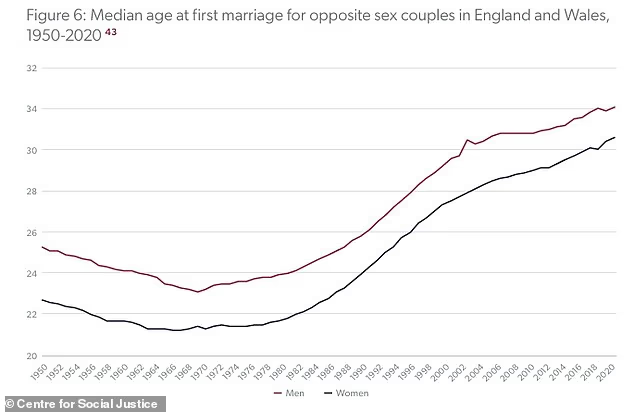
Couples in the UK are getting married later than ever before, the report says, with the average age now about 30 for both men and women
The report recommends reducing the school leaving age and providing more in-work training and apprenticeships in a bid to address the issue.
It also suggests encouraging young people to marry, and to do so at a younger age.
Many women misunderstand how age affects fertility, it argues, adding that around two thirds of women believe it is possible to have a baby at ‘any age’ thanks to medical advances.
‘Given the huge challenge the UK faces with its fertility rates it is vital that motherhood is seen not only as necessary, but as good and valuable too,’ it adds.
Miriam Cates, a senior fellow at the CSJ, said to reverse the birthrate crisis we must ‘make family formation a national priority once again’.