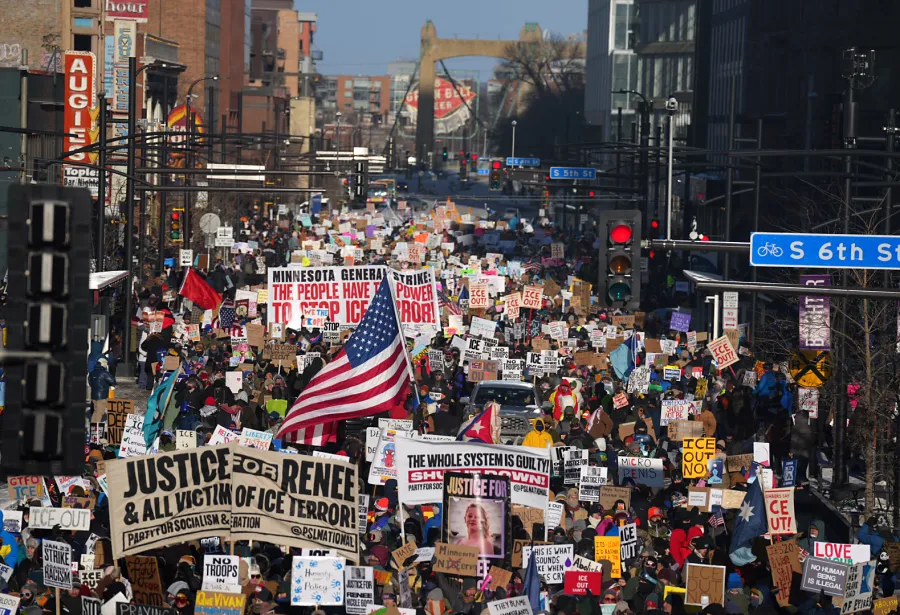
(NewsNation) — Protests against the immigration crackdown in Minnesota are now stretching into a second month and local leaders are warning about the impacts on the community.
The Trump administration has continued to crack down on protesters, with Attorney General Pam Bondi warning protesters, “If you riot in a place of worship, we will find you.”
A federal judge also ordered the release of five-year-old Liam Ramos and his father, who had been detained in an ICE facility in Texas for two weeks.
While Ramos is home, the school district where he attends preschool has canceled school on Monday due to a credible threat. That comes after the district posted that they were happy that their student was returned home after being held in detention, the district adding that four other students are being held in ICE detention in Texas as well.
Now, city leaders in Minneapolis say the disruption is spreading far beyond the streets and affecting the basic functions that keep daily life running.
Minneapolis Chief Operations Officer Margaret Anderson Kelliher said teams have been working around the clock and acknowledged the toll it has taken on police officers.
“They’re carrying a mental load no different than anybody else. Many of our city employees live here, too. Our police officers are putting in countless hours,” Kelliher said in a statement.
The police department is already understaffed and has spent nearly $2 million in overtime responding to immigration enforcement-related calls in just four days following the shooting of Renee Good, according to the Wall Street Journal.
Minneapolis estimates that businesses across the city are now losing $10-$20 million in revenue every single week. Leadership warns the strain is growing and the damage caused is nothing short of catastrophic, with ripple effects for months, if not years, to come.
Thousands of students have turned to remote learning across the cities as well.
“I’ve got kids who are carrying papers, even though they’re legal citizens, because they’re brown and they should not have to do that,” teacher Meg Hirman said. “There’s kids who aren’t coming to school, they’re staying home, which is terrible. We saw that with COVID, kids need to be in school.”
County hospital systems say they’re seeing more patients use telehealth for primary health care than they have since the early days of the pandemic.
St. Paul City Council Member Hwa Jeong Kim warned that the disruption could affect everything from local spending to basic services that people rely on every day, including food systems, health care and housing stability, adding that the region is now trying to avoid a deeper economic and housing crisis.
“We see folks that have rented out city facilities and now have canceled them. We’ve seen a great reduction in the attendance at school as well,” Kim said. “We’re also seeing an increas of needs for services, folks that are maybe too scared to go into the doctor, that needed to see someone 30 days ago, are now looking at calling 911 for ambulance services for more dire health needs.”
Kim said some businesses have warned of potential long-term closures, which would mean less tax revenue for the Twin Cities and fewer jobs.
But the Trump administration argues that mass deportation of undocumented immigrants will lead to lower housing costs and more jobs for U.S. citizens.