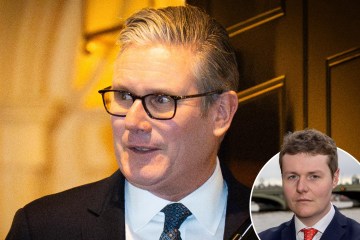
THE spectre of Ed Miliband dictating national security would leave many of you breaking into a cold sweat and fearing you had been teleported to a terrifying parallel universe.
Unfortunately, this is no mere fever dream of some unsettling alternative reality — this is Downing Street 2026.
Credible reports yesterday revealed the Energy Secretary spearheaded a Cabinet revolt against Donald Trump using British bases to attack Iran.
According to The Spectator, he led a cabal of ministers who forced Sir Keir Starmer into withholding support for our oldest ally in their war against the murderous Tehran regime.
The PM himself was said to be initially in favour of helping the US, but was quickly bent into shape by a “petulant” Miliband.
Just let that sink in: the man rejected as Prime Minister by voters in 2015, browbeating our actual premier into submission on the gravest of issues.
READ MORE FROM JACK ELSOM

It sounds unbelievable, but is emblematic of the growing extent the PM’s own personal judgment is taking a backseat to the whims of Labour MPs.
Starmer is now trapped in a vicious cycle. The weaker he grows, the more emboldened his internal critics feel, which makes him more unpopular with voters.
This downward spiral has been evident for about a year, most noticeably after he surrendered to a backbench rebellion on welfare cuts.
But it has been on steroids since the Greens’ charge up the opinion polls in recent weeks.
Hannah Spencer’s victory in the Gorton and Denton by-election was followed by a YouGov survey showing that Zack Polanski’s party had leapfrogged Labour into second place nationally.
The usual suspects have inevitably seized on this ballot box humbling as irrefutable evidence Starmer needs to tack violently to the Left.
He needs to start being more “progressive”, whatever that means.
Like clockwork, they came.
Angela Rayner demanded the PM “be braver” in adopting an unashamedly “Labour agenda”.
Current deputy Lucy Powell said the party needed to lead the “progressive alliance” of British politics.
Sadiq Khan wrote in The Guardian (where else?) that Labour must “stop channelling Reform and unite with progressives”.
All coded language for one giant lurch to the Left — and a disastrous misreading of the current state of British politics.
For starters, it overlooks the inconvenient fact that Labour has been bleeding more of its voters to Nigel Farage’s Reform party since the election than to the Greens or Lib Dems.
Had last week’s by-election been in Dover rather than Greater Manchester, we might be having a rather different conversation.
The siren calls to be more socialist forget just how left-wing this government has been.
In 19 months, Labour has raised more than £60billion in taxes to foot a mass programme of redistribution.
They include class-warfare raids on private schools, employers, mansions and inheritance.
The Employment Rights Act is the most sweeping transfer of power from businesses to unions and workers in modern times.
Crusading ministers are gung-ho on Net Zero and sucking back up to the EU.
The two-child benefit cap has been axed. Railways are being nationalised. Teenagers get to vote. Welfare reform has been dodged. Palestine has been recognised. The public sector has got fat pay rises.
Whisper it, but this has been a pretty left-wing government to boot.
And what good has it done Starmer, who is languishing with historically low popularity ratings?
It is no coincidence that it is the two insurgency parties — Reform and the Greens — who are riding high in the polls.
Their popularity is less a reflection on a sudden nationwide dash to the extremes, but speaks more to the total exasperation of voters fed up with decades of broken promises.
Starmer is not helped by the dizzying amount of U-turns, gaffes and scandals that have defined his premiership from the off.
But the PM nevertheless looks set to appease his left-wing MPs even more.
Having burned through most of his political lives, he is hyper-aware that shaking the wasp’s nest of the Parliamentary Labour Party any further could be fatal.
Weakness breeds weakness, and the PM is now being relentlessly pushed around by his increasingly vocal but out-of-touch left-wingers.
Which brings us back to Friday’s National Security Council where Miliband’s cabal flexed their muscles and coaxed Starmer to change his mind on aiding American pilots.
A decision to support the US in conflict reaches wounds deep in the Labour psyche, combining a longstanding loathing of Trump with an unease of foreign wars.
Many Labour MPs bear the scars of the Iraq war, from which the party has never really recovered.
They also know how their base — and dwindling rump of Muslim voters — would recoil if Starmer was seen to be blindly following America into another Middle Eastern conflict.
Even if the PM himself had made this decision, it would be something.
But the fact that Starmer was cajoled into accepting their position — reportedly against the advice of his capable Defence Secretary John Healey — is quite astonishing.
Into the dustbin went the painstaking hard yards he put in to build a relationship with Trump in his early days.
Sucking up to the often erratic — and sometimes oafish — President was not always easy nor edifying, but through gritted teeth the PM became pally with him for the sake of Britain.
That it was Miliband who convinced him to jeopardise this against his initial better judgment is likely an omen of things to come.
While unpopular with the country, Red Ed is worshipped by deluded Labour members and respected by mutinous MPs.
And it is them who Starmer really wants to avoid conflict with right now . . .
DITHERING MAKES US WEAK
THE words of former general Sir Richard Barrons yesterday were sobering.
As Britain dithered in mobilising our defences, he said countries around the world “will begin to wonder whether the UK has the muscle to apply in situations like this that in former times we clearly did.”
For many proud patriots that will be incredibly uncomfortable reading.
It makes it all the more important that Labour stops dragging its feet on the long-awaited Defence Investment Plan.
This flagship blueprint for our nation’s security was first promised last autumn, but is still yet to appear.
It is no secret that the delay comes down to a funding row between the Treasury and the Ministry of Defence, with top brass warning of a £28billion black hole.
I hear that Rachel Reeves is stubbornly digging her heels in, telling Defence Secretary John Healey to get a grip on spiralling departmental spending.
The Chancellor spies savings in the MoD’s sprawling land and property empire and wants them to cut their own cloth.
She may have a point.
But either way this squabble needs to be sorted out now.
We cannot afford to penny-pinch on the defence of the realm – nor send a signal to the world that we are.