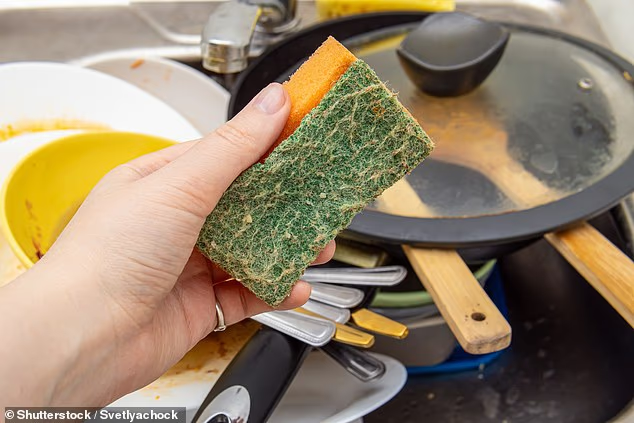
It’s an item that most of us have in our sink.
But just how often do you change your kitchen sponge?
The topic has been widely debated on Reddit, with answers ranging from once a week to ‘when it looks gross or smells bad’.
Now, Dr Primrose Freestone, Associate Professor in Clinical Microbiology at the University of Leicester, has settled the debate once and for all.
According to the expert, you should really be changing your kitchen sponge on a daily basis.
‘How often you clean your kitchen sponge depends on what you have been using the sponge for,’ Dr Freestone told the Daily Mail.
‘If for something likely to be germ ridden such as dirty vegetable or raw meat or fish, then I dispose of these after a single use as it is not easy to clean all microbes off a kitchen sponge.
‘For everyday usage, I throw my sponge away after a single day – and during this day, the sponge will get multiple antibacterial detergent treatments.’
It’s an item that most of us have in our sink. But just how often do you change your kitchen sponge?

Dr Freestone and her colleagues carried out an experiement in which they used sponges for different durations, ranging from one day to five months. The two– and five–month (pictured) sponges had evidence of ‘fungal colonisation’
The sponge debate has swirled on Reddit for years, with many users sticking to a weekly change rule.
‘If you’re using it daily? You should definitely replace it weekly. At least. And keep it clean and dry when it’s not in use,’ one user claimed.
Another added: ‘Oh, kitchen sponges? Every week or two. I keep a bunch under the sink, I’ll buy them by the box load.’
And one joked: ‘Weekly or when it gets gross from scrubbing something, whichever comes first.’
However others are so worried about germs that they shun sponges entirely.
‘I don’t use one. Too much fear of it getting germy,’ one user commented, while another added: ‘No sponges! They gross me out.’
To get to the bottom of it, Dr Freestone and her colleagues carried out an experiement in which they used sponges for different durations, ranging from one day to five months.
The sponges were occasionally disinfected throughout the experiment, and at the end of the test, the researchers analysed the microbes on them.

Disgustingly, the researchers found ‘substantial bacterial numbers’ in the sponge after just 14 hours of use (pictured) – even after a wash with antibacterial washing up liquid and hot water
Disgustingly, the researchers found ‘substantial bacterial numbers’ in the sponge after just 14 hours of use – even after a wash with antibacterial washing up liquid and hot water.
The three–day–old sponge was ‘heavily colonised’ with bacteria, while the two– and five–month sponges had evidence of ‘fungal colonisation’.
In terms of the specific germs, Dr Freestone warns: ‘Any type of germ in your kitchen or whatever the sponge came into contact with will be in that sponge.’
This includes listeria, salmonella, and even some germs that are resistant to antibiotics, she added.
Based on the findings, Dr Freestone advises using a fresh sponge every day.
She said: ‘Sponges are not expensive and so dispose of them daily is my advice.’
On Reddit, many sponge haters have suggested using brushes instead.
‘I stopped using sponges and switched to brushes because I realized how gross sponges get and it freaked me out (also, they’re so hard to keep dry and clean!). I replace the brush every 2 months,’ one user said.
Another added: ‘I stopped using [sponges]. For any dishes that need to be hand–washed, we have a brush where you fill the handle with dish soap.’
According to Dr Freestone, this is wise, although she highlights that brushes can also pick up nasty germs over time.
‘Brushes might be more hygienic than sponges,’ she tentatively said.