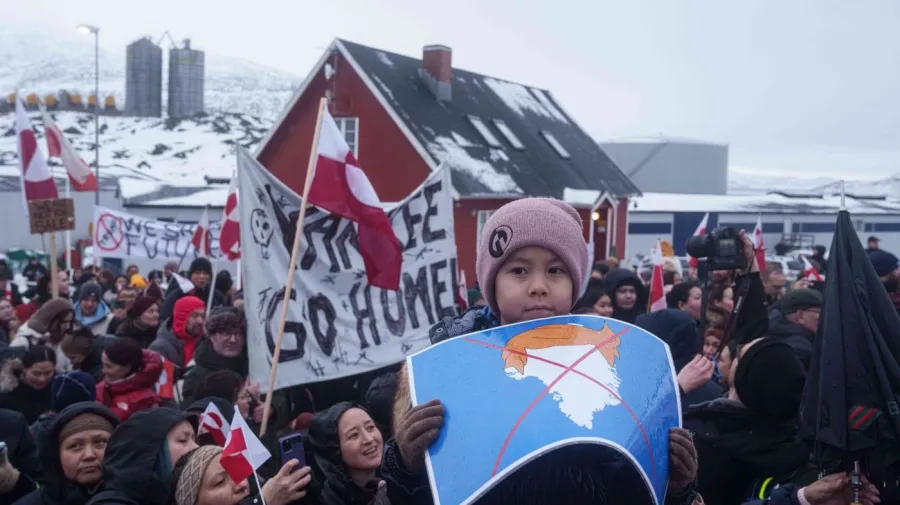
(The Hill) — Greenland holds large quantities of rare earth elements, but experts say annexing the territory may not vastly improve U.S. access to them.
President Donald Trump has dug in on his efforts to take over Greenland, which is part of Denmark, a NATO ally. Despite vocal objections from leaders across Europe, Trump has insisted it is important for the U.S. to take possession of the island, refusing to rule out the use of the military to do so.
Asked Tuesday during a press conference to mark his first full year back in office how far he was willing to go to acquire Greenland, the president told reporters: “You’ll find out.”
While Trump also recently said, “We need Greenland for national security, not minerals,” some of his allies are eyeing both the territory’s location and its natural resources.
“Greenland has massive rare earth minerals and critical minerals. There are enormous economic benefits to America,” Sen. Ted Cruz, R-Texas, told Fox News over the weekend.
Trump adviser Mike Waltz similarly said last year that the administration’s push for Greenland is “about critical minerals. ”
Greenland has significant quantities of rare earth elements — minerals that can be used in various technologies, including semiconductors, batteries, lasers, magnets and nuclear energy. Ultimately, such technologies can be used in everything from data centers to military weapons to renewable power and electric vehicles.
These minerals aren’t actually exceedingly rare, they just occur in small deposits and can therefore be uneconomic to mine.
The International Energy Agency, whose members include major energy-consuming countries, has projected that by 2050, global demand for rare earth elements used in magnets will double. It said that China is expected to remain their largest supplier.
According to the Center for Strategic and International Studies, Greenland has two of the largest deposits of rare earths in the world, but the conditions there — particularly the fact the island is largely covered in ice — pose a challenge for actually mining those deposits.
And that is just one of the hurdles.
“Greenland is large. Some of these mining sites are quite remote. They require people with specialized skills … to access these minerals, and most of these places are not settled and not near places where people live,” said Penny Naas, senior vice president for innovation and competitiveness at the German Marshall Fund of the United States, a think tank that promotes transatlantic cooperation.
“There’s still … other places around the world that are easier to mine” Naas added, also noting that mining in Greenland often faces local opposition.
And, she said, an American takeover may not actually yield different results for companies than just working with existing authorities.
“Greenland is relatively open on investment,” Naas said. “In general, right now the U.S. could go in and mine in Greenland as is.”
“There’s only one U.S. entity that has applied for and received mining permits in Greenland. The U.K. recently got one. There’s a lot of Canadians and Australians that have mining permits. But … the challenge is not so much going in and getting it. It’s that it’s just an incredibly harsh environment to mine in,” she added.
China controls much of the world’s mineral supply chains. The country accounts for 61% of global rare earth element mining and more than 90% of rare earth element refining, according to the 2025 IEA report.
However, over the course of the past year, the U.S. government has set up deals with miners to produce rare earths domestically.
Ian Lange, who was part of the White House Council of Economic Advisers during Trump’s first term, noted that companies were working toward “vertically integrated supply chain[s]” while Greenland is “totally away from the supply chain.”
“Sure, there’s dirt there that has the minerals that people talk about in it, but my general sense is: So does the U.S., so does Canada, so does Australia, so does Brazil,” said Lange, who is now an economics and business professor at the Colorado School of Mines.
He said the markets may not have a need for Greenland’s minerals — comparing it to an area with too many grocery stores.
“Greenland’s like a Whole Foods. We’ve got Trader Joe’s, we’ve got Kroger. We’ve got …17 grocery stores near us and somebody says, ‘Hey, let’s put in an 18th,’” he said. “Greenland would be the 18th grocery store.”