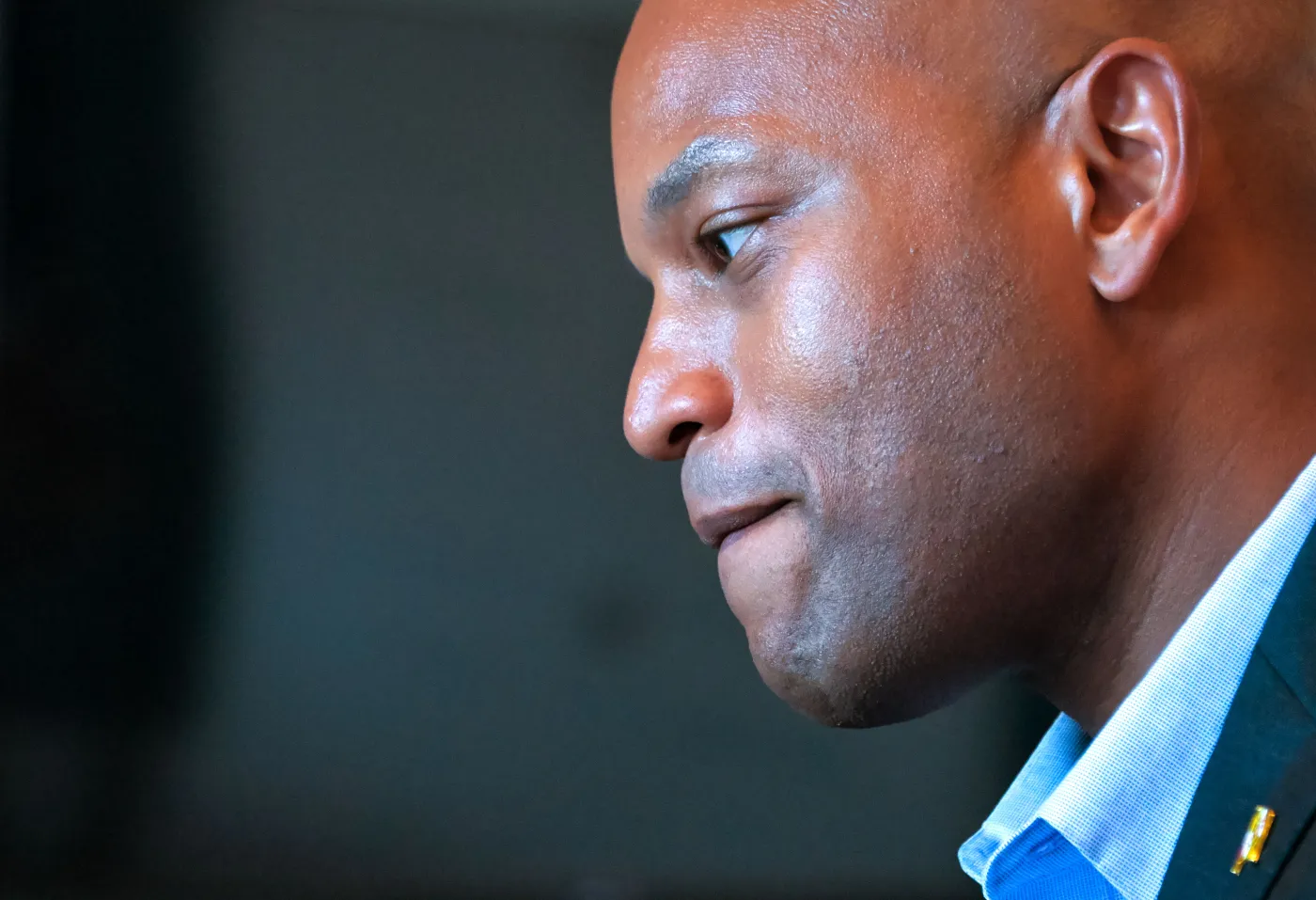
Maryland Gov. Wes Moore is proposing billions in spending while the state stares down a widening fiscal hole — and when pressed repeatedly about where the money is coming from, the governor offered a response, but not an answer.
Standing before a friendly crowd of state public school leaders last week, Moore unveiled what his administration touted as a $10 billion education agenda for Maryland’s public schools in 2026, pushing K-12 spending to record levels for the fourth consecutive year. The proposal would add about $374 million in new education spending — a nearly 17% increase — while lawmakers enter the legislative session facing an estimated $1.4 billion deficit.
While the governor repeatedly emphasized “record funding” and “strategic investments,” a simple question remained unanswered: Where is the money coming from?
With the deficit looming, Spotlight on Maryland pressed Moore directly on how his administration intends to fund a growing list of spending commitments while complying with the state constitution, which requires a balanced operating budget — one in which forecasted revenues must equal or exceed spending.
When asked whether he would consider pausing any spending in light of another billion-dollar deficit, Moore responded with a familiar refrain heard during his time in office.
“We are going to, in the fourth year in a row, introduce a balanced budget,” Moore said. “There will be no tax increases in this budget, but we are going to make smart, strategic investments in our long-term growth.”
Pressed again — this time more directly — on whether balancing the budget would require either cutting spending or raising taxes, Moore seemed to reject the premise.
“I just said we’re not going to raise taxes,” Moore said, before adding, “We’re going to make smart, strategic investments.”
When asked a third time, plainly, “Where is the money coming from?” Moore did not answer. Instead, members of his team moved him away from reporters as applause rose in the background.
The exchange crystallized what critics say has become a defining feature of Moore’s fiscal messaging: putting emphasis on the word “investments,” paired with few specifics about offsets, cuts or long-term funding sources.
“That’s an interesting turn of phrase — ‘investments’ instead of ‘spending,’ just like they say ‘revenues’ instead of ‘taxes,’” said Maryland Sen. Minority Whip Justin Ready, a Republican, representing Carroll and Frederick counties.
Ready said that the governor’s rhetoric obscures a basic reality.
“What happens in Maryland is that when they make their ‘investments,’ they’re confiscating more and more dramatic amounts of money from everyday working Marylanders,” Ready said.
Republicans and some fiscal analysts say the state should be pulling back — not expanding — after narrowly avoiding a $3 billion fiscal cliff, as forecast by the nonpartisan Maryland Department of Legislative Services. Ready said GOP lawmakers pushed last session for freezing discretionary spending and reevaluating mandated increases, proposals that ultimately did not advance either legislative chamber.
Instead, Moore’s administration has continued to announce new initiatives and funding commitments found in his prior budgets.
Among them:
- A $17 million state investment to “decarbonize public schools”;
- $10.5 million to help finance a new vehicle processing center at Tradepoint Atlantic for luxury carmaker McLaren and others;
- $62 million in state funding to shore up the state’s Supplemental Nutrition Assistance Program, or SNAP, benefits last November, including $10 million for “Maryland food security partners.”
Beyond targeted programs, Spotlight on Maryland has already reported that the Moore administration significantly expanded the size of the state government’s workforce. During his first two years in office, the executive branch added more than 3,300 jobs.
Based on average compensation, that growth was estimated to amount to more than $427 million annually in recurring salary and benefits.
On July 1, Moore implemented a statewide hiring freeze and buyouts to cut $121 million from the state’s personnel budget. Moore blamed the decision on “fiscal storms” and headwinds from the federal government.
Dr. Daraius Irani, chief economist at Towson University’s Regional Economic Studies Institute, said the current trajectory raises sustainability concerns.
“Part of this is recognizing that the state government can’t do everything that it wanted to do,” Irani said. He added that Maryland should be scrutinizing whether agency missions remain aligned with core public needs.
“Yes, I want the state government to look at its budget and make sure the missions of each of the agencies are aligned with the purpose of providing those services,” Irani said.
Looking ahead, the Department of Legislative Services predicts deficits each year through at least fiscal 2031, driven by a structural spending deficit, mandated increases in education funding, Medicaid growth, debt service and pension obligations.
The projected deficits are:
- Fiscal 2027: $1.4 billion deficit;
- Fiscal 2028: $3.1 billion deficit;
- Fiscal 2029: $3.5 billion deficit;
- Fiscal 2030: $4 billion deficit;
- Fiscal 2031: $4 billion deficit.
Ready said that the outlook contradicts political messaging from the governor and his allies. Last summer, a pro-Moore super PAC ran advertisements claiming, “We solved this budget deficit.”
Ready calls that claim “false.”
“We still have a budget deficit,” Ready said. “And in the out-years, it gets worse.”
Do you have a tip related to this story? Send news tips to [email protected] or contact Spotlight on Maryland’s hotline at (410) 467-4670. Spotlight on Maryland is a collaboration among The Baltimore Sun, FOX45 News, and WJLA in Washington, D.C.