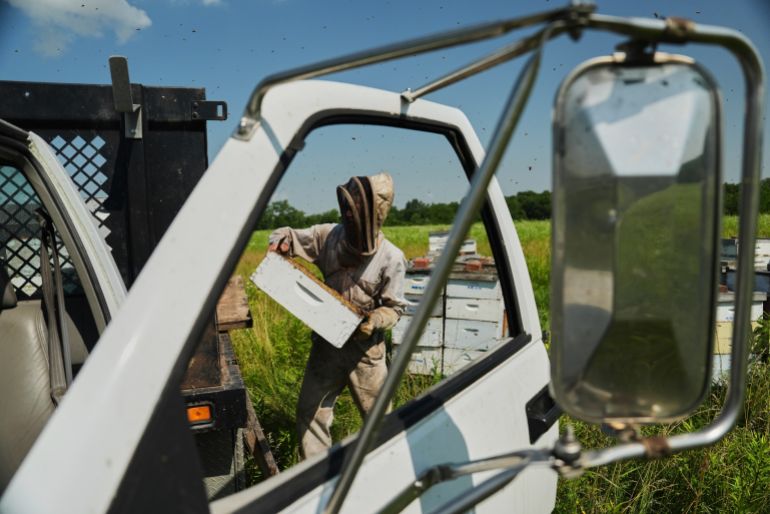
Sweat covers Isaac Barnes’s face under his beekeeper’s veil as he hauls boxes of honeycomb from his hives to his truck. It is a workout in what feels like a sauna as the late-morning temperatures rise.
Though Barnes was hot, his bees were even hotter. Their body temperatures can be up to 15 degrees Celsius (27 degrees Fahrenheit) higher than the air around them. As global temperatures rise, scientists are trying to better understand the effects on managed and wild bees as they pollinate crops, gather nectar, make honey, and reproduce.
They noticed flying bees gathering nectar avoided overheating on the hottest days by using fewer but harder wingbeats to keep their body temperature below dangerous levels, according to a study published last year. Scientists also say that bees, like people, may cope by retreating to a cooler environment such as the shade or their nest.
“Just like we go into the shade, sweat, or we might work less hard, bees actually do the exact same thing so they can avoid the heat,” said Jon Harrison, an environmental physiologist at Arizona State University and one of the study’s authors.
Generally, most bees are heat-tolerant, but as the climate warms, some experts think their ability to fend off disease and gather food might become more difficult. Habitat loss, increased use of pesticides, diseases, and lack of forage for both managed and wild bees are all listed as potential contributors to the global decline of bees and other pollinators.
Earlier this year, preliminary results from the annual US Beekeeping Survey found that beekeepers lost almost 56 percent of their managed colonies, the highest loss since the survey started in 2010.
Almost all of the managed honeybee colonies in the United States are used to pollinate crops such as almonds, apples, cherries, and blueberries. Fewer pollinators can lead to less pollination and potentially lower yields.
Back at Isaac Barnes’s hives in Ohio, thousands of honeybees fly around as he gathers boxes to take back to his farm for honey production. Nearby, a couple of his bees land on milkweed flowers, a rare bit of plant diversity in an area dominated by maize and soya bean fields.
For Barnes, who operates Honeyrun Farm with his wife, Jayne, one of the challenges heat can pose to his 500 honeybee hives is fending off parasitic mites that threaten the bees. If temperatures get too hot, he cannot apply formic acid, an organic chemical that kills the mites. If it is applied when it is too hot, the bees could die.
Last year, they lost nearly a third of the 400 hives they sent to California to help pollinate commercial almond groves. Barnes thinks those hives may have been in poor health before pollination because they were unable to ward off mites when it was hot months earlier.
It is only in the last decade that people have become aware of the magnitude of the pollinator decline globally, said Harrison, of Arizona State University. Data is limited on how much climate change and heat stress are contributing to pollinator decline.

The Trump administration’s proposed budget would eliminate the research programme that funds the US Geological Survey Bee Lab, which supports the inventory, monitoring and natural history of the nation’s wild bees. Other grants for bee research are also in jeopardy.
US Senator Jeff Merkley of Oregon said his country’s pollinators are in “grave danger”, and he will fight for the federal funding. Pollinators contribute to the health of the planet, the crops we grow and the food we eat, he said.
“Rather than taking bold action to protect them, the Trump administration has proposed a reckless budget that would zero out funding for critical research aimed at saving important pollinators,” he said in a statement to The Associated Press news agency.
Harrison said his research on this topic would come to a halt if cuts are made to his federal funding, and it would generally be more difficult for scientists to study the disappearance of bees and other pollinators and improve how they prevent these losses. Not being able to manage these pollinator deaths could cause the price of fruits, vegetables, nuts, coffee and chocolate to rise or become scarce.
“Hopefully, even if such research is defunded in the US, such research will continue in Europe and China, preventing these extreme scenarios,” said Harrison.