
Amna Nawaz:
All eyes are on Cuba, as the world waits to see what will happen to the leaders and the people of the Caribbean island nation. President Trump says he wants to take action, while the leaders of the country remain defiant.
At first glance, life in Cuba’s capital of Havana feels familiar, the famous Malecon Avenue by the sea, the colorful buildings and antique cars. But these streets scenes, quieter than just a few months ago, disguise a city and a nation now in crisis.
Juana Perez, Havana Resident (through interpreter):
The power hasn’t come back on at my house, and we have been about 12 hours without lights. And, well, I plan to face the day as usual, just as Cubans do.
Amna Nawaz:
This week, the country faced the third wide-scale failure of its power grid since December. Without enough gas, less than half of Havana’s trash trucks are allowed to run. Piles of garbage spill over into the historic streets.
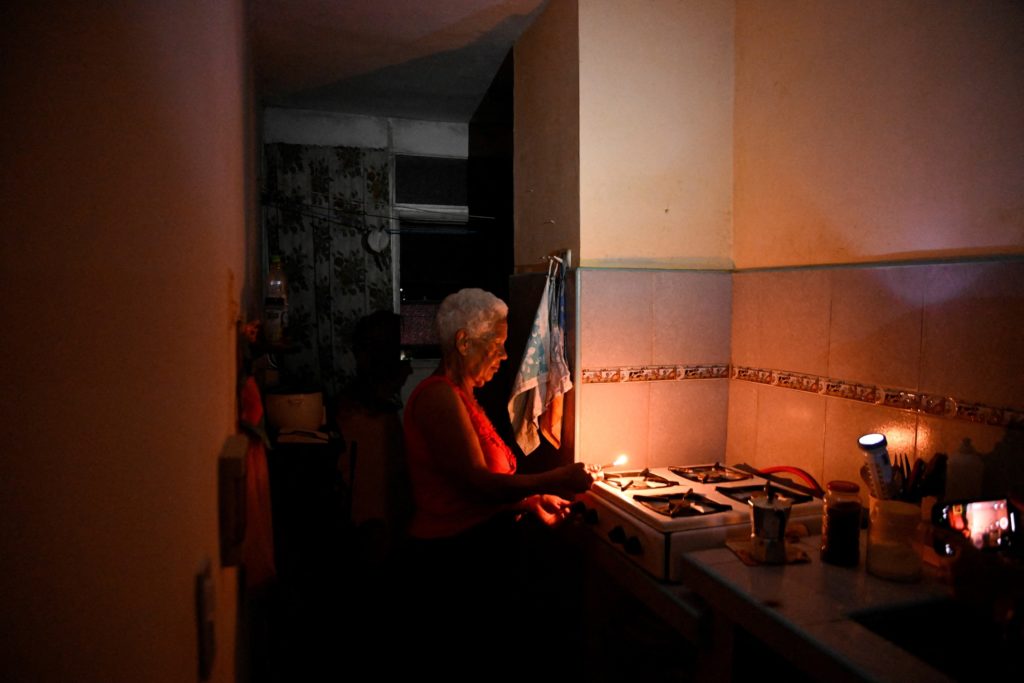
And as the sun sets, a now routine darkness takes over, with 10 million people left without light, pitch-black streets, and no electricity to cook the little food people are able to find.
Pedro Ramos, Havana Resident (through interpreter):
We are two older people, both in our 70s, and she’s also sick. Our food has spoiled. I’m boiling three pieces of chicken to try and save something to eat because the situation is really bad.
Silvia Perez, Havana Resident (through interpreter):
Really bad, really bad. We have nothing left. We’re doing really bad. And I just want to die so I can get some rest from this country. May God forgive me for speaking like this.
Amna Nawaz:
Cuba has long dealt with blackouts. A system hampered by an aging power grid, U.S. sanctions, and fuel shortages was further crippled after an American raid in Venezuela, Cuba’s ally, led to a total energy blockade, and to ramped-up threats from President Trump.
Donald Trump, President of the United States: Taking Cuba, I mean, whether I free it, take it. I could do anything I want with it, you want to know the truth, a very weakened nation right now.
Amna Nawaz:
A message echoed by Secretary of State Marco Rubio.
Marco Rubio, U.S. Secretary of State: So, they’re in a lot of trouble, and the people in charge are — they don’t know how to fix it, so they have to get new people in charge.
Amna Nawaz:
Back on the island, anxiety about what comes next.
Luis Enrique Garcia, Havana Resident (through interpreter):
What will happen to Cuba, the world asks. And we’re also here at this moment saying to ourselves, what will happen to us? But I believe, I truly believe, there will be dialogue and understanding.
Amna Nawaz:
And defying President Trump’s sanctions, two tankers carrying crude oil are on their way to Cuba after Russia declared its unwavering solidarity.
To share more about the evolving situation in Cuba, including the political stakes, I’m joined by Lillian Guerra, a professor of Cuban and Caribbean history at the University of Florida.
Professor Guerra, welcome to the “News Hour.” Thanks for joining us.
Lillian Guerra, University of Florida: Thank you so much for having me.
Amna Nawaz:
So, at the end of that report, you heard a little bit of hope from that gentleman there about dialogue between the U.S. and the Cuban government.
What do we know about those talks and what could come of them?
Lillian Guerra:
Well, first, we know very little about the talks.
We know that there are two major members of the Castro family who have been the spokespeople, allegedly. At least one of them is the grandson of Raul Castro, and the other has a similar relationship. He’s the grand-nephew of both Fidel and Raul.
Now, both of these men have very, very high ranks in what is GAESA, the Cuban military’s corporate conglomerate that really controls 80 percent of the economy. And they have no legitimacy in the eyes of the Cuban people. It is important to note, though, that because they control the economy and they also control the armed forces, they are apparently the ones that Trump’s administration is turning to in order to negotiate some form of transition.
And I find that very problematic, along with probably a majority of Cubans in this country and those on the island.
Amna Nawaz:
So put that together with the U.S. calls for a change in leadership in Cuba. Could one of these people involved in the talks now be in charge? And what would that look like?
Lillian Guerra:
In fact, one of them, Oscar Perez-Oliva Fraga, is often called the economy czar.
And he was put forward as early as November of 2025 by the Cuban Communist Party itself as a replacement for President Miguel Diaz-Canel when he completes his term in office. So if he were to take power, it would actually be exactly what the Cuban Communist Party would like.
I think that right now we don’t know exactly what is next. And the Cuban people don’t know either because they often don’t have electricity and can’t charge their phones. They don’t have access to television. Their government censors the news. So they’re really reliant in many ways on social media and word of mouth to find out what’s happening.
I think that the best-case scenario would be one in which the Cuban government would finally do something to alleviate the economic and political repression on the island by simply saying that they will agree to legalize opposition political parties and that in some way or another they will reduce the management of the economy by the armed forces, which really should have no role in managing the economy.
Amna Nawaz:
We should point out too a lot of people in Cuba rely on family members outside of the country to send in supplies, to send in money to help sustain them. How does all of that impact the Cuban economy and what does that look like now?
Lillian Guerra:
Yes, actually, if Marco Rubio is right about one thing, it is that there is still a subsidy in Cuba and that subsidies are what the Cuban government has been dependent on.
So that subsidy is the billions of dollars a year in goods and in cash that Cubans like myself send their relatives, and we will find any way to do so. A lot of money comes in simply with mules, which are people who travel to Cuba from Colombia, from Mexico, from New York, wherever they can travel, and they charge a commission and they bring in things for our family.
We are allegedly, according to many economists’ measures, supporting about 40 percent of the population. I think that part of the problem with that scenario in general is that not everybody has family abroad, and the vast majority of Black Cubans, who comprise at least 40 to 50 percent of the population, do not have family abroad.
It’s more than poverty. It’s immiseration. And all we have are different degrees of immiseration among the Cuban people.
Amna Nawaz:
Professor, I have got about 30 seconds left, but I have to ask. Cuba’s faced crises before. Do you see this one leading to real change in the country?
Lillian Guerra:
I think that something will happen, because expectations are extremely high, both on the island and in South Florida.
And, frankly, the longer it takes to come to some decision, the more likely it is that Cubans will take to the streets and start attacking the Cuban Communist Party headquarters in different places and perhaps simply confront the state themselves. And that would be devastating, I think, because nobody has weapons in Cuba.
All they have are their ideals.
Amna Nawaz:
That is Professor Lillian Guerra of the University of Florida joining us tonight.
Professor, thank you so much.
Lillian Guerra:
Thank you.


