The last remaining nuclear treaty between the US and Russia is set to expire in just weeks, raising global fears of a renewed arms race.
The New Strategic Arms Reduction Treaty (New START), signed in 2010, is due to end on February 6. It is the eighth agreement between the two nations since the 1963 treaty that banned nuclear tests in the atmosphere, outer space and underwater.
New START is the third iteration of the pact and limits each side to 1,550 deployed strategic warheads.
If it lapses, it will mark the first time in nearly 50 years that the world’s two largest nuclear powers operate without formal restrictions on their arsenals.
Together, the US and Russia hold roughly 87 percent of the world’s nuclear warheads.
Arms control experts warn that the expiration could prompt both nations to deploy warheads beyond previous limits, accelerating the weakening of the global arms control framework.
Stephen Herzog from the Middlebury Institute of International Studies in California said it increases global risk by reducing transparency and enabling unchecked competition among leaders who appear willing to rely on nuclear arms.
‘In a situation where Russia is increasingly unpredictable, and in a situation where the administration of the United States is unfortunately increasingly unpredictable, not having a vital,’ he told New Scientist.
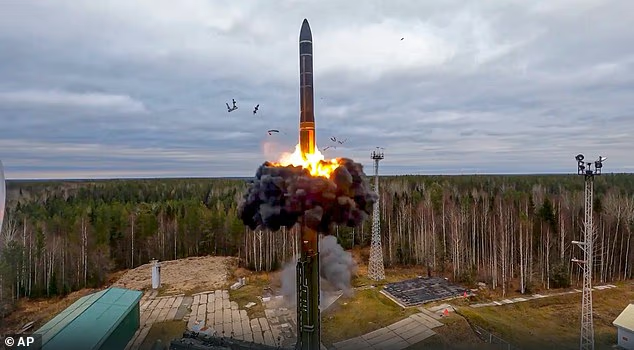
The last remaining nuclear treaty between the US and Russia is set to expire in just weeks, raising global fears of a renewed arms race. Pictured is a Russian Yars intercontinental ballistic missile during a test fire in 2022

President Donald Trump indicated he would allow the last US-Russia strategic arms control treaty to expire without accepting an offer from Moscow to voluntarily extend its caps on deployments of the world’s most powerful nuclear weapons
The treaty cannot be extended, as written, it allowed one extension, and Russian President Vladimir and former US President Joe Biden agreed to roll it over for five years in 2021.
President Donald Trump indicated he would allow the last US-Russia strategic arms control treaty to expire without accepting an offer from Moscow to voluntarily extend its caps on deployments of the world’s most powerful nuclear weapons.
‘If it expires, it expires,’ Trump said of the 2010 New START accord in an interview he gave to the New York Times on Wednesday. ‘We’ll just do a better agreement.’
Trump told the New York Times that China, which has the world’s fastest-growing strategic nuclear force, should be included in a treaty that replaces New START.
The first New START treaty was signed in 1991 and cut the number of deployed strategic nuclear warheads.
START II in 1993 aimed to significantly reduce strategic nuclear weapons, banning multiple warheads (MIRVs) on intercontinental ballistic missiles (ICBMs) and eliminating Russian SS-18 missiles.
However, it never fully entered into force due to Russian delays related to the U.S. withdrawal from the Anti-Ballistic Missile (ABM) Treaty, and Russia formally repudiated it in 2002, with later agreements like New START eventually taking its place.
Russia has the most confirmed nuclear weapons, with over 5,500 nuclear warheads.

In September, Russian President Vladimir suggested that the treaty limits be extended for another 12 months. But the treaty was written to allow one extension, which was used under the Biden administration
A nuclear weapon launched via an intercontinental ballistic missile (ICBM) from Russia would take approximately 30 minutes to reach the continental United States.
Total nuclear warheads owned by these two countries alone count for nearly 90 percent of nuclear weapons in the world.
However, the number of warheads for North Korea and Israel is unconfirmed.
It has been estimated that North Korea has enough fissile material to develop between 40 and 50 individual weapons, while Israel has material for up to 200, with an estimated 90 existing warheads.
Some agreements on nuclear weapons remain in effect, though their impact varies.
The Treaty on the Prohibition of Nuclear Weapons seeks the complete elimination of nuclear arms and has gained supporters, but none from the world’s nuclear-armed states.
Meanwhile, several nuclear powers are signatories to the Treaty on the Non-Proliferation of Nuclear Weapons (NPT), though it has limited effect on the total number of warheads.
Among all these agreements, New START has been the only treaty that effectively held the US and Russia accountable for reducing their arsenals.
Moscow and Washington, both focused on the war in Ukraine, have not conducted formal talks on a successor to New START, though both sides have made some informal statements.
In September, Putin suggested that the treaty limits be extended for another 12 months.
He also proposed including the nuclear arsenals of Britain and France in future negotiations, a suggestion both countries have rejected.
Trump has not responded officially but told The New York Times that he would prefer a broader agreement that could involve ‘a couple of other players,’ without specifying which nations.