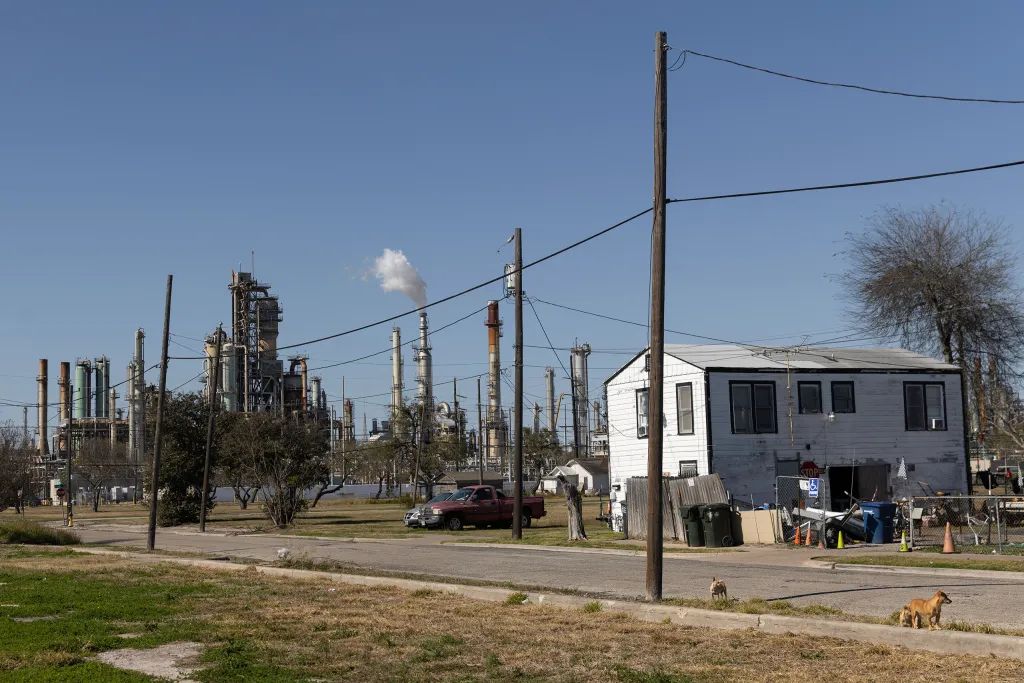
Companies that own refineries in Corpus Christi say they are working to secure alternative water sources to maintain operations and prevent a shortage of gasoline and jet fuel in Texas and beyond as the city scrambles to delay or avoid a rapidly-escalating water crisis.
The city earlier this week said it could enter a water emergency in as soon as two months; at that point the city would have roughly six months before supply could no longer meet demand.
With gasoline prices rising amid the U.S.-Israel war with Iran, water limitations in the Coastal Bend — a growing fuel and chemical hub — could further drive up prices, industry officials said.
“If water limits force changes, facilities might have to slow production, take units offline or run at lower rates,” said Ed Longanecker, president of the Texas Independent Producers and Royalty Owners Association, an oil and natural gas industry trade group. “That would hit local jobs, reduce economic activity and cut into revenue that flows through the Port of Corpus Christi, which is one of the country’s leading crude oil export points.”
On a statewide level, Longanecker added, “any disruption at these refining and export sites could tighten supplies of gasoline, jet fuel, diesel and other refined products across Texas,” which would affect fuel prices.
The outsized impact of the industries using Corpus Christi water threatens to create ripple effects far beyond the Gulf Coast, said Ray Perryman, an economist and founder of the Perryman Group, which conducts economic analyses across several Texas industries.
“The presence of refineries in the Corpus Christi area are shifting the severe water shortage from a local problem to an issue with significant potential economic ramifications for the state and nation,” Perryman said.
An extended drought has coincided with a years-long effort by city leaders to attract more industry to Corpus Christi Bay — which in turn has driven up demand for water.
Industrial consumers account for about 50% to 60% of the city’s water use, local officials said.
The city was counting on a desalination plant to help it keep ahead of that demand, but the City Council killed the project last year because of concerns over its escalating price tag and fears that it would harm the bay’s ecosystem. City leaders are now scrambling to revive the project, which would take years to come online.
With two of its main reservoirs dropping below 10% of capacity, the city is pushing forward with an array of potential solutions, from increasing how much it pumps through its main pipeline that draws from Lake Texana and the Colorado River to drilling wells to tap local groundwater.
The city has also turned to water conservation, asking residents to reduce water use by banning lawn watering and requiring them to wash cars and boats with a 5-gallon bucket or face a fine.
It’s unclear whether those fixes will deliver enough water quickly enough to avert the crisis.
Gov. Greg Abbott — who sharply criticized Corpus Christi leaders for their handling of their water supply — ordered agencies last week to suspend normal procedures in an effort to speed some water projects and buy the city more time.
“With each passing day, the options that we have available to us diminish,” said Bob Paulison, director of the Coastal Bend Industries Association, which works with 21 companies that could be impacted by the shortages, plus the Port of Corpus Christi. “I thought we learned that lesson 15 years ago [during the last major drought] … and we’re learning it again the hard way.”
Companies reached by The Texas Tribune said they remain confident that they can remain operational during a water shortage. However, ExxonMobil and Flint Hill Resources are both seeking alternative sources of water, according to the companies.
Flint Hill Resources operates two refineries in Corpus Christi that turn up to 350,000 barrels per day of crude oil into fuels that it distributes to different markets, including San Antonio, Austin, Waco and Dallas-Fort Worth.
A company spokesperson said Flint Hill Resources has begun working with local officials on plans to draw wastewater from the city’s Allison Wastewater Treatment Plant. The company hopes to install temporary filtration equipment it expects will allow it to draw and use 1.5 million gallons a day. It’s unclear when those plans would come online.
“We are optimistic we will be able to manage the potential curtailment scenarios without significantly disrupting our operations,” the spokesperson said.
Flint Hills is so far the only refinery with an agreement to draw water from the wastewater plant, approved by the Corpus Christi City Council in late January.
ExxonMobil, along with Saudi Arabia-based Saudi Basic Industries Corporation, jointly operates a plastics manufacturing facility in nearby San Patricio County. The companies say they are exploring alternative water sources that are not currently used for public consumption.
The three facilities owned by the two companies are among the largest volume users of Corpus Christi’s municipal water supply.
The region’s refining capacity is close to 1 million barrels of refined products per day, including 450,000 barrels of gasoline, or about 5% of the nation’s supply of refined products, said Todd Staples, president of the Texas Oil & Gas Association.
The oil and natural gas industry also supports about 115,000 jobs in the Coastal Bend region, crucial pieces of the regional and state economies that are now at risk, Staples said.
“Industry subject matter experts will continue to work collaboratively with city officials to ensure the Coast Bend region thrives and contributes to delivering the power that fuels our modern way of life,” Staples said. “Time is of the essence, because a prolonged water shortage will have yet-to-be determined consequences on the production capacity of facilities that are served by the city.”
Paulison, the industrial association director, said the companies he represents launched water reduction measures long ago. He said Corpus Christi has grappled with drought for nearly five years.
The association’s companies produce a mix of diesel, jet fuel, refrigerants and bulk ibuprofen for markets both local and across the country.
Paulison said the companies have taken steps to reduce water usage, such as washing vehicles and equipment less frequently and using saltwater where possible. Companies have also bolstered leak detection and repair, he said, adding that they are also fast-tracking projects to use treated wastewater and lessen their reliance on the city’s water supply.
The companies’ goal “is to continue to operate, even in a Level 1 [water] emergency,” Paulison said. “What we’re focusing on is operating and continuing to supply customers with product.”
Industry leaders called on state and local officials to find solutions to the water problem quickly. They said Texas’ nation-leading oil and gas producers depend on the city’s refining capacity
“The local economy and the country’s energy picture rely heavily on Corpus Christi’s role as a key processing, transport and export point for oil and gas coming from the Eagle Ford, Permian and other [oil-producing] basins,” Longanecker, the trade group president, said. “Thousands of jobs depend on it. Reliable water supplies are essential to keep everything running smoothly during this shortage.”
Alejandra Martinez contributed to this report.
Disclosure: Texas Oil & Gas Association has been a financial supporter of The Texas Tribune, a nonprofit, nonpartisan news organization that is funded in part by donations from members, foundations and corporate sponsors. Financial supporters play no role in the Tribune’s journalism. Find a complete list of them here.
Source link