As the war between the US, Israel and Iran intensifies, a viral theory has claimed the conflict may echo a chilling prophecy in the Bible’s Book of Revelation.
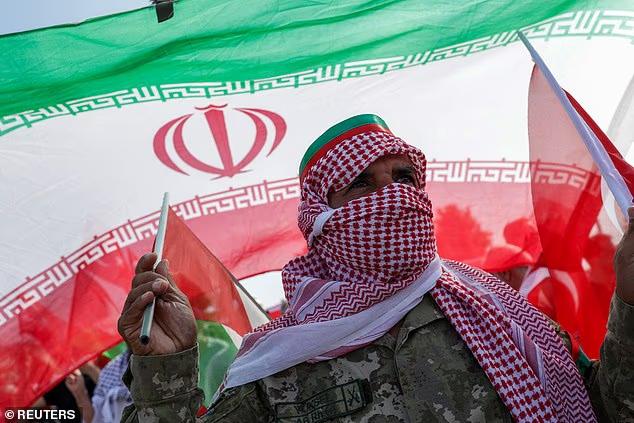
Some users argued that the colors of Iran’s national flag mirror the Four Horsemen of the Apocalypse: conquest (white), war (red), famine (black) and death (pale or green) described in Revelation as signs of the end times.
Critics noted the theory is incomplete because Iran’s flag does not contain the color black, which represents famine in the biblical text.
However, some social media users attempt to explain the missing horse by linking it to rising food prices or potential oil disruptions in the Persian Gulf, though the Book of Revelation itself makes no connection between the prophecy and Iran.
In Revelation 6, when the Lamb of God opens the first four of seven seals, four horsemen are released, initiating a period of divine judgment and devastation on Earth.
The theory also draws on a prophecy in the Book of Ezekiel describing an invasion of Israel by ancient nations, including Persia, now modern-day Iran, which some believers say echoes the growing confrontation between Iran, Israel and the United States.
Pastor Jeff Cramer at Westminster Calvary in Colorado said the current moment carries ‘biblical significance’ because ‘Iran is ancient Persia,’ arguing that ‘there are prophetic issues that are with them for sure.’
He pointed to Ezekiel 38, which names Persia among the nations aligned against Israel, and said recent developments in the Middle East have caused some Christians to believe those prophecies could be moving closer.
A theory spreading online has claimed that the colors of Iran’s national flag mirror those of the Four Horsemen of the Apocalypse, a biblical prophecy some believe signals the end of the world

The wild theory comes as the US and Israel enter the 13th day of attacks on Iran
‘We’re living in the prophetic timeline somewhere close to chapter 37 and the opening of chapter 38,’ Cramer said.
He argued that Israel remains central to biblical prophecy, saying, ‘Israel is always God’s timepiece when it comes to prophecy,’ and suggested modern conflicts involving Iran should be viewed through that lens.
Social media users pointed to reports that rising energy prices triggered by turmoil in the Middle East are beginning to drive up costs across agricultural markets, fueling fears of another global food price surge.
‘One of the four horsemen in the Book of Revelation is famine,’ one X user posted, linking the theory to warnings that higher fuel and fertilizer costs could push global food prices higher.
This conspiracy theory traces back to a form of biblical interpretation called dispensationalism, which interprets Revelation as a literal roadmap for future events.
The author of Revelation is traditionally identified as John, believed by many to be the Apostle John, who also wrote the Gospel of John.
The book describes a dramatic sequence of events leading up to the ‘end times,’ including natural disasters, plagues, persecution, chaos and the opening of seven seals that unveil a dramatic future.
Revelation 5 opens with John seeing God holding a scroll sealed with seven seals, a document believed to contain judgments and plans for what’s to come.
The only one worthy to break the seals is the Lamb, a symbol for Jesus Christ, who was slain but has triumphed.

The white horse symbolizes Conquest, the red horse stands for War, the black horse denotes Famine, and the fourth, described in ancient Greek as ‘ashen’ or ‘chloros,’ often interpreted as pale green, represents Death
‘I watched as the Lamb opened the first of the seven seals. Then I heard one of the four living creatures say in a voice like thunder, ‘Come!’ John wrote in Revelation 6:1.
The subsequent passages describe the Four Horsemen riding forward, while the following seals unveil further upheaval, including the persecution of martyrs, a great earthquake and the darkening of the sun.
When the seventh seal is opened, silence falls in Heaven for about half an hour, marking a dramatic transition to the next series of judgments.
The wild theory comes as the US and Israel enter the 13th day of attacks on Iran.
Iran’s newly appointed supreme leader has issued his first message since taking power on Thursday, warning that the US and Israel will have to pay ‘compensation’ for their strikes and vowing to keep the vital Strait of Hormuz closed as leverage in the escalating conflict.
The threat targets one of the world’s most critical shipping routes, through which roughly a fifth of global oil supplies pass, raising fears the war could spill further into global trade and energy markets.
At the same time, the International Energy Agency warned the fighting has triggered what it called the ‘largest supply disruption in the history of the global oil market,’ prompting countries to release emergency oil reserves in an attempt to stabilize prices.
Meanwhile, President Donald Trump has continued to offer mixed signals about how long the conflict may last, making conflicting remarks about whether the fighting could end soon or continue for months.