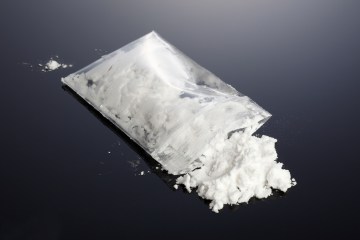
FAMILIES of teens who have fallen prey to ketamine have told of the horror of watching their kids turn into “zombies” in front of their eyes.
Scores of Britain’s young people are falling prey to the drug, with devastated families warning it’s become an “epidemic” across the UK.
Ketamine use in Britain is surging to record levels – with increasing numbers of young people becoming hooked on the drug.
It’s left them battling a raft of devastating health effects, including addiction, wrecked bladders, and excruciating pain.
Known among users as K, or Special K, it makes them feel as if they are dreaming or detached from reality – but it can also leave them confused, nauseated and hallucinating – sometimes referred to as a “K-hole”.
It’s usually snorted in powder form and first appeared on UK streets around 20 years ago.

The drug’s use is widespread and famous overdose victims include TV drag queen The Vivienne who was tragically discovered at home in January with five empty ketamine bags.
James Lee Williams, 32, died from cardio-respiratory arrest due to the use of ketamine and was found in the bath after a “couple of days”, an inquest found.
While Friend’s star Matthew Perry, 54, died after being found face-down in a jacuzzi at his Los Angeles home on October 28, 2023.
The doctor who supplied the star with dozens of vials of ketamine that led to his death was sentenced to 30 months in prison earlier this month.
Despite its reclassification as a Class B substance in 2014, ketamine use has doubled in the UK since then.
And since 2013 its use among youngsters has rocketed by 231 per cent — making it more popular than heroin, LSD or ecstasy.
Craig Hamer, 43, from Burnley, Lancashire, spoke to The Sun about how the drug claimed the life of his 23-year-old son Ethan in a harrowing account that he said is “the hardest thing” he’s ever been through.
‘HE LOOKED LIKE A ZOMBIE’
Described as a “good kid” by his father, Ethan was found face down on his bed on April 28 – he started taking ketamine from as young as 14.
It all started when Ethan’s grandfather – with whom he had a very close relationship – was diagnosed with Alzheimer’s, which “knocked him sideways”.
His grandfather passed away when Ethan was 19 and, sparked by grief, the addiction started to take hold.
“He started taking it a lot more to cope with the grief of losing his grandad,” Craig said.
For a time afterwards, Ethan worked and lived with his father, building up a business together, and his drug taking seemed to have “settled down”.
But Ethan was “still dabbling” at the weekends with his friends, with Craig saying it was “the norm” and they were all doing it at parties.
Craig recalled one time he saw Ethan returning home in the early hours of the morning on the security cameras after he had been taking the drug.
“He couldn’t walk, he couldn’t stand up – he was bent over, trying to put his bag over his shoulder, and he looked a bit like a zombie, doing zombie movements,” Craig said.
Fast forward four years and Ethan was dealt another heart-breaking blow with the sudden death of his mother.
“Out of nowhere, his Mum just died. She went to bed with a headache and got up in the morning with a bleed on the brain,” Craig said.
This was in April 2024 – from then, Ethan spiralled and “really started going downhill”.
‘HE COULDN’T STOP PEEING’
Craig described his son as “such a good kid” and a “loving kid” who liked his football and was a “really good swimmer”.
But the drug started to take more of a hold on Ethan as he used it to cope following the death of his mother – it had alarming effects on his health and behaviour.
“He was just screaming and shouting. Like venting his anger but not actually making any sense. He was becoming really difficult to be around,” Craig said.
“Towards the end, he started ringing people up saying, ‘will you talk to me Mum, she keeps shouting at me’ and ‘I don’t know why she’s shouting at me’ and she’s dead.
“He was hallucinating, because he was taking that much drugs. He wasn’t eating.
“He’d lost so much weight. His cheekbones were coming through his face. He used to have really bright white teeth. They were yellow, really bad. And he just stunk.
“He couldn’t stop peeing. And if he needed a wee, it just came straight out of him. He didn’t have the option of going to the toilet. He had no control over it.”
Craig felt helpless, trying to help his son as much as possible – paying his bills, making sure he had food, and asking the police to carry out welfare checks.
There were drastic changes to Ethan’s personality – his siblings struggled to live with him and he “lost total respect for everybody”.
And his health had deteriorated so much that he couldn’t eat – all he would consume was ice pops and food he could easily swallow.
“When we went round, we’d noticed that there was food all over the house. Not open, he’d just been tossing it around and losing his mind, getting frustrated,” Craig said.
Despite wanting to, Ethan couldn’t escape the drug because of the debilitating pain he was in.
THE TOLL ‘K’ TAKES ON YOUR BODY
KETAMINE can lead to death by putting pressure on the heart and respiratory system.
But its other effects on the body, which are often irreversible, are horrifying, too.
“Ketamine bladder syndrome is one of the worst symptoms,” Dr Catherine Carney, an addiction specialist at Delamere, told Sun Health.
This is where the breakdown of ketamine in the body causes inflammation in the bladder wall.
It leaves people unable to hold urine and passing chunks of their bladder tissue.
Some users face the prospect of having their bladders removed entirely.
Dr Carney explains: “The lining of the bladder can shrink over time and be extremely painful for those experiencing it.
“This can often lead to lower abdominal pain and pain when passing urine, as well as bleeding.
“It’s usually what has forced people to get help because they can’t tolerate it any more.
“We’ve had young men in agony, wetting the bed.
“Their whole life is focused on where there’s a toilet because they can only hold urine for ten minutes.
“For a teenager or someone in their early 20s, that’s absolutely life-changing.
“In some cases, the bladder damage progresses to the kidneys and people get kidney failure, too.
“This is developing in people who have been using for two years, so it is relatively quick.”
Dr Carney adds that the urine samples of new guests checking into the clinic are often just a “pot of blood”.
This is followed by weeks of agony coming off the drug. An irony of ketamine use is people tend to take more and more to numb the pain of the side-effects it causes.
Dr Carney says: “There’s nothing that we can give which is as strong as a medical anaesthetic (the ketamine). We can use codeine-based products or anti-inflammatories.
“Some antidepressants help at night, but the pain is hard to manage in the early days.
“Most people that come to us, the bladder will improve to the point that they don’t need to have it removed.
“But once you’ve got a bladder that has shrunk to the size of 70ml, that’s never getting better.”
In a vicious cycle, he’d stop using ketamine but the resulting pain meant he would go straight back to it.
Craig recalled one heartbreaking moment when Ethan went to visit his other grandfather, telling him: “I don’t think I’m going to be here next year, Grandad”.
“He sat down with his grandad and his grandad gave him a shave and then they just had a talk,” Craig said tearfully.
‘I KNEW HE WAS DEAD’
Craig says Ethan died on Sunday, April 27 and that the last time anyone saw him was on the Saturday.
On that fatal Sunday night, Craig was visiting a friend and received a mysterious phone call when he set off home.
“On the way home, I just got a feeling to ring Ethan. I started ringing him and he wasn’t answering. I knew there was something wrong, I just knew because his phone was always on,” Craig said.
“What I haven’t told people is that I got a phone call about six o’clock from a withheld number. I answered it, and it went dead on me.
“I personally believe he rung me for help instead of anyone else, instead of 999.
“He rang me and that’s when he knew he was going to die because his phone’s gone dead and he was found face down on his bed.
“And I think that’s when it’s happened because that’s when I got the feeling there was something wrong. I do believe that.”
Ethan was survived by his daughter who was just four months old when he tragically passed away.
“That was another thing, he couldn’t deal with the pressure of that. He wasn’t ready for children. He found out his girlfriend was pregnant two weeks after his mum had just died,” Craig said.
“She ended up having a girl that’s a double of Ethan. She’s got his traits.
“He never even picked her up. That’s the sad thing. They were alive for a good four months together. He sat there and spoke to her but wouldn’t pick her up.”
‘IT’S AN EPIDEMIC’
Craig said ketamine is rife and that “all the young kids are on it”.
“Especially in Accrington where my son was, it’s an epidemic,” he added.
Ketamine use among 16-24 year olds hit 3.8% in 2024, a 231% increase since 2013.
Increasing use of the drug isn’t confined to the younger generations either with older demographics increasingly taking the drug – both confirmed by WithYou and King’s College London.
According to adult substance misuse treatment statistics published by the government this month, there was an increase from 2.3% in 2023 to 2024 to 3.2% in 2025 of adults entering treatment with ketamine problems.
The number of ketamine users starting treatment stood at 5,365 – 12 times higher than it was in 2014 to 2015 when it was 426.
In September, a study by King’s College London estimated 123 people died from taking the drug in 2024, compared to just six people in 2014.
There were 696 deaths recorded by coroners during the 25 years between 1999 and 2024, with nearly a fifth of them in the most recent year alone.
And according to the National Drug Treatment Monitoring System, the number of under-18s in England who listed ketamine as one of their problem substances soared from 335 in 2021/22 to 917 in 2023/24.
Its cheap cost – around £15-30 for a gram compared to £80 for cocaine – and availability are among the factors for its increased consumption.
“This is why it’s a bad drug, because it’s that cheap,” he added.
Users also mix it with other drugs, such as super-strong painkillers, and lose track of how much they have taken.
Brooks Lape, an addiction expert and founder of Start Your Recovery said the rise is fuelled by several factors including its “perceived safety” due to its medical use and reputation as a treatment for depression.
“Its accessibility and affordability make it more appealing than other substances; and the social normalisation of ketamine use within nightlife and youth culture.
“The tolerance and dependence can develop quickly, and anyone noticing warning signs like needing more to feel the same effect, must seek help early.”
‘I SPENT £50,000 ON KETAMINE’
Tom Kirk, 26, from Scunthorpe said he faced organ failure at 25 after spending £50,000 on ketamine.
After six years of taking the drug, Tom was told in March 2024 that his bladder, kidneys and liver were functioning at just 20% – his doctors told him he could die if he carried on.
“My grandma was worrying about having to go to my funeral,” he said.
“I was sitting there thinking that no 25-year-old should be in hospital unable to walk like that because of drugs.”
He first started taking ketamine at Creamfields festival in 2018 but the real struggle came during the Covid lockdowns.
Tom got to a point where he was spending £50 a day on ketamine and was taking it before work, during breaks, at lunch and after work and got worse after he was made redundant.
He said: “I’d try to go to sleep but I’d get up and go to the toilet every 20 minutes.
“I was in excruciating pain for hours and hours, sat in the shower – before going back to my room to take more ketamine.”
He added: “Ketamine was this escapism; it was escapism from reality.
“And I feel like that’s a big think for people, especially people with poor mental health, it takes them away from the world they live in.”
The drug took a shocking toll on his health – his tubes from his kidneys to his bladder were blocked up with an infection and inflammation and nothing could pass through.
He was bed bound for two months, with nephrostomy bags to help him urinate, because the drug had damaged and shrunk his bladder.
But through charity WithYou, he managed to secure three months in rehab – he now runs a weekly ketamine group and contributes to Lincolnshire Council’s ketamine research team.
But WithYou warned that Tom’s story highlights a growing problem.
They reported that ketamine cases among their young clients had risen from under 10% in 2019/20, to 23% in 2024/25.
A spokesperson for the charity said: “Over the last five years, the number of young people being supported across WithYou for ketamine use has more than doubled, from 213 in 2019/20 to 478 in 2024/25.”
‘TRY AND GET THEM HELP’
The Sun reported in March how ketamine misuse is rising so fast that law enforcement chiefs view it as a threat approaching the scale of armed gangs, cyber attacks and fraud.
When asked what legacy he would like his son’s death to leave, Craig said: “Just change, really. Getting it reclassified to Class A, then I believe it will become dearer.
“It will be harder for kids to get, which in turn will stop them from taking it. The police just take it off them now.”
Ministers announced they were considering reclassifying ketamine from Class B to Class A but have yet to take any action.
If they choose to do so, supplying and producing the drug could carry up to life in prison while possession could result in seven years behind bars, an unlimited fine, or both.
In the UK currently, the maximum penalty for supplying and producing it is 14 years in prison and an unlimited fine.
Craig was also asked what he would say to other parents in the same situation.
“I tried everything. Just try and not push them away, just try and get them drug help. Find out what the underlying issue is.
“Because a lot of these kids, I find, are taking the drug because there’s something else in the background that’s affecting them, that they want to forget about.”
‘NO COMMUNITY IS SAFE’
Ethan isn’t the first young person to fall victim to the dangerous drug in Lancashire recently either.
What started as a recreational habit spiralled into a six-year long K-hole addiction for Beth Ashton, 25, who sadly died last November – like Ethan, she had started taking the drug at just 14-years-old.
Heartbroken, her mum Natalie, from Skelmersdale, West Lancashire, has made it her mission to raise awareness of the drug and the dangers it poses.
West Lancs Ketamine Awareness and Support is a community group focused on prevention, education and support for parents and young people, many of whom started taking the drug in their early teens.
Natalie said she was overwhelmed by how many people turned up when she launched her first coffee morning.
She told The Sun: “I didn’t know what to do with my grief and I just thought I needed to do something really productive with my time and channel it.”
“These kids are using it to deal with emotional pain – the common thread is that they’ve tried it recreationally and when they take it, it just dulls everything.
“It’s easier to get ketamine than it is alcohol. You can walk into town and you’ll have young kids pulling up on bicycles in balaclavas and they’ll be asking, ‘what do you want’?”
“Another big common thread was COVID – it saw a rapid increase, they were doing Zoom calls, ket parties upstairs in the bedroom because we were all in lockdown.
“A lot of kids, they’re in their bedroom, you walk in and see your kid half asleep but you wouldn’t naturally think, ‘oh, they’re in a k-hole’.”
Natalie said she “hasn’t seen anything like it” with ketamine, adding that “no community is safe at the moment”.
“Prevention is education. It’s the only way,” she said.
“There’s just not enough information and I think the parents need to start talking to them about it like its a sexual health conversation.”
Based on Natalie’s own tragedy, she told parents to “don’t be so naive” to think it wouldn’t happen to their own children.
She told them to look out for warning signs including frequent urination, leakage and the use of hot water bottles to deal with the pain and cramps.
“I think everyone right now is just fixated on the ketamine bladder – but there’s so many other issues that go along with it.
“We’re seeing young men having prolapses, you get ketamine gut, there’s loss of sexual function – these kids aren’t going to talk to their parents about this. So it leaves it hidden for a long time.”
She added young people get stuck in a vicious cycle of physical pain but mental pain too because “they can’t face what they’ve done to their own bodies”.
Natalie also agreed with Craig’s call for reclassification of the drug to Class A but said it “won’t stop the problem”.
“Education, I think, is the biggest way we fight this. Getting the conversation on everyone’s mind and have parents more vigilant.
“We’re only seeing the tip of the iceberg in terms of the damage that it’s cause and how widespread it is. It’s the most frightening thing.”
Seeking help for ketamine addiction
Whether you’ve been using ketamine for a short time or are battling a long-standing addiction, it’s never too late to seek help for your dependence.
You can discuss your problems with your GP and they can refer you to a local drug service.
If you’re not comfortable talking to a GP, you can approach your local drug treatment service yourself.
Visit the Frank website to find support near you.
If you’re having trouble finding the right sort of help, call the Frank drugs helpline on 0300 123 6600. They can talk you through all your options.
Otherwise, UKAT has rehabilitation programmes specifically tailored to your needs.