Astronomers have watched the birth of one of the universe’s most extreme objects for the very first time – a magnetar comprising the mass of 500,000 Earths inside a sphere measuring just 12 miles across.
Magnetars are a type of neutron star, an incredibly dense object mainly made up of tightly packed neutron, which forms from the collapsed core of a massive star during a supernova.
What sets magnetars apart from other neutron stars is that they also have the most powerful known magnetic fields in the universe.
For context, the strength of our planet’s magnetic field has a value of about one Gauss, while a refrigerator magnet measures about 100 Gauss. Magnetars, on the other hand, have magnetic fields of about a million billion Gauss.
Scientists observed a superluminous supernova called SN 2024afav for more than 200 days. Normally the light from a supernova fades after reaching a peak in brightness, but SN 2024afav flickered as it faded, producing small light pulses.
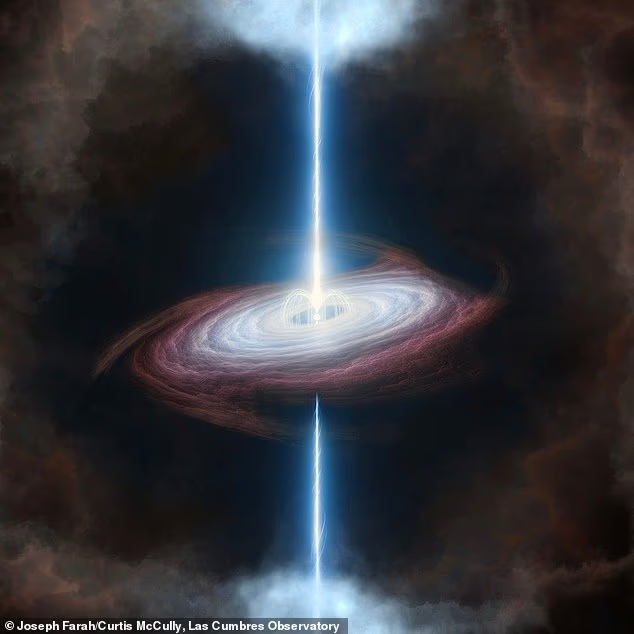
They theorised that debris had formed a swirling gas disc after falling back into a magnetar and that the debris’ axis of rotation was tilted as a result of general relativity, their study published in Nature stated.
An artist’s impression of a magnetar surrounded by a swirling gas disc that is tilted because of the effects of general relativity
According to Einstein’s theory of relativity, the pulsating light was the result of a massive spinning object whipping space-time fabric around it – otherwise known as a magnetar.
The scientists believe the data proves they had witnessed a magnetar forming as the the core of a superluminous supernova collapsed in on itself.
Alex Filippenko, a professor of astronomy at the University of California, Berkeley and co-author of the study said it was ‘definitive evidence’ of a magnetar.
He told The Times: ‘To see a clear effect of Einstein’s general theory of relativity is always exciting, but seeing it for the first time in a supernova is especially rewarding.’