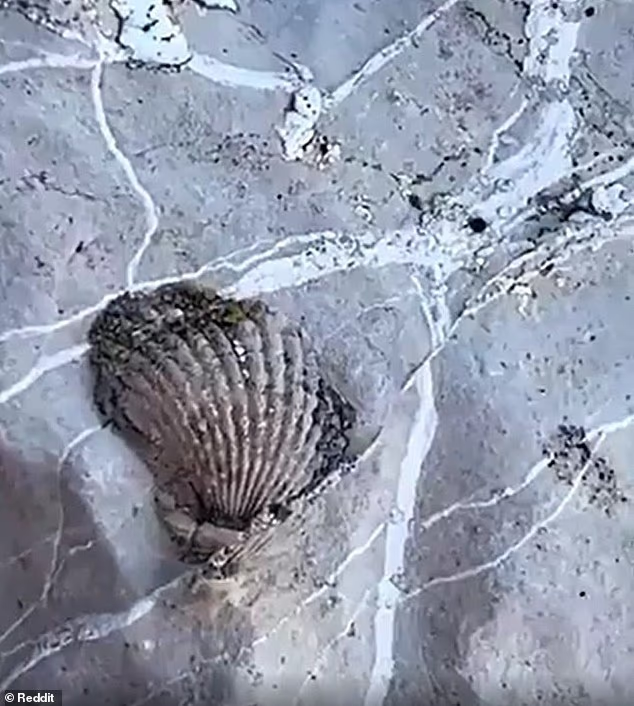
The discovery of ancient sea fossils atop several mountains around the world has reignited debate over the biblical story of Noah’s Great Flood.
A viral video showing hikers uncovering fossilized seashells in the Guadalupe Mountains, a range stretching across west Texas and southeastern New Mexico, has fueled fresh speculation online that the towering peaks were once submerged beneath an ancient ocean.
The clip, which has been viewed more than seven million times, shows the group inspecting and collecting rocks, revealing embedded marine fossils such as bivalve seashells and other shellfish remnants.
The discovery has sparked a wave of debate online, with some viewers claiming the fossils are evidence of a global flood described in the Bible.
The Great Flood is portrayed in the Book of Genesis as a global catastrophe sent by God to wipe out widespread human corruption and violence.
According to the biblical account, Noah was instructed to build a massive ark to preserve his family and pairs of every animal species.
But geologists say the shells are remnants of ancient seabeds that were lifted thousands of feet into the air by tectonic forces over millions of years.
Marine fossils have been discovered on mountain ranges around the world, including the Himalayas, Andes and Rocky Mountains, which scientists say were once covered by ancient seas before being pushed upward as continents collided and mountains formed.
The viral video, shared in 2025, was taken by a group hiking in the Guadalupe Mountains, a range stretching across west Texas and southeastern New Mexico

The clip, which has been viewed more than seven million times, shows the group inspecting and collecting rocks, revealing embedded marine fossils such as bivalve seashells and other shellfish remnants
Despite the scientific explanation, the viral video triggered a flood of online reactions.
‘[I] didn’t need this discovery to believe in the great flood,’ one user wrote on X.
‘There have been discoveries all over the world that point to a great flood theory. It happened.’ Another commenter declared: ‘The Bible is accurate and true!’
However, many other users pushed back on the biblical interpretation, noting that marine fossils in mountains are a well-known geological phenomenon linked to the movement of tectonic plates.
Scientists explain that many rocks found in modern mountain ranges originally formed on the floors of ancient oceans, where marine creatures such as clams, corals and trilobites once lived.
When these animals died, their shells sank to the seabed and became buried in layers of sediment.
Over millions of years, the sediment hardened into rock, trapping the shells inside and turning them into fossils.
Later, the slow movement of Earth’s tectonic plates pushed these ancient seabeds upward during massive continental collisions.

Several mountains, including a range in Italy, have been found to have fossilized sea life. The discovery has sparked a wave of debate online, with some viewers claiming the fossils are evidence of a global flood described in the Bible
As the plates crumpled and lifted the crust, the fossil-filled rocks were carried thousands of feet into the air, eventually forming mountain ranges.
The National Park Service explained that millions of years ago, much of what is now west Texas and southeastern New Mexico was covered by a shallow inland sea known as the Delaware Sea.
Marine animals such as clams, sea urchins and other shell-forming creatures lived in these waters, and when they died, their shells settled to the seabed and were preserved in layers of sediment that later hardened into rock.
Tens of millions of years later, powerful tectonic forces slowly pushed these ancient seabeds upward, lifting the fossil-filled rocks thousands of feet and forming what are now the Guadalupe Mountains.
Scientists say this process also explains why marine fossils can now be found high in places such as the Himalayas, the Andes and the Rocky Mountains, even though those regions were once located beneath ancient seas.
One of the most striking examples is found near the summit of Mount Everest.
Researchers have identified marine fossils embedded in a rock formation known as the Qomolangma Limestone near the world’s highest peak.
The fossils, dating back roughly 450 million years, formed on the floor of the ancient Tethys Ocean before the collision of the Indian and Eurasian tectonic plates thrust the seabed upward to form the Himalayas.
Evidence of ancient oceans has also been uncovered high in the Andes Mountains of South America.

Geologists say the shells are remnants of ancient seabeds that were lifted thousands of feet into the air by tectonic forces over millions of years. Picutred is the Antequera in Spain
Fossils of prehistoric marine organisms have been found at several sites across the range, demonstrating that parts of the Andes were once submerged long before tectonic forces raised the mountains.
In North America, clues to a vanished sea can be found in the Rocky Mountains.
Much of the region was once covered by the Western Interior Seaway, a vast inland ocean that split the continent millions of years ago.
When the waters receded, they left behind layers of marine sediment and fossilized sea life that are still visible in the rock today.
The Appalachian Mountains, among the oldest ranges on Earth, also contain widespread marine fossils preserved in sedimentary rock layers.
These rocks hold the remains of ancient fish and other sea creatures from a time when large portions of the region were covered by prehistoric oceans.
Further west, marine fossils dating back roughly 300 million years have been discovered in New Mexico’s Sangre de Cristo and Santa Fe mountain ranges.
Scientists have identified scallops and other ocean-dwelling organisms preserved in rock from the Pennsylvanian period, when shallow seas covered parts of the region.
Even Antarctica holds evidence of this dramatic transformation.
Marine fossils found in the Transantarctic Mountains suggest parts of the frozen continent once hosted ocean environments before massive shifts in Earth’s crust reshaped the landscape.