A day after a federal court ruled against President Trump’s latest global tariffs, his administration returned to the drawing board on Friday, trying to preserve its powers to wage economic warfare in time for high-stakes trade talks with China.
The latest legal blow concerned the 10 percent tariff that Mr. Trump imposed in late February on nearly all U.S. imports. The president unveiled that policy as a sort of temporary fix, after the Supreme Court tossed out his initial duties, but a panel of judges once again found that the White House had run afoul of the law.
The result was a familiar set of headaches for Mr. Trump, who has tried repeatedly — and with mixed success — to stretch his authority to tax imports without the express permission of Congress. Yet the president seemed unfazed by his latest defeat, telling reporters he would pursue his tariffs “a different way,” before the administration took the first steps toward appealing the case.
Technically, the Court of International Trade only declared the president’s across-the-board, 10 percent tariff to be illegal. Otherwise, it did not issue an order forcing the government to stop collecting it from all importers, at least for now. Still, the outcome marked both a political and legal setback for Mr. Trump, who had spent much of the week issuing trade threats against Europe and preparing for talks in China.
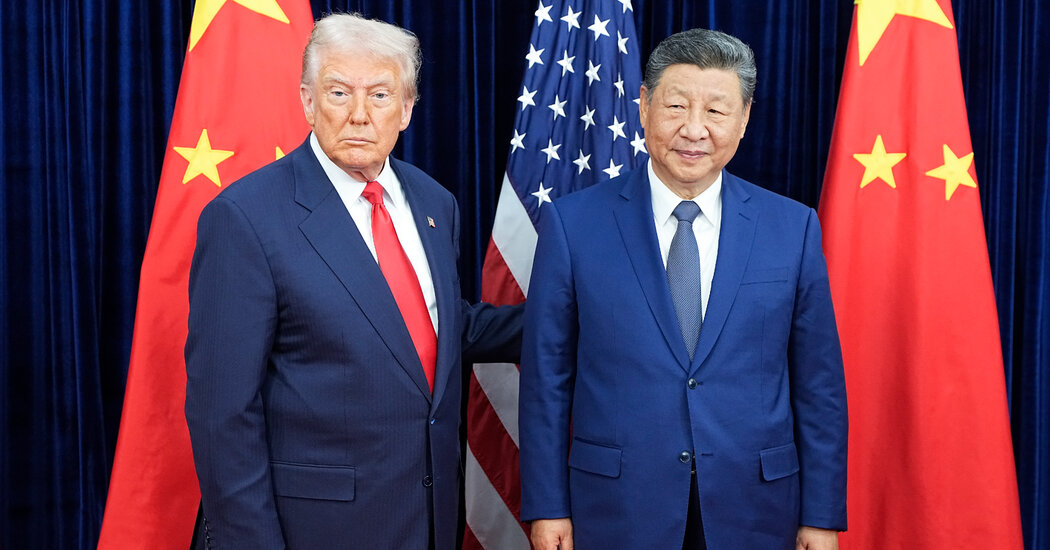
Tariffs are expected to be a major topic on the agenda when Mr. Trump travels to Beijing to meet next week with his counterpart, Xi Jinping. Trade experts said the court decision could undercut the president’s leverage. Eswar Prasad, a professor of economics at Cornell University, said the ruling “severely handicapped” the administration’s ability to employ tariffs against foreign nations, leaving Mr. Trump with a “much weaker bargaining hand” when it comes to China.
“Any threats by Trump to hit China with broader and higher tariffs if Xi doesn’t bend to his will on economic and geopolitical matters now seem like empty bluster rather than credible ultimatums,” he said.
One of the president’s top trade advisers, Jamieson Greer, appeared to brush aside some of those concerns on Friday. During an interview on Fox Business, he criticized the court for ruling against the White House, claiming that some of the judges on the panel were “apparently just hellbent on importing more from China.”
Mr. Greer, who defended the president’s use of trade powers, added that the administration is “confident on appeal we’ll be successful.” Shortly after his comments, the Justice Department filed a notice that it would appeal the matter in the U.S. Court of Appeals for the Federal Circuit.
At the heart of the matter is Mr. Trump’s decision to invoke a trade power that no president had ever used. Known as Section 122 of the Trade Act of 1974, it permits the president to impose tariffs up to 15 percent for 150 days, but only in response to strict conditions, including a “balance of payments” crisis.
The term itself reflects a bygone concern from the time the law was adopted, when the U.S. dollar was pegged to gold, creating unique economic risks. But the Trump administration sought to argue that the law still applied today, pointing in part to the country’s persistent trade deficit, a different measurement, which reflects the gap between U.S. imports and exports.
In the end, a majority of judges on the Court of International Trade found the argument unpersuasive and sided with small businesses and states that had sued. It was the second time that some of those challengers had prevailed against Mr. Trump, after they persuaded the Supreme Court to invalidate his earlier use of emergency powers to impose withering tariffs.
The new decision raised the odds that the administration could soon have to pay back the billions of dollars collected from its 10 percent tariff, on top of the $166 billion that the government already owes to U.S. importers from its last legal defeat. But the fight appeared far from over, and much remained uncertain by Friday — not just for American businesses, which paid the cost to import goods, but for the Trump administration itself.
“President Trump has lawfully used the tariff authorities granted to him by Congress to address our balance of payments crisis,” Kush Desai, a White House spokesman, said in a statement. “The Trump administration is reviewing legal options and maintains confidence in ultimately prevailing.”
For one thing, the court appeared to bar the collection of the president’s 10 percent tariff for only some of the plaintiffs that sued, many legal experts said. That raised the odds that droves of U.S. businesses could soon mobilize and “file a court case” of their own asking for similar relief, said Ted Murphy, a top trade lawyer at the law firm Sidley Austin. He added that he also expected the trade court to pause its order pending an appeal.
The timing is important to Mr. Trump, who had always envisioned his across-the-board tariff as a stopgap that would allow the government time to prepare a set of more lasting rates using another set of authorities, known as Section 301. But that process was widely expected to take months, since the law requires the government to conduct investigations into other countries’ trade practices before Mr. Trump can apply new duties.
Those inquiries targeting dozens of countries are well underway, and the president at times has suggested the final rates could be set at new highs. Some experts believe the tariffs imposed using Section 301 could be more legally durable, though the administration could still face lawsuits over his aggressive use of the law.
Michael Lowell, the chair of the global regulatory enforcement group at the law firm Reed Smith, said the White House probably would not have to worry about “a broad attack on that authority.” But, he said, the courts had recently drawn something of a line in the sand, suggesting they would be “very skeptical of the administration looking to the past and finding and repurposing” other powers to advance its trade agenda.
Unlike the president’s other trade gambits, his use of Section 301 to apply tariffs was successful in the past, including on China. That left some analysts to conclude that Mr. Trump, while blemished, would still retain some leverage ahead of his trip to Beijing next week.
“Unless they have amnesia, China should remember quite vividly how during Trump’s first term, the U.S. imposed multiple rounds of tariffs under Section 301 on China during negotiations,” said Sarah Schuman, a former U.S. trade official who is now managing director at Beacon Global Strategies.
The administration still has multiple options “to increase tariffs on China in pretty short order,” she added.
Mr. Trump’s trip to China had been scheduled for April, but was delayed because of the war in Iran. U.S. officials have said their goals for the visit include establishing a “board of trade,” which would oversee commerce between the countries in an effort to balance trade and reduce the U.S. trade deficit with China.
On Friday, Mr. Greer sketched out a long list of concerns that the administration planned to raise with its Chinese counterparts, from its adherence to past purchase agreements to its approach to artificial intelligence.
“There’s not really a situation where we go, we get China to change the way they govern, the way they manage their economy; that’s all baked into their system,” he said. “But I think there is a world where we find out where we can optimize trade between China and the U.S. to achieve more balance.”