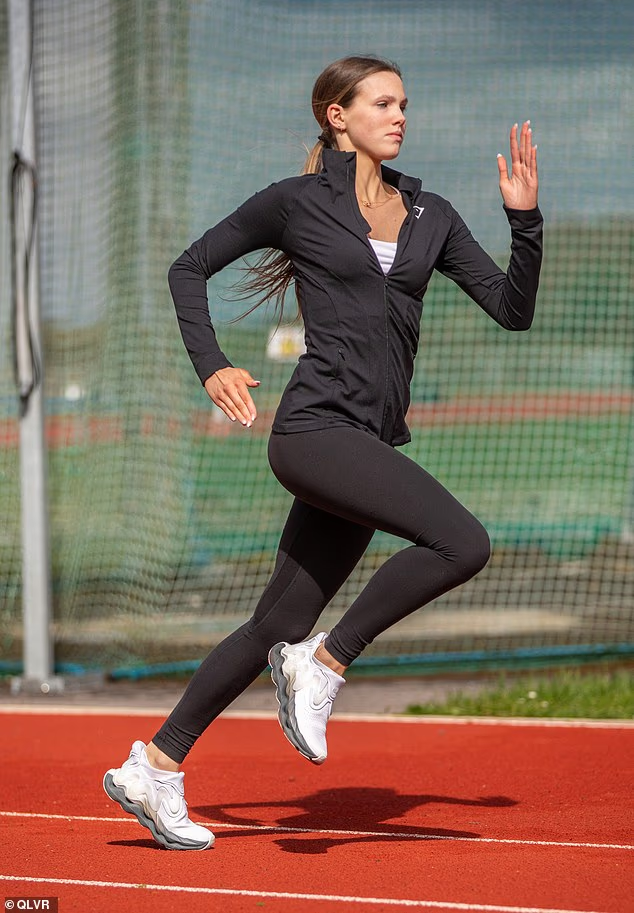
Working out is good for your health – but the clothes and shoes you wear while doing it could be having the opposite effect.
Studies show that a significant proportion of the fitness gear sold not only fails to support health – it may actively work against it.
Nicolle Dean, co-founder of sneaker company QLVR, told the Daily Mail that your workout accessories might actually be causing long-term damage, undermining the very goal you are working toward and putting you at risk of suffering an injury.
She explained that items made from synthetic materials such as polyester, nylon and elastane shed thousands of microplastic particles every time we wash and wear them.
She added that many are treated with ‘forever chemicals’ linked to hormonal disruption, reproductive issues and even certain cancers.
In addition, most of the sneakers women are running in were actually designed for a man’s foot, which can cause serious problems.
Dean, who has co-created the world’s first running slipper designed specifically around female biomechanics, has spent years looking at the gap between what the fitness industry promises and what it delivers.
She told the Daily Mail: ‘I kept coming back to the same uncomfortable realization. Whether it’s sneakers [or] fabrics… the industry sells the idea of health but the reality of what it’s putting on women’s bodies is often not fit for purpose.’
Working out is good for your health – but the clothes and shoes you wear while doing it could be having the opposite effect
From your leggings and sneakers to your water bottle and sports bra, she broke down how your sports gear may be secretly hurting you.
Most gym clothes are made out of materials with ‘forever chemicals’ and microplastics
Dean explained that the leggings in most women’s gym bags are almost certainly made from polyester, nylon or elastane – synthetic, petroleum-derived fibers chosen for their stretch, durability and sweat-absorbing performance.
They are also, in most cases, shedding thousands of invisible plastic particles every time they are worn and washed.
Research published in the Marine Pollution Bulletin found that a single 6kg wash load of synthetic fabric could release more than 700,000 microplastic fibers.
And Dean said the concern with gym clothes is not only what they release into waterways during washing, but what happens while the item is being worn.
Emerging evidence has suggested that microplastics can enter the body through sweat glands and hair follicles under conditions of heat, sweat and prolonged friction – precisely the conditions of a typical workout.
Microplastics act as carriers, attaching easily to other chemical compounds, and studies using human skin models have shown that up to eight percent of certain chemicals can be absorbed from microplastics through sweat-moistened skin.

Nicolle Dean, co-founder of sneaker company QLVR, told the Daily Mail that your workout accessories might actually be causing long-term damage
Phthalates, commonly used to soften plastics and frequently detected in synthetic activewear, have been shown to interfere with estrogen and testosterone production when absorbed through the skin – potentially impacting fertility in both women and men.
Dr Howells, a consultant in reproductive medicine with a decade of experience in Obstetrics and Gynecology, said: ‘Many plastics contain endocrine-disrupting chemicals – including BPA, phthalates and PFAS – that can mimic or block the body’s natural hormones.
‘In women, this can interfere with ovulation and the menstrual cycle. In men, it can affect sperm quality, count and motility. The chemicals in plastics can potentially mimic estrogen and testosterone.
‘They can also trigger inflammation in the body – and chronic inflammation can disrupt the uterine environment, making it less receptive to pregnancy.’
Dean suggested washing gym wear at a lower temperature to reduce fiber shedding, changing out of your clothes promptly after exercise, and looking for activewear made with natural or certified-clean fibers.
And microplastic shedding is not the only chemical concern in standard activewear. A second problem lies in the invisible coatings applied to performance fabrics to make them water-resistant, sweat-absorbing and stain-repellent.
Dean said those coatings typically contain PFAS – a family of around 15,000 man-made chemicals known as ‘forever chemicals’ – because they do not break down in the environment or in the body.
They have been linked to endocrine disruption, fertility issues, immune suppression and certain cancers.
Many women’s sneakers are actually designed for men’s feet

She said most of the sneakers women are running in were actually designed for a man’s foot, which can cause serious problems
Dean explained: ‘The footwear industry has spent decades designing sneakers around male foot shapes.
‘So it is no surprise that so many women experience discomfort or instability, because the shoes were never built for them in the first place.’
The problem is structural, not cosmetic, she said, as women’s feet are not simply smaller versions of men’s.
They have narrower heels, wider forefeet and higher arches on average, while a wider pelvis creates a greater Q-angle at the knee – meaning more inward knee movement during running.
Women’s lower muscle mass and different ligament elasticity mean they typically require more stability, alignment support and shock absorption than a male-designed shoe provides.
‘When you put a woman into a shoe built for a male foot, you typically see poor heel hold, midfoot instability and pressure in the forefoot,’ Dean said.
‘Over time, the poor fit contributes directly to plantar fasciitis, shin splints, runner’s knee and even hip misalignment.
‘Poor alignment at the foot travels up the entire kinetic chain – knees, hips, lower back.’
Research published in the British Journal of Sports Medicine has demonstrated greater vertical impact loading in female runners with medically diagnosed injuries – consistent with exactly this kind of biomechanical mismatch.
The reason it persists is commercial, according to Dean – creating sneakers genuinely for a female instead of sharing molds for both genders costs more. So, most sneaker brands take a male mold, reduce it proportionally and market the result as a women’s shoe.
‘The industry calls it designing for women,’ Dean went on. ‘In most cases, it is shrinking and pinking a male shoe, and the cost saving is real.
Most people wear the wrong size sports bra while working out

Research estimates that between 70 percent and 100 percent of women are wearing the wrong bra size (stock image)
Research estimates that between 70 percent and 100 percent of women are wearing the wrong bra size.
And Dean explained that ill-fitting bras not only fail to provide adequate support – they contribute to poor posture and musculoskeletal problems including neck and back pain, upper limb neural symptoms and deep strap furrows from excessive pressure.
When the trapezius muscle directly beneath the bra straps is compressed, the nerves running under it can become impinged, causing numbness, tingling and pain that radiates into the arm and hand.
Symptoms often appear hours after exercise, meaning most women never connect them to what they were wearing at the gym.
Research through Breast Research Australia found a correctly fitting sports bra alleviated 85 percent of orthopedic symptoms in participants.
Plastic water bottles can also cause chemical exposure
According to Dean, the plastic water bottle turns out to be a significant and largely overlooked source of chemical exposure.
A 2024 study in the Proceedings of the National Academy of Sciences found an average of 240,000 micro- and nanoplastic particles per liter of bottled water. Nanoplastics are of particular concern because they are small enough to enter the bloodstream directly.
Heat and repeated use accelerate the problem. Squeezing the bottle, opening the cap, and sun exposure all increase the release of plastic particles into the water.
Switching to a BPA-free bottle may not be the answer either. Manufacturers commonly replace BPA with chemically similar substitutes that carry comparable hormonal risks.
Stainless steel or glass bottles do not leach chemicals and are not affected by heat.
Dean added: ‘Women are starting to ask these questions about compromises that are no longer acceptable. And when they do, they realize just how much the industry has been getting away with. That conversation is well overdue.’