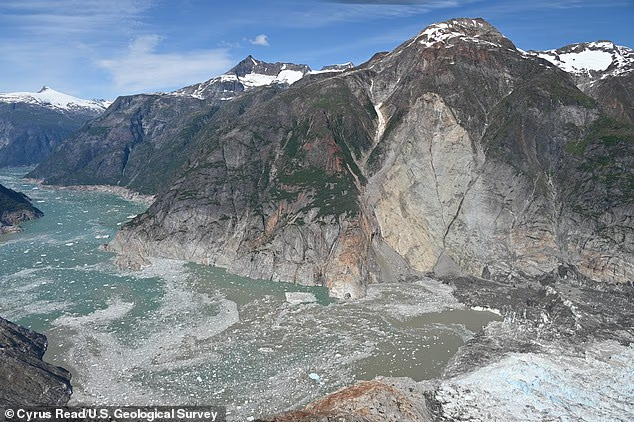
A huge tsunami 1.5 times the size of the Eiffel Tower hit a popular tourist spot in Alaska last year, a new study has revealed.
Measuring 1,578ft (481 metres) high, the tsunami ran up the wall of Tracy Arm fjord on 10 August, 2025.
This makes it the second highest tsunami ever recorded – second only to a tsunami in Lityua Bay, Alaska, in 1958, which measured 1,720ft (524 metres).
While Tracy Arm is a popular spot for cruise ships, thankfully no one was caught in the wave as it hit early in the morning, at around 5.30am.
The tsunami was triggered by a landslide, which was ultimately a result of climate change, according to researchers from UCL.
‘Fjords with retreating glaciers have seen a sharp increase in tourism,’ explained co–author Dr Stephen Hicks.
‘More people are visiting these beautiful places in the polar and sub–polar regions but they are at the forefront of climate change impacts and so can be dangerous.
‘This event took everyone by surprise. The area had not been identified as hazardous.’
A huge tsunami 1.5 times the size of the Eiffel Tower hit a popular tourist spot in Alaska last year, a new study has revealed. Note the trimline along the far side of the fjord, caused by the tsunami stripping the walls of vegetations

Measuring 1,578ft (481 metres) high, the tsunami ran up the wall of Tracy Arm fjord on 10 August, 2025. This makes it the second highest tsunami ever recorded – second only to a tsunami in Lityua Bay, Alaska, in 1958, which measured 1,720ft (524 metres)
While no–one was caught in the wave, there were several eyewitnesses, whose accounts were used in combination with numerical modelling and data from satellites and seismometers to piece together exactly what happened.
According to the researchers, the glacier holding up the mountain had retreated rapidly – by 500 metres in a matter of weeks – leaving the rock unsupported.
As the rock plunged into the water, it triggered an enormous wave in the water below.
The wave scraped off trees and plants along the walls of the fjord, leaving a sheer rock face.
This allowed the researchers to infer the wave at a height of 1,578ft (481 metres) for over 0.6 miles (1km).
A group of kayakers camped out further down the fjord reported waking up at around 5:45am to find water flowing past their tent, carrying away one of their kayaks and much of their gear.
Another eyewitness described a two–metre wave coming along the beach.
Meanwhile observers on a cruise ship anchored near the mouth of the fjord saw currents and white water, but no obvious wave.

While no–one was caught in the wave, there were several eyewitnesses, whose accounts were used in combination with numerical modelling and data from satellites and seismometers to piece together exactly what happened

According to the researchers, the glacier holding up the mountain had retreated rapidly – by 500 metres in a matter of weeks – leaving the rock unsupported
Given the size of the tsunami, the researchers estimate that the amount of rock that crashed into the water was equivalent to 24 Great Pyramids of Giza.
Dr Dan Shugar, lead author, based at the University of Calgary, said: ‘Normally with these gigantic rock avalanches, they often give some sort of warning signs in the weeks, months, years prior when the slope is slowly moving down the mountain.
‘It’s sagging and then it catastrophically gives way in a rock avalanche.
‘In this case, that didn’t happen.’
Given the popularity of the site, the researchers say that urgent action is needed to avoid a repeat incident.
‘We need to reduce the risk of these expeditions by better identifying the riskiest areas and getting investment into warning systems that might give us a few hours’ or days’ notice of a potentially catastrophic event,’ Dr Hicks explained.
‘With hindsight, there were some warning signs.
‘Tiny earthquakes occurred at an increasing rate in the days to hours before the landslide, signalling that this mass of rock was starting to crack.

Given the size of the tsunami, the researchers estimate that the amount of rock that crashed into the water was equivalent to 24 Great Pyramids of Giza
‘Many seismic monitoring stations provide data in real–time, so this gives us some optimism that we can turn what we have learned into a warning system.’
So far this year, at least six cruise lines have been forced to change their itineraries to avoid the Tracy Arm fjord.
Dr Shugar added: ‘Ultimately what we hope is that coastal municipalities, the cruise ship industry and other stakeholders take these threats seriously.’
The news comes shortly after scientists warned the French Riviera is ‘overdue’ a tsunami.
Experts say there is a ‘100 per cent’ chance a great wave will form in the Mediterranean Sea in the next 30 years.
The tsunami could hit France‘s southern coastline in as little as 10 minutes from the trigger, causing chaos for tens of thousands of people who flock there during the summer months.
WHAT CAUSES TSUNAMIS?
A tsunami, sometimes called a tidal wave or a seismic sea wave, is a series of giant waves that are created by a disturbance in the ocean.
The disturbance could be a landslide, a volcanic eruption, an earthquake or a meteorite; the culprit is most often an earthquake.
If the landslide or earthquake triggering the tsunami occurs nearby the shore, inhabitants could see its effects almost immediately.
The first wave of the tsunami can arrive within minutes, before a government or other institution has time to issue a warning.
Areas that are closer to sea level have a higher risk of being affected by the waves.
Researchers have found that a layer of the remains of microscopic organisms at the bottom of the ocean can cause tsunamis (file photo)
Those less than 25 feet from sea level are the most dangerous.
The cause of death most frequently associated with tsunamis is drowning. Additional hazards include drinking water contamination, fires and flooding.
Initial tsunami warnings are usually based on seismic information only.
Inhabitants of coastal areas that might be exposed to a tsunami are encouraged to follow evacuation routes in the event that they receive a tsunami warning.
They should seek higher ground or move inland immediately to get away from the ocean.