A new form of money being explored in Washington could reshape how Americans buy, sell and save, sparking warnings from lawmakers.
Known as a Central Bank Digital Currency (CBDC), or ‘digital dollar,’ the form of money would be issued and regulated by the Federal Reserve. Formal discussion regarding CBDC intensified around 2020.
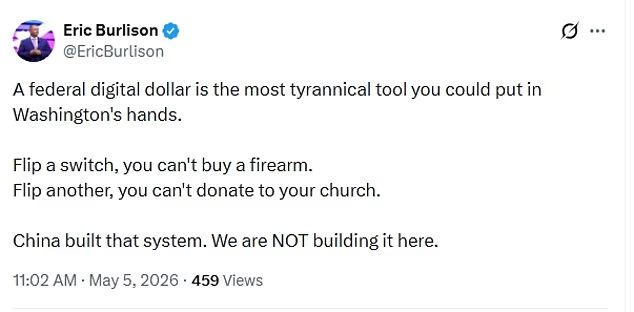
The debate on the US adopting the digital dollar has been reignited online after Congressman Eric Burlison deemed it ‘the most tyrannical tool you could put in Washington’s hands.’
‘Flip a switch, you can’t buy a firearm. Flip another, you can’t donate to your church. China built that system. We are NOT building it here,’ the Missouri representative posted on X on Tuesday.
If the US government were to adopt CBDC, critics have warned that it could directly manage money flow, monitor transactions in real-time, instantly distribute payments and enforce targeted monetary policy.
Potential capabilities include programming money for specific uses, reducing financial privacy, and potentially enforcing negative interest rates.
Many lawmakers have been pushing to block the Federal Reserve from creating a digital currency, trying to attach a ban to several major bills.
Most recently, they attempted to include it in legislation extending a key surveillance program. However, that effort fell through when Congress passed the measure without the digital currency restriction before an April 30 deadline.
The debate on the US adopting the digital dollar has been reignited online after Congressman Eric Burlison deemed it ‘the most tyrannical tool you could put in Washington’s hands’
The House voted 235-191 to extend the spy program, known as Section 702 of the Foreign Intelligence Surveillance Act (FISA).
However, a group of Republican lawmakers had hoped to include an effort to block CBDC in the bill, but the Senate resisted.
Senate Majority Leader John Thune warned that any legislation including a ban on a digital currency would be ‘dead on arrival’ in the Senate, effectively killing the proposal.
Instead, lawmakers approved a short-term extension to keep the surveillance program in place while the debate continues.
Burlison responded to Thune’s comments on X, saying: ‘I don’t care what Thune thinks.
‘A Central Bank Digital Currency is a threat to all of our rights and liberties. It must be banned.’
Rep Scott Perry of Pennsylvania, a member of the House Freedom Caucus who is a supporter of the ban, said in the press conference that most of his constituents ‘don’t want the government monitoring their bank accounts, telling them what they can buy, when they can buy it, and when they’re not allowed to buy.’
More than 130 countries are researching or launching CBDCs, with full usage in the Bahamas, Jamaica and Nigeria.

If the US government were to adopt CBDC, critics have warned that it could directly manage money flow, monitor transactions in real-time, instantly distribute payments and enforce targeted monetary policy
China’s ‘e-CNY’ leads in pilot scale with $986 billion in transactions, while India’s digital rupee is also in active testing.
The e-CNY in China operates as a state-backed, pilot-stage digital currency, functioning similarly to WeChat Pay or Alipay for payments.
While not restricting total spending, the government is strictly banning private crypto and utilizing the traceable, programmable e-CNY to control capital flow, enhance monitoring and potentially steer consumer behavior.
Several US states have passed legislation banning or restricting the use of CBDC within their jurisdictions, primarily focusing on prohibiting its use as legal tender or in state financial transactions.
Florida led this initiative, followed by states including Alabama, Georgia, Indiana, Louisiana, Montana, Nebraska, North Dakota and Utah.
In 2022, the Federal Reserve released a paper weighing the pros and cons of creating a central bank digital currency.
The paper stressed that no final decisions about a US digital currency have been reached.
But it suggested that a digital currency that ‘would best serve the needs’ of the nation would follow an ‘intermediated model’ under which banks or payment firms would create accounts or digital wallets.
The Federal Reserve said it would not proceed with creating a CBDC ‘without clear support from the executive branch and from Congress, ideally in the form of a specific authorizing law.’
‘While a CBDC could provide a safe, digital payment option for households and businesses as the payments system continues to evolve, and may result in faster payment options between countries, there may also be downsides,’ Fed officials wrote.
Challenges include maintaining financial stability and making sure the digital dollar would ‘complement existing means of payment,’ the Fed said.
The central bank also needs to tackle major policy questions, such as ensuring a CBDC does not violate Americans’ privacy and that the government maintains its ability to combat illicit finance.’
Unlike cryptocurrencies, which are typically run by private actors, a CBDC would be issued and backed by the central bank.
It would differ from electronic transactions that happen through large commercial banks in that it could give consumers a direct claim to the central bank, similar to physical cash.