A former Neuralink staff member has claimed she was attacked by virus-infected monkeys while employed as an animal care specialist.
Lindsay Short began working at the Elon Musk-owned company in 2021 and later filed a California lawsuit alleging she was scratched multiple times over several months while working closely with rhesus macaque monkeys carrying Herpes B.
Herpes B, which can cause severe brain inflammation and spinal cord damage, is considered extremely dangerous to humans and can be fatal if not treated quickly, making safety protections critical for workers handling infected animals.
Dr Lisa Jones-Engel, who spent 17 years working for the Washington National Primate Research Center (WaNPRC), told the Daily Mail that infections like Herpes B are more common in macaques than many people realize.
‘Herpes B is enzootic in macaques, meaning that under natural conditions, animals are exposed and infected by the time they are about three years old,’ the expert said.
‘The infection is often latent, intermittent, and clinically silent, which makes it difficult to detect and easy to miss, so colonies may appear virus-free on paper when they are not.’
The lawsuit claims that, in 2022, a monkey reached through the bars of its cage and scratched through Short’s glove to her hand, ‘exposing her to Herpes B in the process.’
A year later, according to the suit, Short was reportedly clawed in the face by another virus-infected primate. Short ‘was brutally scratched by monkeys on no less than three separate occasions within a six-month period,’ the lawsuit claims.
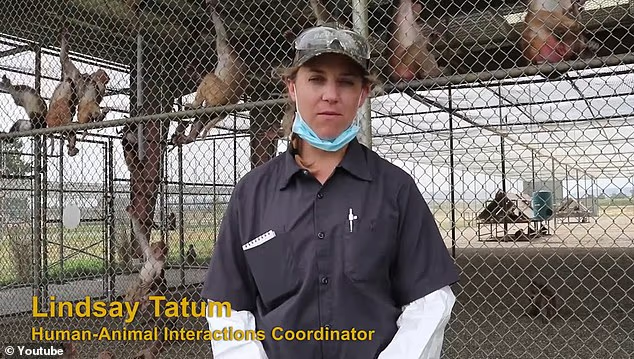
Lindsay Short, formerly known as Lindsay Tatum, began working at the Elon Musk-owned company in 2021
The Daily Mail has reached out to Short, her lawyers at Valliant Law and Neuralink, and has yet to receive responses.
Jones-Engel, who is currently the Chief Science Advisor on Primate Experimentation at PETA, said that even animals that test negative can still pose serious risks to handlers.
‘Monkeys can test negative and still harbor the virus, or only shed it intermittently,’ she explained.
‘That’s why federal guidance emphasizes treating all macaques as potential carriers, regardless of their test status.’
Short alleges in the lawsuit that after reporting safety concerns, requesting medical care, and later disclosing her pregnancy, she was demoted and ultimately terminated, actions she claims were retaliatory.
The lawsuit states: ‘In each and every instance, Plaintiff was exposed to a potentially life-threatening virus, but at no point did Neuralink alter its policies or provide Plaintiff with Workers’ Compensation.’
Neuralink has faced growing scrutiny over its animal testing practices, particularly regarding rhesus macaque monkeys used in brain-implant experiments.
In 2022, federal regulators opened an investigation into potential animal welfare violations after advocacy groups and employees raised concerns that some procedures may have caused infections, complications, and deaths among test animals.

The lawsuit states that Short ‘was brutally scratched by monkeys on no less than three separate occasions within a six-month period.’ Pictured is a monkey used in Neuralink experiments, but not the one mentioned in Short’s lawsuit
Separately, in 2023, the Physicians Committee for Responsible Medicine (PCRM), a nonprofit medical advocacy group, called for a federal investigation into whether the company violated hazardous material transport laws.
The federal probe concluded in 2023 when regulators said they found no systemic violations of federal animal welfare rules.
However, subsequent inspections by other agencies flagged quality-control issues, keeping scrutiny on the company’s research practices.
Federal health guidelines from the National Institutes of Health and the Centers for Disease Control and Prevention require enhanced protective equipment to prevent direct skin exposure when working with research animals.
However, according to her lawsuit, Short alleges she was not provided with proper safety gear and was instead issued reusable scrub jackets that left parts of her wrist exposed.
Federal biosafety standards require strict protective equipment when working with macaques, said Jones-Engel.
‘At minimum, federal guidance calls for gloves, protective clothing such as lab coats, and face protection like a face shield when working with macaques or their tissues,’ she explained.
‘In practice, exposures like bites or scratches should trigger immediate use of a Herpes B scrub kit and urgent medical evaluation.’
Short’s complaint states the first major incident occurred in September 2022, when a rhesus macaque allegedly reached through the bars of its cage and scratched her hand.
The filing claims the animal’s claws tore through her glove and broke the skin, raising fears of possible infection. According to the lawsuit, she immediately reported the injury and sought medical treatment.
Short alleges the response from management was not supportive. Instead, she claims supervisors reacted negatively, a reaction she believes may have been linked to federal reporting requirements triggered by workplace injuries involving research animals.
However, Jones-Engel noted that reporting requirements around Herpes B exposures are often misunderstood.
‘I have never seen regulations that require facilities to report worker Herpes B exposures to the USDA,’ she said.
‘If medical treatment beyond first aid is required, the injury may be recorded on an OSHA log, but not every exposure must be formally reported.’

Elon Musk’s Neuralink has faced growing scrutiny over its animal testing practices, particularly regarding rhesus macaque monkeys used in brain-implant experiments, but the company has denied all and any wrongdoing
The Daily Mail has contacted OSHA and has yet to receive a response.
According to the complaint, tensions escalated in the weeks that followed as Short continued raising concerns about safety practices.
The filing alleges the situation intensified in March 2023, when Short was assigned to perform a procedure she claims she had not been trained to carry out. During the task, the lawsuit alleges, a monkey scratched her across the face, prompting another request for medical care.
According to the complaint, supervisors reacted angrily and warned there would be ‘severe repercussions’ if similar incidents occurred again.
Short alleges that after continuing to raise concerns about safety, training and reporting standards, her working conditions began to change.
According to the lawsuit, she was demoted in May 2023 from a full-time salaried role to a reduced hourly position with fewer benefits.
Short further alleges workplace tensions escalated in June 2023 after she informed the company’s human resources department that she was pregnant and requested workplace accommodations.
According to the complaint, less than 24 hours later, she was called into a meeting and presented with a separation agreement and notice of termination citing performance issues.
The lawsuit states the close timing between her pregnancy disclosure and termination raised concerns of retaliation.
Short claims she was terminated despite previously receiving a promotion earlier that year.
The complaint outlines multiple legal claims against the company, including retaliation, pregnancy discrimination, whistleblower retaliation, wrongful termination, and emotional distress.
According to the lawsuit, Short suffered financial losses, emotional distress, anxiety, and other hardships following her termination.
She is seeking damages for lost wages, emotional distress and other financial losses.
Jones-Engel emphasized that working with macaques requires constant vigilance and rapid medical response following any injury.
‘Personnel should be properly trained, appropriate protective equipment must be used, and any bite or scratch should trigger immediate first aid,’ they said.
‘CDC guidance recommends scrubbing the wound with soap or iodine for 15 minutes, flushing it for another 15 to 20 minutes, and seeking urgent medical care.’
Neuralink has not admitted wrongdoing, and the claims outlined in the lawsuit remain allegations that have not been proven in court.