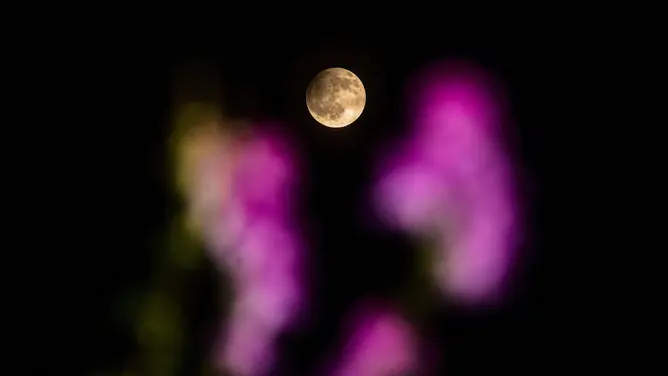
May’s full moon put on a stunning show from New York to Kenya.
April showers bring May flowers—and it’s not just Earth’s surface in bloom. Look up, as the sky joins in to kick off the month with a flower of its own.
On May 1, a Full Flower Micromoon will soar into the sky, and don’t be fooled by the belittling title, the micromoon will tower over the night sky.
The full-flower moon is seen during a penumbral lunar eclipse in Srinagar.
(Photo by Saqib Majeed/SOPA Images/LightRocket via Getty Images / Getty Images)
The flower moon will blossom into the sky and reach peak illumination at 1:23 p.m. ET, according to the Farmers Almanac.
MAY SKYWATCHING GUIDE: FROM METEOR SHOWERS TO FULL MOONS, HERE IS WHAT TO LOOK UP FOR THIS MONTH
While most Americans will miss out on the flower micromoon’s brightest point, it will still be a good time to plant yourself in a chair for a night of skywatching.
In the spirit of “April showers bring May flowers,” the flower moon gets its name from the burst of spring blooms across North America—nature’s colorful grand finale before the summer.
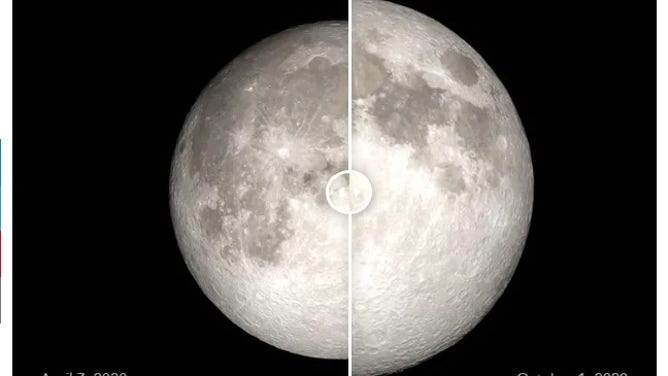
This is a NASA image comparing the relative size of the supermoon to the micromoon. NASA says it is about the difference between a quarter and a nickel.
(NASA’s Scientific Visualization Studio / NASA)
A micromoon occurs when the moon is at its farthest point from Earth in its orbit, known as apogee, the counterpart to a supermoon, when the moon is at its closest point.
According to NASA, the moon will be approximately 249,180 miles from Earth.
ONCE IN A BLUE MOON
Don’t have time on Thursday to experience the Full Flower Micromoon? Have no fear, this opportunity only comes once in a blue moon.
To conclude May, yet another full moon will grace the sky – the Blue Moon will soar into the sky to wrap up the month on May 31.
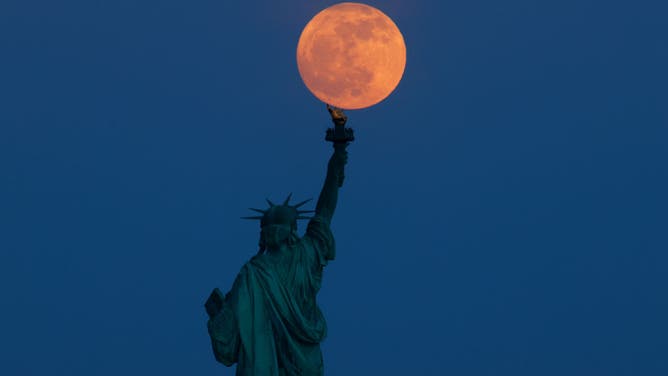
JERSEY CITY, NJ – MAY 22: The full Flower Moon rises behind the Statue of Liberty at twilight in New York City on May 22, 2024, as seen from Jersey City, New Jersey. (Photo by Gary Hershorn/Getty Images)
(Gary Hershorn / Getty Images)
A Blue Moon – which has nothing to do with color — occurs when there are two full moons in one month—hence the origin of the phrase, “once in a blue moon.”
The moon’s 29 and ½ day cycle doesn’t neatly line up with the Gregorian calendar, so every so often, an extra full moon rises into the sky in a single month.
On the first and final nights of May, the Full Flower Moon opens the show and the Blue Moon closes out the month in lunar style.