Palantir, the data analysis and technology firm, is many things to many people.
It’s a major military contractor, and its technology has helped the Trump administration track people for deportation. It also worked with the federal government to distribute Covid-19 vaccines. For some privacy advocates, it’s a Big Brother-like entity. And some amateur investors speak about Palantir’s stock performance and one of its founders, Alex Karp, with fervent excitement.
Now, Palantir hopes that people will wear its merch.
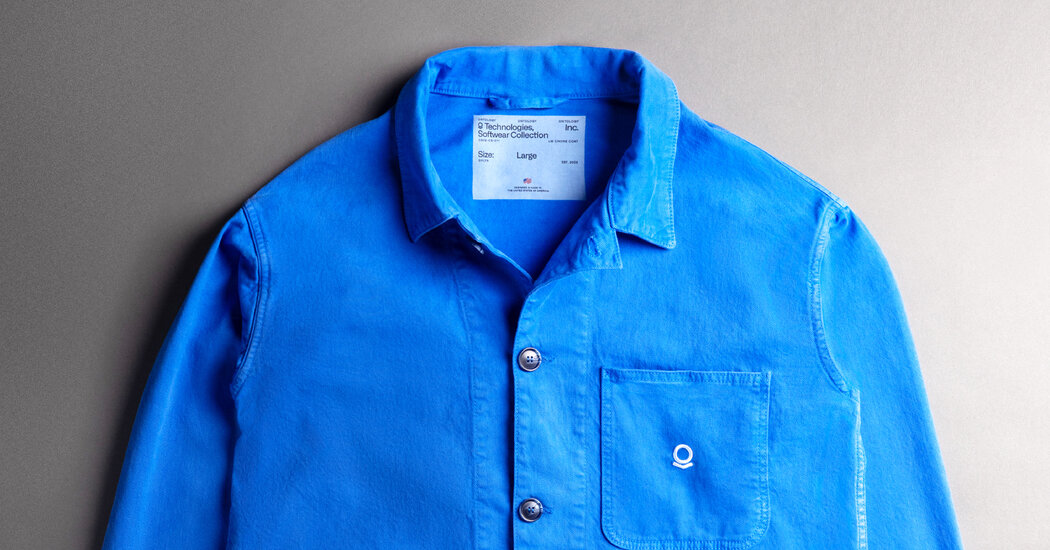
Palantir has sold clothing — including logo-emblazoned hoodies, shorts, caps and a T-shirt featuring Karp’s favorite motto, “Dominate” — for years. A new line of chore coats dropping on Thursday is a step up in ambition.
Eliano Younes, head of strategic engagement at Palantir, wanted to make something “that wasn’t a bland corporate polo or vest,” he said. “Something that was comfortable, stylish and durable for the front lines or for daily life.”
The jacket, which costs $239 and comes in bright blue and black, closely resembles a classic chore coat — heavy blue twill, denim or moleskin coats with three patch pockets (two roomy ones at the bottom and a smaller one at the breast). The French jacket, also known as bleu de travail (work blues) was created to outfit laborers in 19th-century France. The blue or indigo color helped conceal oil or dirt stains, and it may have inspired the term “blue-collar work.”
Work wear has long been worn by those not engaged in manual labor. Over the years, chore coats have been worn by celebrities such as Austin Butler, Jacob Elordi and Jeremy Allen White. The photographer Bill Cunningham was almost always seen in one. Even Paul Newman sports a chore coat in the 1967 film “Cool Hand Luke.”
Peter Zottolo, a fashion photographer and electrician based in San Francisco, described Palantir’s version of the chore coat as “nothing interesting,” though he said he understood the appeal of the chore coat in fashion circles, citing a collaboration between the Japanese brand Sacai and the work wear staple Carhartt, as well as the Row’s version, which had a cotton-cashmere lining. Though, he added, “a software company that is associated with government agencies is not generally associated with cool.”
This is hardly the first time the Silicon Valley set has leaned into fashion beyond standard corporate merch like tote bags and T-shirts. Last month, Nvidia, the chip giant, introduced green sweaters featuring a cartoon rendering of the company’s chief executive, Jensen Huang. Vintage tech merch from companies like Intel and Apple fetches high prices on resale sites like eBay. Nor is Palantir the first defense contractor to sell apparel. Lockheed Martin, the weapons manufacturer, licenses its name to Doojin Yanghang, a South Korean manufacturer that designs and produces streetwear.
Some critics see Palantir’s push into fashion as a way for the company to gain cultural capital and influence its public perception. Brendon Holder, a New York-based writer, sees Palantir’s chore coat as an attempt by the company to appeal to a “left-leaning, performative male type that would be in Prospect Park reading ‘Infinite Jest.’” (An unexpected customer base could wear the garment ironically, as was the case with Tucker Carlson’s merch.)
“When you wear work wear, you’re telling people, ‘I’m down to earth,’” Zottolo said, adding, “It usually is a disarming outfit.”
This drop, according to Younes, demonstrates Palantir’s commitment to “re-industrializing America.” The company designs and manufactures its garments in Montana using local and imported materials.
The designs for the merchandise, Younes said, are inspired in part by the personal styles of Shyam Sankar, Palantir’s chief technology officer and executive vice president, and Karp, who, beyond his standard-issue navy suits and quarter-zips, is known to have an affinity for brightly colored ski gear.
The company’s online store, which sells products in limited drops, frequently sells out of items within 15 minutes, Younes said. (The company typically makes between 300 and 1,000 units per garment. It has made 420 chore coats.) He said its customer base spanned the globe, with 29 percent of sales coming from outside the United States. In October, Palantir staged a two-day pop-up store in Seoul, and the company is considering another one stateside.
“It’s not political,” Younes said. “It’s about people who love Palantir and are aligned with our mission.” He said he expected the jackets “to probably sell out in 30 minutes.”