Scientists have discovered the edge of the Milky Way, and it’s even closer than expected.
While it might sound simple enough, spotting the galaxy’s edge from our place in its spiralling arms is a task that has baffled scientists for decades.
Now, an international team of researchers say that the outer edge is located approximately 40,000 light–years from the black hole at the galactic centre.
That means Earth is just 13,300 light–years from the edge, placing us much closer to the galaxy’s outer limits than its core.
The difficulty in finding the galactic edge is that the Milky Way doesn’t come to a clean stop but sprawls out like a city gradually fading into quiet suburbs.
What researchers wanted to find was the limits of the galaxy’s star–forming region, which is where new stars are still being born.
Lead author Karl Fitneni, a researcher at the University of Insubria, told the Daily Mail: ‘Inside it, you have the part of the galaxy that is still actively building itself with ongoing star formation.
‘Outside it, you have a disc region populated almost entirely by stars that have drifted there from elsewhere.’
Scientists have discovered that the edge of the galaxy is located 40,000 light–years from the core. This means Earth is just 13,300 light–years from the edge
Finding the Milky Way’s edge from our fairly restricted viewpoint is a tricky task, but scientists have a powerful technique to help them.
As a galaxy forms, star formation begins earliest in the regions near the galactic centre, where gas and dust are densest before spreading out slowly over billions of years.
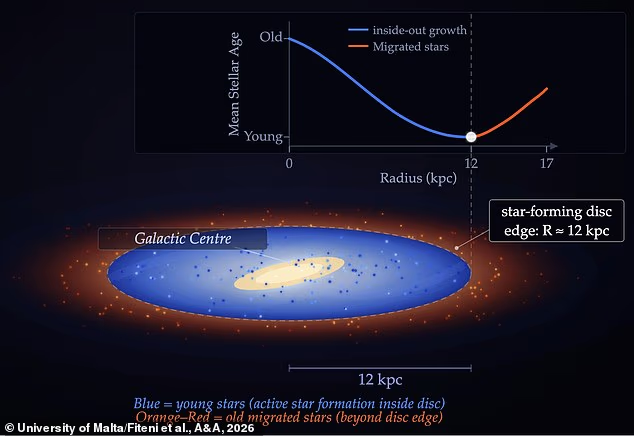
Due to this process of ‘inside–out’ growth, stars generally get younger as you move further away from the galactic centre.
The very youngest stars sit right on the edge of the star–forming disc, where the processes of stellar formation have only just caught up.
However, galaxies only follow this rule up to a certain point, beyond which the stars suddenly start getting older again – creating a distinctive ‘U’ curve.
The point where stars are at their very youngest marks the outer limit of the galaxy’s star–forming region and the ‘edge’ of the galaxy.
In their new research, conducted at the University of Malta while Dr Fiteni was a PhD student, scientists took the age measurements of 100,000 stars in the Milky Way.
As expected, the stars grew younger as they moved further away from the galactic core until they reached a point between 35,000 and 40,000 light–years from the centre.

Stars in the Milky Way get younger as they move further from the core, until they reach a point at which this trend reverses. That point at the bottom of the ‘U’ curve marks the edge of the galaxy’s star–producing region

Scientists measured the age of 100,000 stars in the Milky Way to find the point at which they are the youngest, marking the limit of where new stars are still being born
After combining this data with state–of–the–art simulations, the researchers could clearly see that this was also the point at which star formation drops significantly.
That revealed that the point right at the bottom of the age ‘U’ curve marks the outer edge of our galaxy’s star–forming region.
There are still many stars beyond this point; in fact, the most distant star still part of the Milky Way can be found a staggering one million light–years from the core.
However, the big difference is that none of these older stars were born in their current locations.
‘Star formation effectively shuts off beyond the edge, so any stars we see further out had to get there from somewhere else,’ says Dr Fiteni.
‘They formed in the inner disc and slowly drifted outward over billions of years through a process called radial migration, where stars are gently nudged by the gravitational pull of the Galaxy’s spiral arms.
‘This migration is slow and random, so the further out a star has travelled, the longer it had to spend doing it, and the older it has to be.’
This process explains why you can still find stars beyond the star–producing region and why the most distant stars in the Milky Way are the oldest ones of all.
Finding the edge is really important for astronomers because the Milky Way inside the star–forming region is very different from the area beyond this border.
It’s a little like how an economist would see a profound difference between a city’s bustling, productive central business district and the sleepy, domestic suburbs.
Although both are part of the same whole, the processes that govern their growth and the effect they have on the wider world couldn’t be more different.
Dr Fiteni says: ‘Knowing where that boundary sits, and why, tells us how far the Milky Way’s disc has grown over its 13 billion–year history, and what’s stopping it from growing further.
‘Those are the numbers astronomers use to compare the Milky Way to other galaxies and to test our broader models of how galaxies form and evolve.’