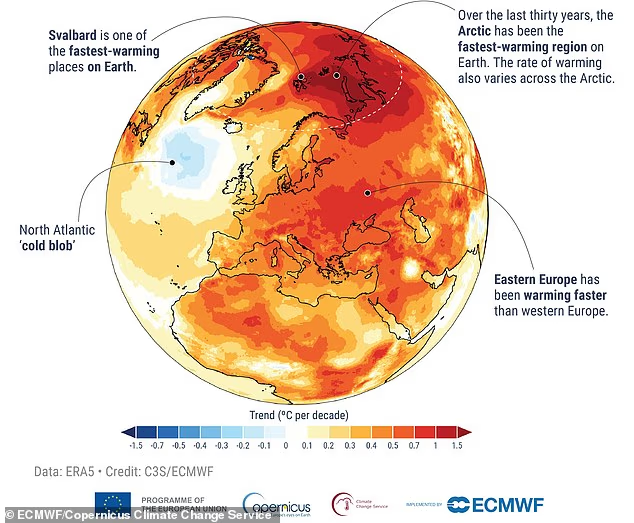
Europe is warming more than twice as fast as the global average due to climate change, a report has revealed.
Over the past 30 years, the planet’s average temperature has been creeping up at a steady 0.27°C (0.49°F) per decade.
However, the annual European State of the Climate report shows that Europe has been warming by a staggering 0.56° (1°F) every ten years.
So, as the world hits 1.4°C (2.52°F) above the pre-industrial average, Europe’s is now 2.5°C (4.5°F) hotter than before the Industrial Revolution.
Experts say that Europe’s rapid warming is driving a wave of extreme weather, heat-related deaths, and devastating wildfires.
Last year, over 1,034,550 hectares (3,994 square miles) of land were destroyed by fire in Europe – the largest area ever recorded.
Samantha Burgess, Strategic Lead for Climate at the European Centre for Medium-Range Weather Forecasts, says: ‘With rising temperatures, and widespread wildfires and drought, the evidence is unequivocal.
‘Climate change is not a future threat, it is our present reality.’
Europe is warming more than twice as fast as the global average, scientists have warned. Europe is now warming at a staggering 0.56° (1°F) every ten years

In 2025, 95 per cent of Europe saw above-average temperatures as a new report warns that Europe’s average temperature is now 2.5°C (4.5°F) hotter than the pre-industrial average
According to data gathered by the Copernicus Climate Change Service (C3S), 2025 was Europe’s third hottest year on record.
Average temperatures soared to 10.41°C (50.74°F) across the continent, just 0.30°C (0.54°F) cooler than the warmest year in 2024.
This led to almost the entirety of Europe seeing temperatures well above normal levels for large parts of the year.
Professor Hannah Cloke, an expert on climate extremes from the University of Reading, says: ‘To see 95 per cent of Europe experiencing above-average temperatures in a single year shows that we are not dealing with isolated extremes in one or two regions. The baseline has shifted.’
Experts say that Europe is warming faster than the rest of the world due to a combination of geography, human factors, and changing weather patterns.
In part, Europe has warmed faster than average due to its proximity to the Arctic, which is the fastest-warming region on Earth.
The Arctic has warmed by an average of 0.75°C (1.35°F) per decade over the last 30 years, which is having a significant knock-on effect on Europe.
Although it might seem counterintuitive, Europe is also warming faster because of efforts to limit pollution.
Join the discussion
Should Europe do more to fight climate change, even if it means sacrificing economic growth?

Europe’s rapid warming has led to a record number of wildfires across the continent, with 1,034,550 hectares (3,994 square miles) of land burned last year

Scientists say that Europe’s rapid warming is partially due to declining snow cover, which would usually reflect radiation from the sun back into space
Tiny particles called aerosols in pollution gather in the atmosphere and reflect light from the sun back out into space, keeping the planet cooler than it otherwise would be.
Since the 1980s, European policies have slashed air pollution and, as a byproduct, reduced the amount of radiation reflected, leading to more warming.
At the same time, the effects of human-caused climate change are creating ‘feedback loops’ which accelerate warming even further.
As the climate warms, weather patterns have shifted to favour more frequent and intense summer heatwaves in Europe, pushing up the average temperature.
Warmer weather also leads to less snow coverage, which would normally act like a reflective thermal blanket, bouncing radiation back into space.
In March last year, snow coverage in Europe reached its third-lowest point since records began in 1983.
The compounding effects mean that the continent is now warming far faster than the global average.
Professor Cloke says: The impacts of climate change are now moving really very fast in Europe.

The only region warming faster than Europe is the Arctic, where temperatures are increasing by 0.75°C (1.35°F) per decade

Almost half of Europe saw an above-average number of days with strong heat stress – a day which has a maximum feels-like temperature of 32°C (89.6°F) or higher
‘The scale and range of these changes show that we cannot rely on old certainties about nature when planning our societies for the future.’
Worryingly, this heating is also occurring in the normally cool higher latitude regions.
In the sub-arctic regions of Scandinavia, a three-week heatwave saw temperatures in the Arctic circle climb above 30°C (86°F).
This warming is already beginning to manifest in measurable ways that have a profound effect on human lives.
Glaciers across Europe are retreating, with Iceland seeing its second-largest yearly glacier loss on record.
Similarly, the Greenland Ice Sheet alone lost 139 billion tonnes of ice last year, contributing directly to rising sea levels.
Dr Akshay Deoras, of the University of Reading, says that this trend is ‘deeply concerning’
Dr Deoras adds: ‘Conditions have shifted dramatically since the 1950s, with warmer, wetter and shorter winters driving major changes in snow and ice cover and contributing to some of the most striking heat extremes on record.’

In an alarming trend, some of the worst heating was seen in the sub-Arctic regions of Finland and Scandinavia, where a three-week heatwave sent temperatures soaring

Europe’s rapid heating is leading to rapid melting in the continent’s glaciers, including in the vital Greenland Ice Sheet
Almost half of Europe saw an above-average number of days with strong heat stress – a day which has a maximum feels-like temperature of 32°C (89.6°F) or higher – with Spain experiencing 50 more days of strong heat stress than average.
According to the World Health Organisation, heat stress is the single largest cause of weather-related deaths worldwide.
Heat stress also creates the conditions for wildfires, which caused havoc across Europe in 2025.
Last year, Spain, Cyprus, the United Kingdom, the Netherlands, and Germany recorded their highest wildfire emissions on record, causing three deaths and affecting 500 people.
Likewise, since a warmer atmosphere holds more water and energy, Europe’s heating has led to an increase in the frequency and severity of storms.
At least 21 lives were lost, and an estimated 14,500 people were affected by storms and flooding across Europe in 2025.
‘Europe is warming faster than any other continent, and this report shows the scale of the consequences is already impossible to ignore,’ says Dr Deoras.
‘Climate change is shifting into a faster gear, and our response needs to as well.’