Runners are smashing records left, right and centre thanks to ‘super shoes’ that give them a spring in their step.
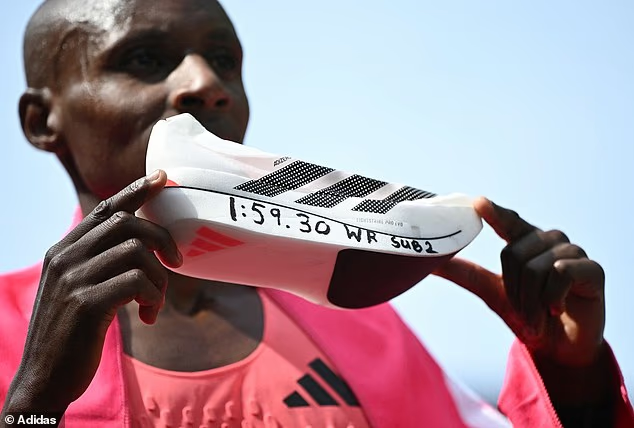
This weekend, Kenya’s Sabastian Sawe made history with the first sub–two–hour marathon in race conditions wearing the ADIZERO Adios Pro Evo 3, one of the lightest racing shoes ever created.
These shoes feature carbon–fibre plates and ‘mattresses’ of foam, which allow runners to move faster, while using less energy.
Studies have shown that super shoes can improve running efficiency by as much as four per cent, shaving minutes rather than seconds off runners’ times.
But as the technology keeps improving, experts are concerned that super shoes could become a form of ‘technological doping‘.
Speaking to the Daily Mail, Shaun Creighton, an Olympian long–distance runner turned sports lawyer at Moulis Legal, said: ‘We should be clear that modern marathon super shoes are performance enhancing devices in a very real sense.
‘I genuinely do not believe a sub–two–hour marathon would have been achieved without super shoes.
‘The regulatory task now is to keep tightening the technical boundaries just enough to preserve the marathon as a contest of human performance first, and of shoe design a distant second.’
Sabastian Sawe smashed the two–hour barrier at the London Marathon wearing the new ‘super shoes’ from Adidas, but experts have dubbed the high–tech footwear as ‘performance enhancing devices’
The controversy surrounding modern super shoes began in 2019 when Kenya’s Eliud Kipchoge became the first person to ever run a marathon distance in less than two hours.
However, some argued that his record shouldn’t count because he was wearing the newly developed Nike Alphafly shoes.
Described as ‘the shoe that broke running’, by sports scientist Dr Ross Tucker, Nike claimed that the Alphafly shoe gave a 3.4 per cent increase in speed.
Across a marathon distance, that can translate into a difference of two to three minutes and make the difference between a fast race and a world record.
The Alphafly’s were promptly banned under new guidelines brought into place by World Athletics, but a new generation of shoes soon emerged to skirt these rules.
World Athletics now rules that no shoe can have a midsole that exceeds 40 mm in height or contain more than one carbon–fibre plate.
As a result, shoe manufacturers have created new, race–legal versions with a ‘stack height’ that just scrapes beneath the legal limit.
The benefits for top–tier athletes’ race times have been immediate and profound.

The controversy over super shoes began when Kenya’s Eliud Kipchoge ran a sub–two–hour marathon while wearing the Nike AlphaFly prototype shoes

Super shoes have led to significant increases in race times for the world’s top athletes, including Tigist Assefa, who shattered the women’s world record by more than two minutes
In 2019, 31 of the 36 podium positions at major marathons were taken by athletes wearing Nike’s race–legal Vaporfly super shoes.
Likewise, Nike’s original claims have now been backed up by research, which shows that amateur and professional athletes stand to make huge gains by adopting super shoes.
Dr Brian Hanley, a sports scientist from Leeds Beckett University, told the Daily Mail: ‘The super shoes return energy better than normal trainers and this reduces the athletes’ workload and lets them run faster for longer.
‘We have found improvements for amateur runners who would run marathons in about 3:30 to 4:30, but it is possible that elite athletes get an even greater benefit from super shoes because they run faster in the first place.’
One consequence of this improvement is that it is no longer possible to compare today’s race times with those from before 2019.
David Roche, an ultramarathon runner and running coach, told the Daily Mail: ‘Times before super shoes are from a different era.
‘Like comparing tennis serve speeds with a wood or composite racket or baseball exit velocities off an aluminium bat versus a wood bat.’
On one hand, Mr Roche sees this as a good thing, adding that he recommends super shoes to ‘everyone pushing their limits’ because they are comfortable and ‘fun’ to run in.

Experts now say that the rules should be tightened on super shoes to prevent marathon times being dictated by shoe technology rather than human performance
But others have been far more critical of the growing ubiquity of high–tech super shoes.
For example, Kenya’s former marathon world record holder Tegla Loroupe previously complained that using super shoes to set records was ‘cheating’.
Another big issue is that super shoes don’t seem to benefit all athletes equally, risking awarding some racers an unfair edge.
Dr Nicolas Berger, an expert in exercise physiology from Teesside University, told the Daily Mail: ‘It’s worth noting that there are super–responders who get a much larger benefit, and some who get little to none.’
While the reasons aren’t fully understood, Dr Berger adds that this is ‘a real measurable advantage’.
Although World Athletics and organisations such as the Ironman triathlon series have placed restrictions on shoe design, there are concerns that these rules don’t go far enough.
The World Anti–Doping Agency (WADA) is primarily concerned with performance enhancing drugs, but can also make rulings on equipment if they are deemed to be ‘against the spirit of the sport.
Shoes like Sawe’s ADIZERO Adios Pro Evo 3 are race legal, but whether they meet this vague criteria is a bigger question for athletes and athletic federations to grapple with.

Shaun Creighton, an Olympian long–distance runner, said he does not believe a sub–two–hour marathon would be possible without super shoes
Mr Creighton, who himself set a marathon time of two hours and 10 minutes without super shoes, says: ‘Since super shoes clearly enhance performance, they do threaten the spirit of the sport.
‘They can distort the relationship between training input and performance output, benefit some athletes more than others, and depend heavily on access and sponsorship.
‘In that sense, a shoe can fall short of the spirit of sport ideal even if it is not classified as “doping” and even if it complies with World Athletics’ technical rules.
‘If those rules are drawn too loosely, events or sports risk sliding away from WADA’s spirit of sport ideal, because results could start to depend more on proprietary midsole technology than on training, toughness, pacing and performance on the day.
‘The regulatory goal should be that performances remain comparable over time and the marathon remains, at its core, a test of endurance and preparation rather than a showcase of proprietary midsole technology.’
How Nike’s £240 Vaporfly sparked the super shoe debate at the 2016 Olympic marathon in Rio
The debate of super shoes isn’t new and first reared its head in 2016, with Nike’s £240 Vaporfly product raising concern among commentators and experts alike.
During the 2016 Olympic marathon in Rio, all three male medallists wore a prototype of the trainer, with the same technology extended to track races from 2018.

The debate of super shoes isn’t new and first reared its head in 2016, with Nike’s £240 Vaporfly product
Now the high–tech trainers, which are lighter and more responsive, are ‘almost ubiquitous on the feet of elite road runners’.
That is according to Jonathan Taylor, a sports researcher at Teesside University, who has branded the revolution in footwear development a ‘technological arms race’.
Experts predicted the shoe improved the running economy of highly trained runners by four per cent compared to a normal shoe, boosting performance by three per cent.
Since 2016 when the Vaporfly was released, the top 50 male marathon runners have improved by about two per cent on average, much of which attributed to the carbon fibre plate.
Similar technology was then transferred into track spikes in 2019 which led to middle– and long–distant records falling.
Regulations were introduced in January 2020 over the sole thickness of track spikes used in sports other than high jump and long jump.
This was due to other companies replicating their carbon–fibre plate and springy foam technology into more spikes for running shoes.
The new regulations require a maximum sole thickness of 20mm for up to 400m races and 25mm for any longer distances.
However, experts say this is far too lenient, suggesting rules should be stricter and to a point where air pods can’t be inserted into the spikes.