It’s a weird moment for electric vehicles in the United States. Sales have fallen since the Trump administration ended the $7,500 tax credit, and car manufacturers are canceling models. And while it’s likely that the recent surge in gas prices will push more people to E.V.s, it probably won’t happen fast.
But if there’s a bright spot in the E.V. market, it’s the budget, high-range car — a corner of the market that’s growing in number of models and, in some cases, even in sales.
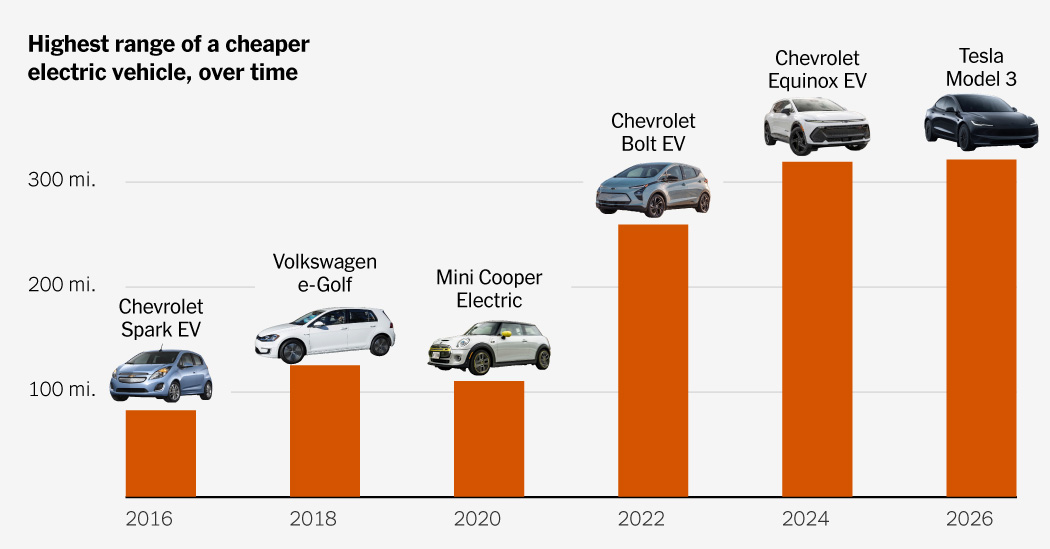
E.V.s under $40,000 can now go as far as the most expensive models of a decade ago.
Range anxiety has long been a sticking point for potential E.V. owners, especially in winter. Most people don’t need to drive far every day, but they want to know they can make the occasional big trip.
Range and price aren’t everyone’s top criteria — there are charging speeds, horsepower, reliability, aesthetics, size and more to consider. But if your primary concern is just how far the car can get you on a single charge without breaking the bank, consider this unusual but useful metric: miles of range per dollar spent.
At a starting price of $32,000, the 2026 Nissan Leaf gets nearly 10 miles of total range for every $1,000 of sticker price, with Chevrolet’s $37,000 Equinox EV close behind. The most expensive E.V.s score much worse on this metric — three miles per $1,000 or fewer — but they’re luxury cars.
(Note that price and range vary even for a single model, depending on the trim; we looked at the cheapest price and longest range for each car and picked the one with the highest ratio of miles to dollars.)
Just five years ago, the best cars in this metric couldn’t top six miles per $1,000. (After adjusting for inflation.)
A big part of that trajectory is battery technology: Prices for lithium-ion batteries, the primary type used for E.V.s, have fallen to around $100 per kilowatt-hour in 2025, from $1,000 in the early 2010s, according to BloombergNEF. Battery density has gone up too.
As battery costs fell and manufacturers built more E.V.s, ranges rose and prices fell. Tesla’s cheapest Model 3 climbed to a range of 321 miles this year, up from 220 when it was launched in the late 2010s, while its inflation-adjusted price decreased.
Or consider the Leaf, which debuted 15 years ago.
By 2016, the cheapest Leaf had 84 miles of range and cost around $30,000, the equivalent of $40,000 today.
Nissan’s $32,000 2026 Leaf has a range of more than 300 miles.
Some automakers have released entirely new models under $40,000 in recent years, including the Chevrolet Equinox and the Subaru Uncharted. And the end of the tax credit led others to drop prices on existing cars: Tesla introduced a trimmed-down, significantly cheaper Model 3, and Hyundai slashed its Ioniq 5 prices by roughly the same amount as the credit.
Altogether, the cheaper end of the market has boomed, and the average price of a new E.V. has fallen. (Used E.V. prices fell, too, and sales climbed.)
There’s still a lot of bad E.V. news among automakers, who have canceled models and pulled back on battery manufacturing. New E.V. sales dropped 27 percent from early 2025 to early 2026. But models that offered a high-range, lower-price trim seemed to weather the downturn better — some of them even picked up in sales, while others held relatively steady despite the end of the tax credit.
New E.V.s still can’t beat new gas cars on sticker price and range. A standard Toyota Corolla can go more than 400 miles on a tank of gas, and costs around $25,000.
Still, the costs of driving a gas car add up: If gas prices settled back to $3.50 per gallon, that relatively efficient Corolla would cost more than $1,100 for the average driver each year, and about the same in maintenance. Over a decade, that would total nearly $50,000. (Car purchase included.)
The $32,000 Leaf would cost around $600 each year to drive, at average U.S. electricity prices, and about the same in maintenance, according to federal estimates. It would add up to $45,000 over the decade.