
Even the nicknames for Asian jumping worms give you the heebie-jeebies: Jersey wriggles, wood eel, crazy snake worms. The reality is that these worms can strip nutrients out of the top layer of soil, severely damaging the roots of plants.
Outdoor enthusiasts have one more concern to add to the list when venturing outside this spring, as officials warn of invasive Asian jumping worms.
Members of the Colorado Department of Agriculture have warned that these invasive species are appearing in the state, prompting them to urge the public to take action.
According to the National Library of Medicine, Asian jumping worms (AJW) are an invasive species in North America that can negatively impact soil habitats.
INVASIVE ‘MURDER HORNET’ LOOKALIKE RAISES CONCERNS FOR POLLINATORS IN THE SOUTH
The jumping worm has existed in the U.S. for decades, but there is no definitive location or time for the first sighting, with the first official record of invasive worms occurring in Maryland in 1939.
This invasive species has begun to turn up in both Colorado and California and can easily spread, as it is known to live in soil, mulch and potting mixes, with its eggs spread by wind.
Earthworms belong to the genus Amynthas, which originates in East and Southeast Asia.
Asian jumping worms pose a significant risk to plant life and forest ecosystems.
(Tom Potterfield / U.S. Department of Agriculture)
“Invasive Asian jumping worms got their name because of the way they thrash around,” Mac Callaham, a U.S. Forest Service researcher who specializes in soil, said. “They can flip themselves a foot off the ground.”
These worms harm soil because they often eat leaves that fall from trees, forming the litter layer, which is home to a vast number of tiny animals essential for plant growth.
CALIFORNIA OFFICIALS WARN OF INCREASE IN TINY BLACK FLIES KNOWN FOR PAINFUL BITES
They can be distinguished by their long red-to-brown color and a prominent band around the body that produces cocoons, according to officials.
The worms create a “nutrient-poor paradox” at the soil surface, resulting in a dry, granular texture that harms plants, and once disturbed, will move erratically with a snake-like motion.
“Soil is the foundation of life – and Asian jumping worms change it,” Callaham said. “In fact, earthworms can have such huge impacts that they’re able to actually reengineer the ecosystems around them.”
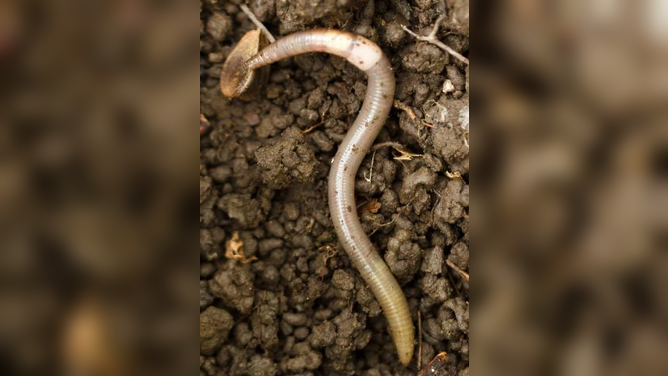
Asian jumping worms can be found in granular soil, as it damages plants.
(Tom Potterfield / U.S. Department of Agriculture)
Infestations of these worms can severely damage plant roots in nurseries, gardens and beyond.
Experts suggest that if you detect the worms, use the mustard pour method for temporary control: mix ⅓ cup of ground yellow mustard seed with 1 gallon of water and pour it slowly onto the soil.
Since there is currently no effective eradication method, this will drive the worms to the surface, making them easier to remove and dispose of.
RARE SPECIES OF MOON JELLYFISH DISCOVERED IN GULF OF AMERICA OFF LOUISIANA COAST
Officials are asking people to file reports if they suspect an infestation in the area.


